



16 Days After Nepal Flood, Hydropower Tunnel Searches Continue; Why Is Rescue So Difficult?

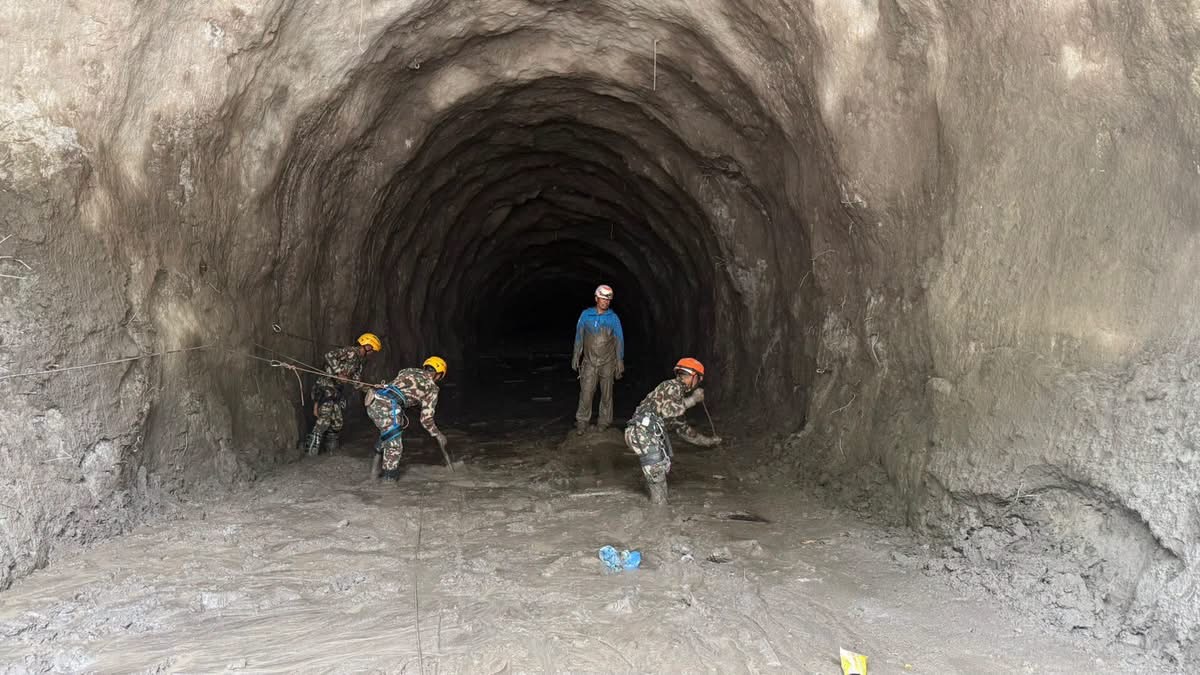
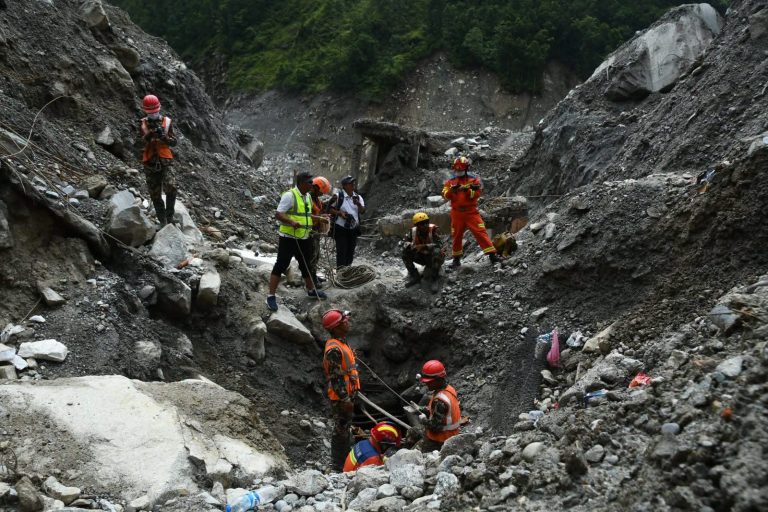
Rescuers conduct a search operation at a flood-damaged hydropower project in Rasuwa, Nepal. Photo: Nepali Army
KATHMANDU, Nepal — A catastrophic flood in Nepal’s mountainous Rasuwa district has left hydropower projects damaged, workers missing and rescue teams struggling to reach tunnels cut off by mud, rock and floodwater, exposing vulnerabilities in an industry that has become central to the country’s energy ambitions.
The Aug. 26 disaster sent the Bhote Koshi and Trishuli rivers surging to levels far beyond what many project operators had anticipated. Floodwater entered the approach tunnels — the main access routes to several hydropower projects — trapping or cutting off workers, technicians and engineers inside.
The damage has also reached beyond the energy sector. Roads, bridges, hotels, trekking routes and other tourism infrastructure have been damaged across an area that serves trekkers heading into the Langtang region, pilgrims traveling toward Kailash Mansarovar and visitors seeking rafting and other adventure activities.
Preliminary government and industry assessments indicate that hydropower projects with a combined generating capacity of about 783 megawatts have been affected, with at least 13 projects reported destroyed or seriously damaged.
As of 7 p.m. local time on Sept. 10, the National Disaster Risk Reduction and Management Authority said joint search-and-rescue operations were continuing at at least eight hydropower projects in the flood-affected area.
At the Rasuwa Bhote Koshi Hydropower Project, rescuers entered about 50 meters into a tunnel and recovered one body, according to the authority. At Langtang, Chilime, Upper Trishuli-1, Trishuli-3A and Rasuwagadhi, search teams had reached tunnels or powerhouse areas but had not found additional people.
A Race Against the Terrain
The rescue effort has been slowed as much by geography as by the damage itself.
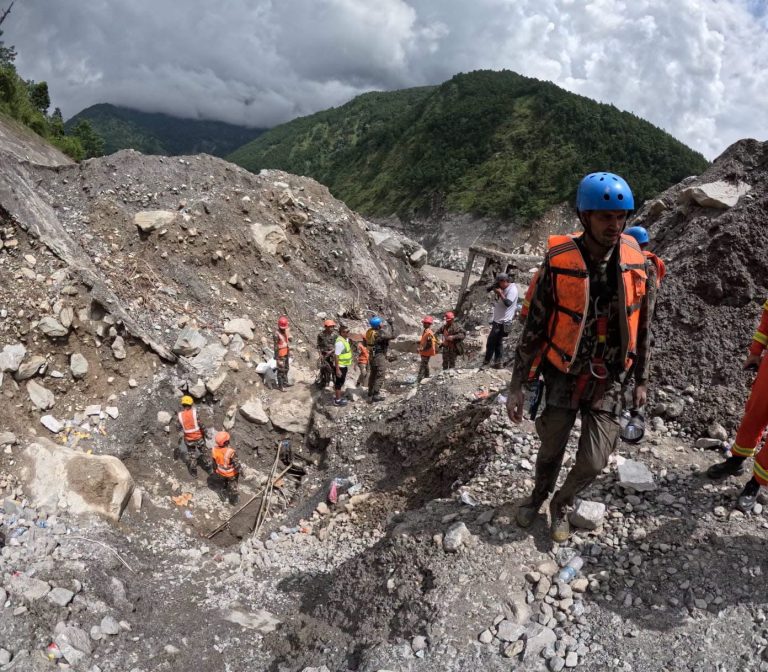
Several hydropower sites sit in narrow valleys where the distance between tunnels and the river is so small that helicopters cannot safely maintain the separation needed to deliver heavy machinery. Dropping equipment from the air can also send it into the river below.
Floods and landslides destroyed sections of the road network, forcing rescue teams and equipment to take difficult alternative routes. Machinery needed to clear mud and debris from the tunnels includes Bobcat loaders weighing roughly 3,000 kilograms and large pumps — equipment that cannot easily be transported into the narrow mountain valleys by helicopter.
At Chilime, rescue teams have been opening an alternative route from the Syafrubesi side, constructing a track, drilling boreholes and using explosives to break through rock so that heavy equipment can reach the tunnel.
The difficult terrain has also complicated the use of helicopters. At some sites, there is insufficient space to maintain a safe distance from the cliffs, while equipment dropped from above risks falling directly into the river.
At one point, rising water levels forced rescuers to halt operations for several hours.
The Army has established a coordinated operation involving Nepal’s security forces, government agencies, project officials and international rescue specialists. Rather than dividing the work among foreign teams, officials said the teams are operating under a unified mission because rescue methods developed elsewhere cannot simply be transferred to Nepal’s distinct tunnel designs and mountainous terrain.
The Nepal Army is coordinating international teams through a multinational military coordination center under the country’s disaster-response framework.
Different projects have been assigned different specialist teams. At Chilime, Nepal Army personnel are working with Indian rescuers and Nepal Electricity Authority experts. At the 218-megawatt Upper Trishuli-1 project, Korean specialists are working alongside the Nepal Army. Chinese rescuers are assisting at Trishuli-3B, while Nepal Army and Armed Police Force personnel are searching at Trishuli-3A.
Inside the Tunnels
The conditions underground have forced rescuers to rely increasingly on technology before sending people into potentially unstable spaces.
Manish Maharjan, a drone specialist involved in the rescue effort, said each tunnel presented a different challenge because of differences in design, length and geology.
At Upper Trishuli-1, rescuers first encountered extensive water and mud. Because conditions were considered too dangerous for people to enter directly, drones equipped with thermal cameras were flown into the tunnel.
The drones traveled more than 150 meters underground, allowing rescuers to assess the water level, debris and other conditions before sending teams inside.
Rescuers later entered using rafting boats, ropes and mountaineering equipment. In some sections, bodies were found beneath heavy construction machinery and debris, Mr. Maharjan said.
But there have also been survivors.
An Armed Police Force team rescued a woman estimated to be between 60 and 65 years old from amid floodwater and debris, according to Mr. Maharjan. Personal belongings found inside affected structures were collected, documented and handed over to the Nepal Police.
Earlier in the operation, two workers were rescued alive from the Trishuli-3A tunnel. A Chinese national was also rescued alive from the Upper Trishuli-1 tunnel on Sept. 5.
At Chilime, eight people have been reported missing, including six believed to have been inside the tunnel, according to a project source. The precise number of people missing across the affected projects remains uncertain, with government agencies, project operators and local sources providing differing figures.
Why Rescue Is Taking So Long
The disaster has raised questions about whether Nepal’s rapidly expanding hydropower industry has kept pace with the safety requirements of working in increasingly remote and hazardous terrain.
Engineer Padam Bhatt said Nepal lacked a specific, comprehensive regulatory safety standard for hydropower tunnels. In the absence of clear requirements, he said, project developers can face incentives to prioritize cost-effective construction over expensive emergency infrastructure.
Many hydropower projects use their main access or approach tunnel as the principal route for workers to enter and leave. If floodwater or debris blocks that entrance, there may be no practical alternative route.
Mr. Bhatt said project operators had generally considered tunnel entrances positioned well above normal river levels to be safe. But the flood in Rasuwa pushed water levels far beyond what had been anticipated.
The disaster also exposed limitations in emergency preparedness. Specialized equipment and expertise could not be brought quickly to several sites, while the destruction of roads and the instability of the rivers further restricted access.
Emergency alarms and clearly defined tunnel safety protocols could also have helped workers move to designated safe areas rather than attempting to escape through increasingly dangerous entrances, Mr. Bhatt said.
Lessons From Other Disasters
The possibility of survival underground has shaped the rescue effort in Rasuwa.
Arnold Dix, an Australian tunnel engineer who has advised on major tunnel rescues, has described the possibility of a relatively stable area inside a tunnel — sometimes referred to as a “Goldilocks zone” — where oxygen and other conditions can remain sufficient for people to survive.
Past disasters have demonstrated how long such rescues can take.
In India, 41 workers were trapped inside the Silkyara tunnel in Uttarakhand after a collapse in November 2023. After heavy machinery struggled to penetrate the debris, rescuers used a narrow passage and manually excavated the final section. All 41 workers were brought out alive after 17 days.
In Thailand, 12 boys and their soccer coach became trapped in the Tham Luang cave after flooding in June 2018. An international team of divers and military personnel spent 18 days carrying out one of the most complicated cave rescues in modern history before all 13 were brought out alive.
In Chile, 33 miners were trapped about 700 meters underground after the San José mine collapsed in 2010. Once rescuers established that the miners were alive, they sent food and other supplies through a narrow borehole. After 69 days underground, all 33 were lifted to the surface in a specially built capsule.
In Pennsylvania in 2002, nine miners trapped by flooding at the Quecreek Mine were rescued after roughly 77 hours of drilling. In Australia, two miners trapped after the collapse of the Beaconsfield gold mine in 2006 were rescued after 14 days of excavation, though another miner died.
Those rescues do not provide a template for Rasuwa. The tunnels, geology, flooding and structural damage are different. But they have reinforced a principle familiar to rescue specialists: A search cannot be considered over simply because the initial rescue window has passed.
Tourism Takes a Hit
Rasuwa is also an important gateway to some of Nepal’s best-known mountain destinations.
The Langtang National Park, Gosaikunda, the Tamang Heritage Trail, Rasuwagadhi border crossing, Bhote Koshi rafting corridor and routes used by travelers heading toward Kailash Mansarovar are all linked to the district.
Flood damage to roads, bridges, trails, hotels and tourism facilities has disrupted travel and raised concerns among businesses preparing for Nepal’s main tourism season.
The Bhote Koshi corridor has long been associated with rafting, trekking and travel toward Tibet. Damage to transportation routes and tourism infrastructure has affected travel plans and local businesses, while disruptions along the route to Kailash Mansarovar have also affected pilgrims.
Reports of foreign tourists and tourism workers who were killed or temporarily unaccounted for have added to concerns about safety in Nepal’s mountain tourism industry. Reports from the Nepal Tourism Board indicated that hundreds of tourists were unaccounted for, although officials cautioned that the number could change as communications were restored and searches continued.
The full economic cost to tourism has not yet been established.
A Test for Nepal’s Hydropower Future
The destruction in Rasuwa is forcing a broader examination of how Nepal designs and protects the tunnels that underpin its hydropower expansion.
Experts have called for hydropower tunnels to have dedicated emergency exits and clearly mapped escape routes, rather than relying primarily on the main access tunnel. They have also proposed gates or valves that could be closed when floodwater threatens an entrance, as well as vertical shafts or boreholes through which rescuers could supply air, water and food during an emergency.
Other measures include real-time monitoring of river levels and rainfall, emergency lighting and radio communications underground, oxygen and first-aid supplies, designated refuge areas and regular rescue drills involving workers, local authorities and security forces.
Remote projects may also need alternative roads, helipads or logistics plans designed specifically for emergency equipment.
The Rasuwa disaster is therefore more than a story of damaged power plants and stranded workers. It has become a test of Nepal’s preparedness for the risks accompanying rapid hydropower development in its mountains — and a warning that infrastructure designed to withstand ordinary conditions may not be enough when rivers rise far beyond them.
For now, the immediate task remains the search for anyone who may still be alive, providing reliable information to families and safely removing debris from the tunnels. The larger questions about regulation, design and preparedness will remain after the rescue teams leave.
This coverage was made possible by a grant from URL Collective, a nonprofit supporting local, diverse media.