






Americans Top Nepal’s Visitor List in October, but Number of Nepali Americans Remains Unknown

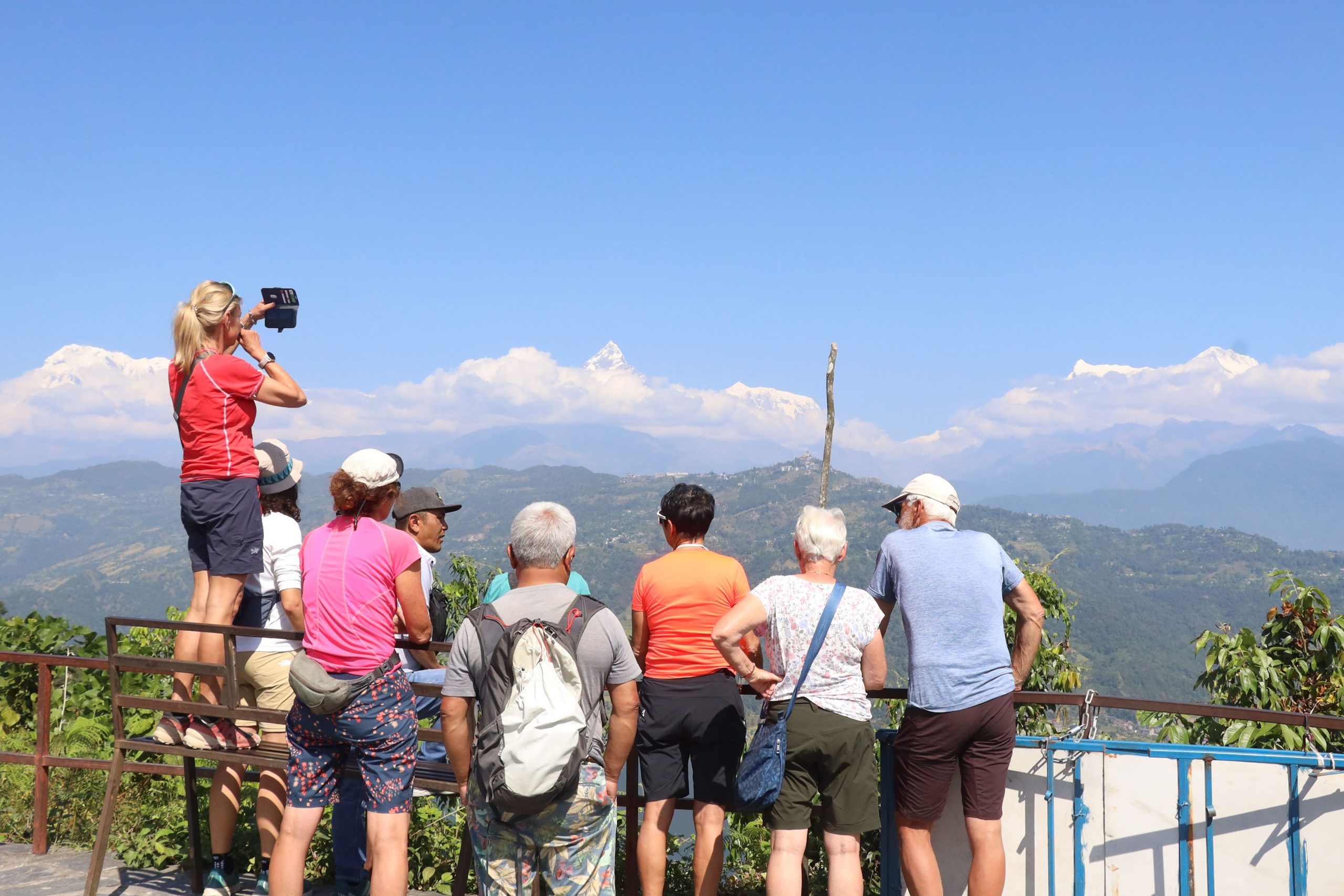
Foreign tourists observing the Himalayan view from Dhungepani, located in Pumdibhumdi, Pokhara Metropolitan City-22, Kaski. (Photo: Radhika Kandel/RSS)
The United States became Nepal’s largest source of international visitors in October, as arrivals from the country rose more than 31 percent from a year earlier, according to preliminary figures compiled by the Nepal Tourism Board from Department of Immigration records.

Nepal received 132,814 international visitors in October, a 3.4 percent increase from 128,443 in the same month last year. The United States accounted for 17,437 visitors, or 13.13 percent of the total, moving ahead of India and China to become Nepal’s largest individual source country.
The shift marks a reversal from October 2025, when India led with 17,298 visitors, followed by the United States with 13,286. Arrivals from the United States increased by 4,151 over the year, while those from India fell by 5,201.
U.S. Arrivals Rise Sharply
Visitors from the United States increased 31.2 percent in October, from 13,286 a year earlier. The timing coincided with Dashain, Nepal’s major Hindu festival, and the fall holiday travel season in the United States, periods when many Nepali Americans may travel to visit family and friends. The tourism figures, however, do not identify visitors by ethnic background, so they do not establish how many of the U.S. arrivals were Nepali Americans.
Nepal’s Department of Immigration has been tracking some travelers of Nepali origin who enter the country using nonresident Nepali visas obtained through an NRN card or citizenship certificate. But those records do not capture the entire Nepali American population. Many Nepali Americans do not hold either document and instead travel on ordinary U.S. passports, entering Nepal on tourist visas and paying the applicable visa fees.
The Nepali American population in the United States is estimated to exceed 125,000, based on figures compiled from U.S. citizenship and population data. That estimate includes more than 100,000 naturalized Nepali immigrants as well as second-generation Nepali Americans born in the United States.
The Asian American Research Center estimated the Nepali American adult population at 91,909 in 2024. The U.S. Census Bureau estimated that about 225,000 people identified as Nepali in the United States in 2023.

The Pew Research Center found that 46 percent of Nepali Americans had lived in the United States for more than a decade and that 47 percent were U.S. citizens. Applied to its estimate of the Nepali population, that citizenship share represents roughly 105,000 people.
Naturalization records also show the community’s growth. According to Department of Homeland Security data, more than 20,000 Nepalis had acquired U.S. citizenship by 2014. Between 2015 and 2023, at least another 56,000 became citizens. Including naturalizations from 2024 through 2026, the cumulative total approaches 100,000.
The department recorded 9,300 naturalizations among Nepalis in fiscal year 2023 and 8,910 in fiscal 2024. The totals were 9,410 in fiscal 2022 and 7,230 in fiscal 2021.
The 2020 Census found that the Nepali population had grown 269 percent over the previous decade, making it one of the fastest-growing Asian American communities with at least 50,000 members.
China and Australia Record Strong Growth
India, traditionally one of Nepal’s largest tourism markets, recorded a sharp decline in October. Arrivals from India fell 30.1 percent, to 12,097 from 17,298 a year earlier. India accounted for 9.11 percent of visitors, compared with 13.5 percent in October 2025.
The figures, however, include only Indian visitors who entered Nepal by air. A large number of Indian tourists also enter Nepal by land, and those arrivals are not included in the airport-based visitor statistics. As a result, the reported figures do not reflect the full number of Indian visitors to Nepal.
China recorded one of the strongest increases among major source countries. The number of Chinese visitors rose 73.1 percent, to 11,695 from 6,755.
Arrivals from the United Kingdom increased 7.6 percent, to 9,385 from 8,718. Australia recorded a 51.4 percent increase, with 9,352 visitors, compared with 6,177 a year earlier.
Germany sent 6,114 visitors, down from 6,366. Arrivals from Sri Lanka edged up to 5,560 from 5,535, while Bangladesh increased to 4,893 from 4,641. France contributed 4,164 visitors and Myanmar 3,025.

Europe Remains the Largest Regional Market
Europe remained Nepal’s largest regional source of visitors, with 39,877 arrivals in October, accounting for about 30 percent of the total. The figure was down 1.8 percent from 40,600 a year earlier.
Asia excluding South Asia contributed 27,040 visitors, a 16.9 percent increase from 23,127. South Asia recorded 24,053 arrivals, down 17.2 percent from 29,060.
The Americas sent 21,270 visitors, a 29.6 percent increase from 16,407. Arrivals from Oceania rose 48.9 percent, to 10,143 from 6,814.
The Middle East recorded 2,335 visitors, down 34.2 percent from 3,548. Africa contributed 421, compared with 443 a year earlier, a decline of about 5 percent.
Nepal Remains Just Below Pre-Pandemic Levels
Despite growth in October, Nepal’s international visitor arrivals remained slightly below their pre-pandemic level for the month.
Nepal received 134,069 international visitors in October 2019. The 132,814 arrivals recorded in October 2026 represent about 99.1 percent of that level, leaving the country roughly 0.9 percent short of its October 2019 total.