




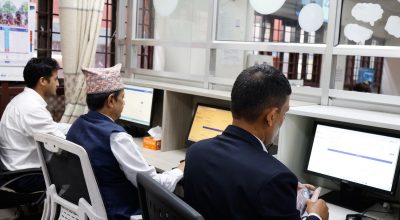

Nepal Remains on U.S. Trafficking Watch List for Third Year as Prosecutions Fall, Russia Recruitment Risks Emerge

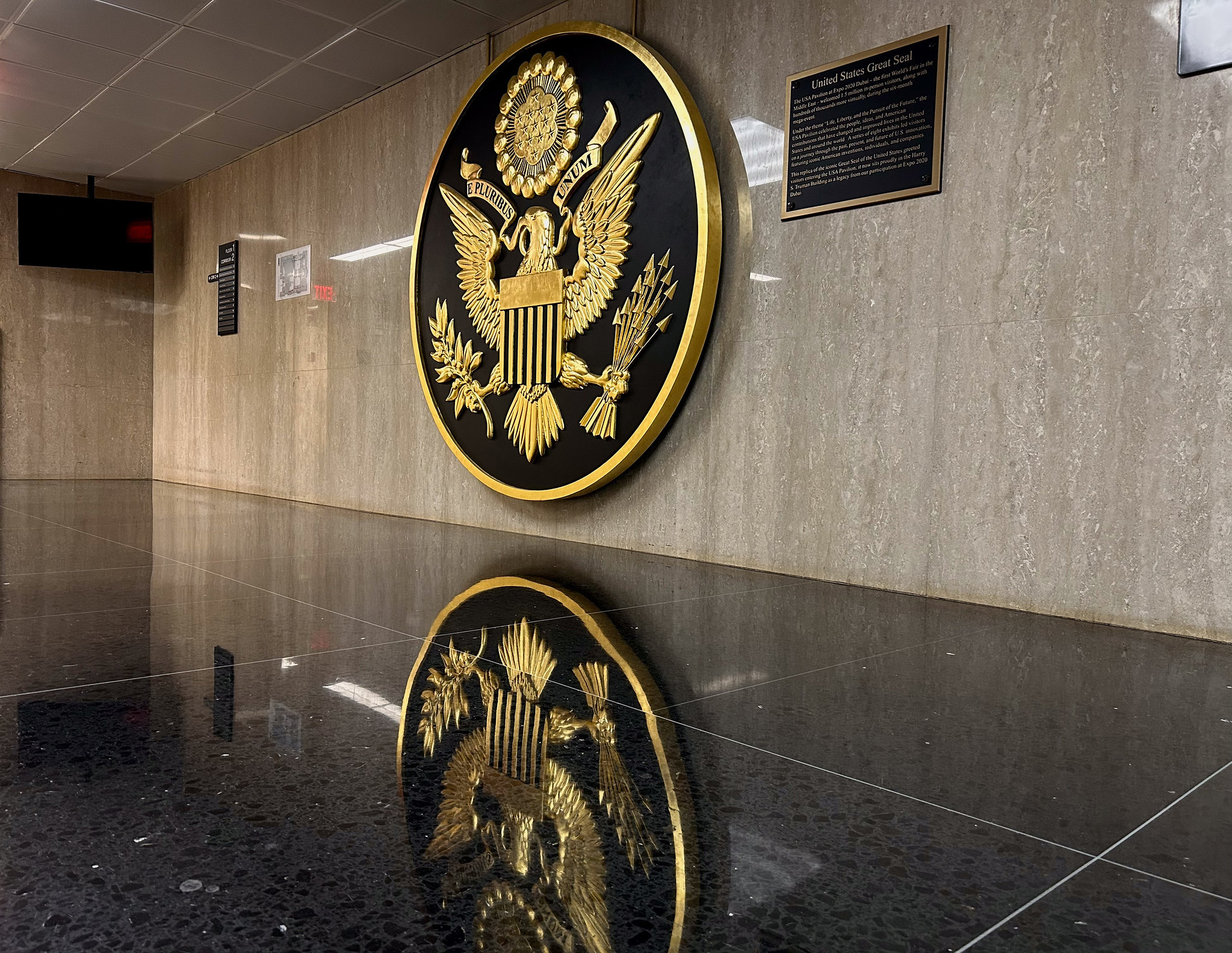
A replica of the United States Great Seal is displayed in the Harry S. Truman Building of the U.S. Department of State in Washington, D.C. (State Dept./Serkan Gurbuz)
NEW YORK — Nepal remained on the U.S. State Department’s Tier 2 Watch List for human trafficking for a third consecutive year in 2026, as investigations and prosecutions declined, gaps in anti-trafficking laws persisted and concerns about official complicity continued, according to the department’s annual Trafficking in Persons report released Oct. 8.
The report found that Nepal had made insufficient progress in several areas of its response to human trafficking, including prosecuting offenders, identifying victims and adopting legislation that meets international standards.
Nepal avoided an automatic downgrade to Tier 3, the lowest ranking, after the U.S. government granted a waiver. The report said Nepal had devoted sufficient resources to a written action plan that, if implemented, would constitute significant efforts to meet the minimum standards for eliminating trafficking.
The designation follows two consecutive years on the watch list. Nepal was placed on the list in 2024 and remained there in the 2025 report.
State Department spokesman Tommy Pigott said human trafficking was “a direct assault on the values of freedom and dignity that define America.” He said the Trump administration would use available tools to pursue traffickers and those who enable them.
Investigations and Convictions Fall Sharply
Nepal reported investigating 188 sex trafficking cases during its fiscal year from July 16, 2024, to July 15, 2025, according to the 2026 report. The government did not provide comparable statistics for forced labor investigations.
The figures mark a significant decline from the previous reporting period, when authorities investigated 392 trafficking cases — 177 involving sex trafficking and 215 involving forced labor — involving 818 suspects.
Courts convicted 169 sex traffickers during the latest reporting period, compared with 406 trafficking offenders convicted in the previous period. Those earlier convictions included 231 for sex trafficking and 175 for labor trafficking.
The government also failed to report statistics on prosecutions and convictions for forced labor in the latest period. It did not provide data on bonded labor cases or enforcement of the Bonded Labor (Prohibition) Act, continuing a reporting gap identified in the 2025 report.
Victim identification also declined. Authorities identified 175 trafficking victims in the latest reporting period, including 152 victims of sex trafficking and 23 of labor trafficking. The previous report documented 203 victims, including 175 victims of sex trafficking and 28 of labor trafficking.
Anti-Trafficking Law Remains Inadequate
Nepal has yet to bring its principal anti-trafficking law into line with international standards, the report said.
The Human Trafficking and Transportation (Control) Act of 2007 defines trafficking in terms that do not fully encompass the international definition. The law focuses on the buying or selling of a person and causing someone to enter prostitution, without adequately addressing forced labor or explicitly requiring the use of force, fraud or coercion as elements of adult trafficking.
For the 11th consecutive year, the government continued working on amendments to the law but did not adopt revisions that would criminalize all forms of sex trafficking and forced labor in line with the United Nations Protocol to Prevent, Suppress and Punish Trafficking in Persons. Nepal acceded to the protocol in 2020.
Penalties under other laws also remain a concern. The 2017 Labor Act provides for up to two years in prison for forced labor, while the 2002 Bonded Labor (Prohibition) Act prescribes civil fines of 15,000 to 25,000 Nepali rupees, equivalent to about $104 to $174 in 2026.
Allegations of Official Complicity Persist
The report identified corruption and alleged involvement by government officials as continuing obstacles to effective enforcement.
Some officials previously accused of involvement in trafficking remained in office, while observers reported that authorities frequently dropped criminal charges against officials suspected of complicity.
In December 2025, the government charged the chief of immigration at Tribhuvan International Airport and six other immigration officials with corruption and money laundering. They were accused of accepting bribes to allow several hundred people to travel abroad on fraudulent visit visas.
Some of the travelers alleged that they had been deceived, mistreated or forced to perform work different from what they had been promised. The immigration chief was released on bail, and the investigation remained ongoing at the end of the reporting period.
The 2025 report had also documented an investigation into an alleged trafficking network involving immigration officials accused of forging documents to send people abroad under false pretenses. That case was pending before the courts at the end of the earlier reporting period.
Victim Protection Remains Uneven
Nepal continued to lack standardized procedures for identifying trafficking victims and referring them to services, a shortcoming the report said had persisted for seven consecutive years.
Front-line officials received limited and inconsistent training, and only some government agencies had internal guidelines for identifying victims. As a result, procedures were applied inconsistently.
The government allocated 10.75 million Nepali rupees, or about $74,767, for victim services in the latest reporting period and referred 862 potential trafficking victims to care. The previous report did not provide a comparable figure for the latest year’s referrals, although it recorded 2,733 referrals during an earlier period.
Despite the allocation, observers said victim services remained inadequate. Nepal lacked dedicated shelters for child trafficking victims, accommodations for people with disabilities were insufficient, and services for vulnerable communities — particularly in rural areas and communities affected by bonded labor — remained limited.
Migrant Workers Face Continued Risks
More than 800,000 Nepalis leave the country annually on work permits, and many face risks of exploitation in India, the Middle East, and Southeast and East Asia, according to the report.
Nepal maintained 12 bilateral labor agreements with destination countries and signed a new agreement with Saudi Arabia in January 2026. The agreements are intended to promote transparent recruitment and protect workers’ wages and contractual rights.
However, several major destination countries still lacked such agreements. The government also continued allowing workers to pay recruitment fees, even though guidelines cap agency fees at 10,000 Nepali rupees, or about $70.
The report said employment agencies continued to charge workers fees above the official limit, reflecting weaknesses in government monitoring and enforcement.
New National Policy, but Enforcement Gaps Remain
Nepal approved a national policy against human trafficking in January 2026, along with a new national action plan that included dedicated resources and implementation timelines ranging from one to five years.
The government reported allocating 22.44 million Nepali rupees, or about $156,079, for training and public awareness activities.
The development marked a change from the previous reporting period, when a 10-year national action plan prepared by the Ministry of Women, Children and Senior Citizens remained awaiting formal approval for a third consecutive year.
The Foreign Employment Board operated 77 migration resource centers across Nepal’s districts, up from about 72 reported in the previous report. The centers provide information about authorized recruitment agencies, maximum fees and the risks associated with overseas employment.
However, the report said government oversight of recruitment agencies remained ineffective, allowing many agencies to continue charging fees above the prescribed limit.
Social Media and False Job Offers Fuel Exploitation
Traffickers increasingly used social media and mobile technology to lure people with false employment offers, the report said.
Nepali men, women and children continued to face sex trafficking and forced labor both within Nepal and abroad. Some Nepalis were exploited in online scam operations in Southeast Asia and the Philippines.
Within Nepal, traffickers exploited adults and children through forced labor and debt-based bondage in agriculture, brick kilns, domestic work and stone breaking.
The Haruwa-Charuwa, Haliya and Kamaiya communities, most of whose members are Dalits, remained disproportionately affected by bonded labor, particularly in agriculture and cattle grazing.
The report also highlighted risks faced by Nepalis recruited to travel to Russia to enlist as foreign fighters in the Russia-Ukraine war. Some migrants reported indicators of fraudulent recruitment. The 2025 report estimated that about 4,000 Nepalis had enlisted and more than 300 had died.