






Trump Tells U.N. That ‘America Is Back,’ Defends Iran War and Claims a Record of Ending Conflicts

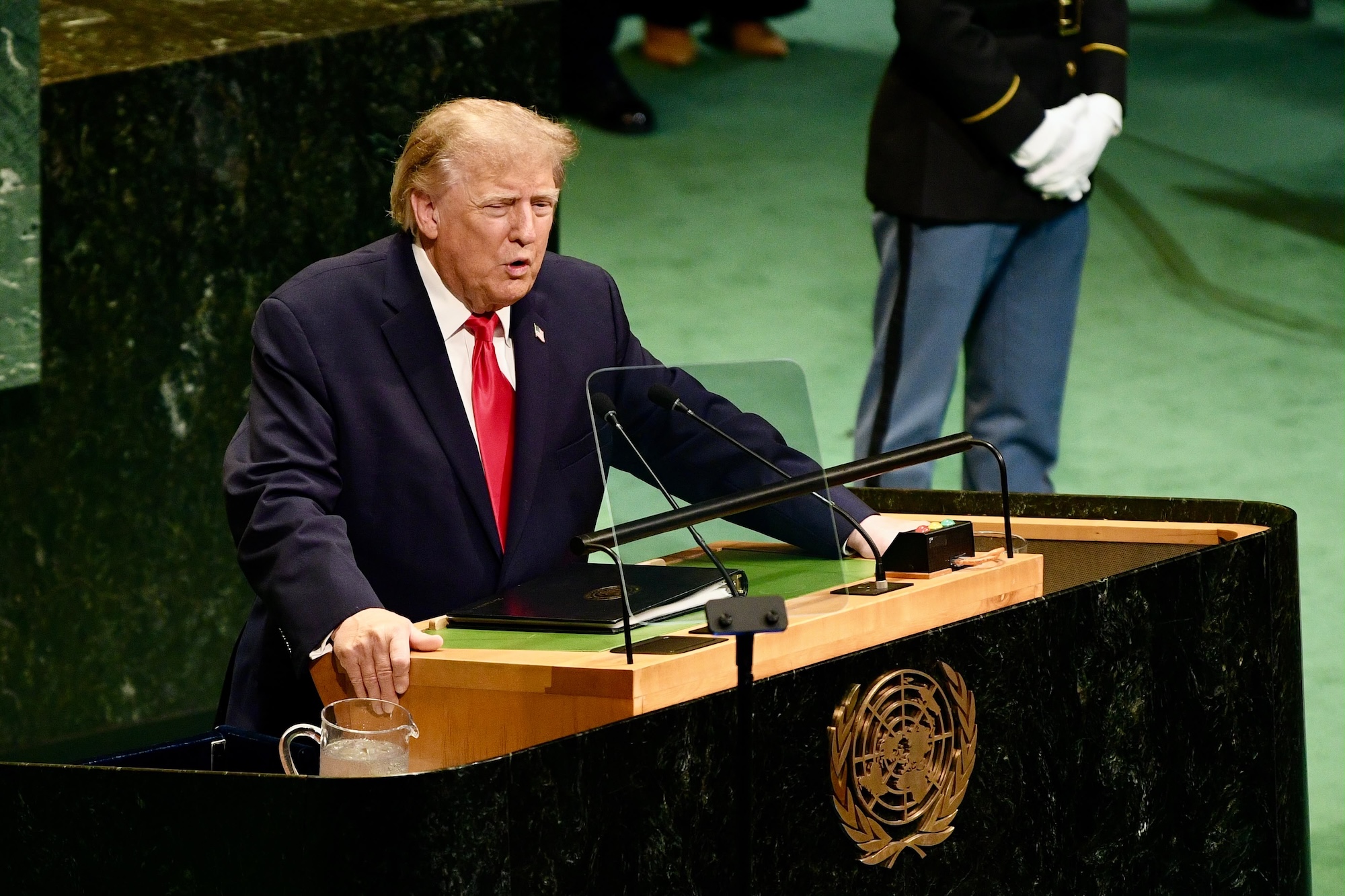
U.S. President Donald Trump addresses the 81st United Nations General Assembly at U.N. headquarters in New York on Sept. 22, 2026. Photo: Rajan Kafle/NepYork
UNITED NATIONS — President Donald Trump used his address to the 81st United Nations General Assembly on Tuesday to portray the United States as stronger, wealthier and more secure than at any point in its history, while defending his administration’s military actions against Iran and presenting himself as a leader who has settled conflicts that previous governments had left unresolved.
Opening his speech by welcoming world leaders to the United States as the country prepares to celebrate its 250th anniversary, Trump declared that “America is back” and said the country was experiencing what he described as a new period of economic and military strength.
“Our economy is the envy of the world,” Trump said. “Our military is the most powerful on Earth. Our technology is second to none.”
He cited a series of economic figures that he said demonstrated the success of his administration, including more than 1 million new private-sector jobs, a record-high average real household income of $87,000 and what he described as the lowest poverty rate in American history.
Trump also said his administration had secured commitments for $21 trillion in new investments in the United States, compared with less than $1 trillion during the previous administration. He said U.S. stock markets had reached 80 all-time records during the previous 12 months.
The president attributed those figures to deregulation, tax cuts and his administration’s broader economic policies.
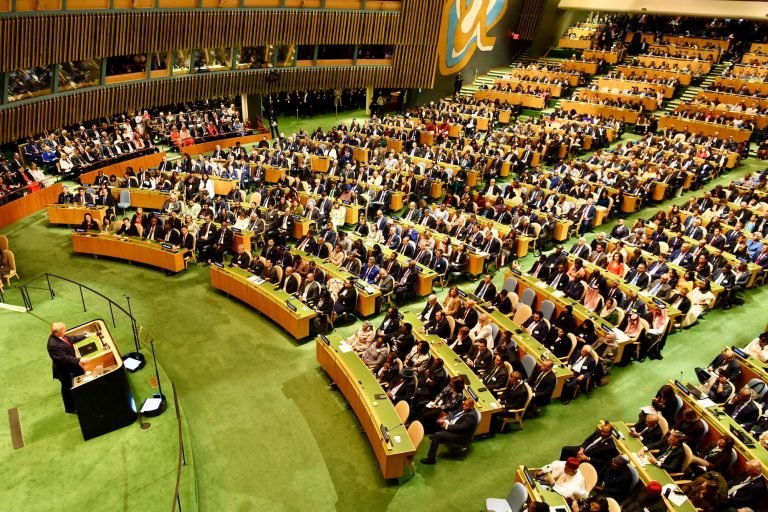
America Is ‘Back,’ Trump Tells World Leaders
Trump made his assessment of the U.S. economy and military strength the opening theme of his address.
He said his administration had removed what he called unnecessary regulations and obstacles to doing business, while passing what he described as the largest tax cuts in American history.
Trump said more money was now being invested in the United States than ever before and that his administration had secured commitments for $21 trillion in new investments from around the world.
“Two years ago, our country was dead,” Trump said. “And now we have the hottest country anywhere in the world.”
He also claimed that the United States had moved from what he called a “dark age” under the previous administration into what he described as a “golden age.”
Trump Puts Iran at the Center of His Foreign Policy
The most consequential portion of Trump’s address focused on Iran.
Trump described Iran as the world’s leading sponsor of terrorism and said his administration had acted after diplomatic efforts failed to persuade Tehran to abandon its nuclear program and support for militant groups.
He said he had initially offered Iran economic cooperation in exchange for ending its nuclear program and support for terrorism. After Iran rejected the proposal, Trump said the United States launched military operations against Iranian nuclear and military infrastructure.
Trump referred to two operations by name — “Operation Midnight Hammer” and “Operation Epic Fury” — and claimed that the latter had destroyed much of Iran’s military capacity.
“All 159 ships of their navy are now lying at the bottom of the sea,” Trump said. He also claimed that Iran’s air force, radar systems, anti-aircraft equipment and missile and drone manufacturing capacity had been largely destroyed.
Trump further claimed that Iran’s inflation rate had risen above 300 percent and described its economy as devastated.
The president said the United States had nonetheless left open the possibility of a negotiated settlement.
Trump presented the choice in stark terms: a deal that would allow Iran to rebuild, or military action that he said could “annihilate” the Islamic Republic.
“I believe we’ll make a deal right after the election,” he said. “Because it doesn’t make sense for them not to.”
Trump added that he was not personally running in the midterm elections and said the Republican Party was running candidates whom he would help.
He also rejected suggestions that the United States was running short of weapons.
“The cowards and traitors would love to say the United States is low on munitions, but that’s not true,” Trump said.
He said 18 major munitions plants were under construction and that the United States would soon be able to increase production and supply allies more rapidly.
Trump called on other countries to join the United States in imposing complete economic isolation on Iran until Tehran stops attacks on commercial shipping, abandons its nuclear ambitions and ends its support for terrorism.
A Claim of Peace-Making Across Multiple Conflicts
Trump used much of his speech to portray his administration as a force for resolving conflicts that had persisted for years or decades.
“While others have talked, I have acted,” Trump said. “While others have spoken of peace, I have made peace.”
He said his administration had settled eight wars since he took office.
Among the conflicts he listed were those involving Cambodia and Thailand, Kosovo and Serbia, the Democratic Republic of Congo and Rwanda, Pakistan and India, Armenia and Azerbaijan, and Gaza.
Trump said his administration had used personal relationships, trade, tariffs and the threat of tariffs, as well as other forms of leverage, to reach settlements.
He quoted statements from leaders of Pakistan, Azerbaijan, Armenia, Cambodia and Rwanda praising his involvement in their respective conflicts.
Trump also said he was working with Russia and Ukraine to end their war.
“We’ll get that one done,” he said. “It’s going to happen, I think, more quickly than people understand.”
Gaza Becomes a Showcase for Trump’s Diplomacy
Trump presented the Gaza war as one of the clearest examples of what he described as his administration’s ability to end a long-running conflict.
He said that a year earlier, when he had addressed the General Assembly, the war was still raging and hostages remained in Hamas tunnels.
Trump claimed that subsequent diplomatic efforts had ended the war and brought home all remaining hostages, both living and dead.
He thanked the U.N. Security Council for what he described as unanimous support for his 20-point Gaza peace plan and for approving the “Board of Peace,” which he said he would chair.
Trump said nearly 30 countries had joined the board and credited Morocco, Bahrain, Qatar, Kuwait, Kazakhstan, Saudi Arabia, Turkey, Uzbekistan and other countries with contributing billions of dollars toward humanitarian relief and reconstruction.
He also named Indonesia, Morocco, Albania, Kosovo, Kazakhstan, Egypt and Jordan among countries that he said had committed troops, police or training to help stabilize Gaza.
Trump Expands His Focus to Venezuela and the Western Hemisphere
Trump devoted another major section of the speech to Venezuela and broader U.S. policy in the Western Hemisphere.
He claimed that U.S. forces had carried out an operation in Caracas and arrested Venezuelan President Nicolás Maduro, whom Trump called an “outlaw dictator” and a “real criminal.”
Trump said hundreds of Venezuelan political prisoners had subsequently been released and that Washington was working with Venezuelan leaders on the country’s future.
He also announced what he described as the largest oil deal in history, involving 65 billion barrels of oil, and said the agreement would benefit both Venezuela and the United States while reducing energy costs worldwide.
Trump linked his Venezuela policy to a broader declaration that the United States would no longer permit threats to gain a foothold in the Western Hemisphere.
He said his administration had designated drug cartels as foreign terrorist organizations and authorized the U.S. military to target them.
Trump compared the cartels to the Islamic State and said the United States had carried out dozens of strikes on cartel drug boats.
He claimed those operations had eliminated 97 percent of drugs entering by sea.
Cuba, Mexico and the Fight Over U.S. Influence
Mexico was another focus of Trump’s speech.
He said the United States could not accept sharing a 2,000-mile border with territory controlled by cartels and called on Mexico to reclaim control of areas he said were dominated by organized crime.
At the same time, Trump said his administration had developed a “very good relationship” with the Mexican government and that both countries opposed the cartels.
Trump also called for fundamental political change in Cuba, describing the communist government as a failed state under unprecedented pressure.
He said Secretary of State Marco Rubio was involved in negotiations with Havana.
“We’ll see what happens,” Trump said.
Trump said the United States would not allow foreign adversaries to establish a foothold close to American territory.
Greenland and a Larger American Military Presence
Trump also discussed Greenland, saying the United States had reached an agreement with Denmark that would give Washington permanent control over security and other needs on the territory.
He said the United States would develop a significant military presence there, including two major military bases.
Trump argued that an expanded American presence in the Arctic and North Atlantic would strengthen the defense of both the United States and Europe.
He linked the policy to NATO, praising Secretary General Mark Rutte and saying the alliance was stronger than ever.
Trump highlighted NATO members’ commitment to increasing defense spending to 5 percent, up from the previous 2 percent target he cited.
Trump Presses for an End to the Russia-Ukraine War
Trump said the United States remained committed to ending the war between Russia and Ukraine.
He said he had recently signed legislation giving him additional tariff authority and indicated that he could use tariffs as leverage to push the parties toward an agreement.
Trump said approximately 25,000 people, mostly soldiers, were dying each month in the conflict.
“I look at those battlefield pictures and I really don’t want to see them anymore,” Trump said.
He also praised first lady Melania Trump for her work to secure the return of displaced Ukrainian and Russian children to their families.
Trump said she had helped bring home “many” children and described her as the only first lady in history to preside over a U.N. Security Council meeting.
He said Melania Trump was also hosting a gathering of “Fostering the Future Together,” which he said included nearly 60 members focused on improving the lives of young people.
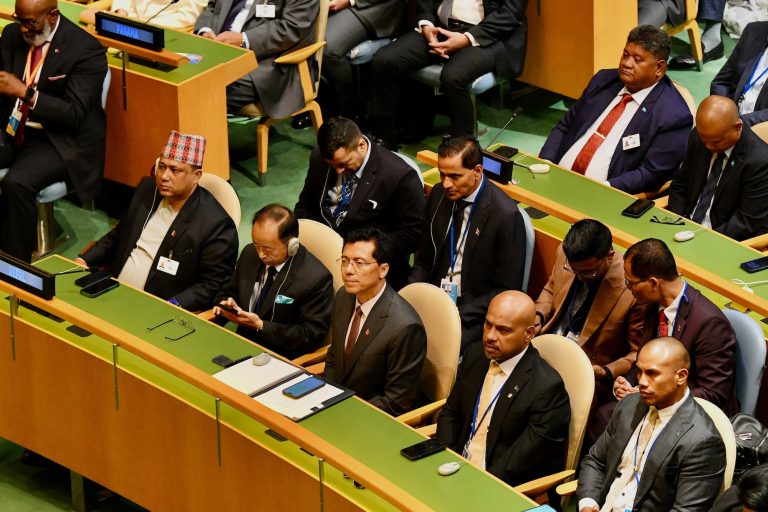
A Sharper Challenge to the United Nations
Trump devoted considerable attention to the United Nations itself.
He praised the organization as having “great potential” but criticized what he called an agenda imposed by unelected global bureaucrats.
Trump said his administration had worked with U.N. member countries on what he described as the most sweeping reforms in the organization’s history.
He said the United States had cut the U.N. budget by 15 percent in 2026 and eliminated more than 4,000 positions.
He also criticized international efforts to establish a global carbon tax and said the United States would not accept international taxation.
“There is no global government,” Trump said. “And while I’m president, there will be no global taxes.”
Trump also attacked the International Criminal Court, saying the United States would not permit American service members to be investigated by a tribunal that he said had no jurisdiction over the United States.
He called on countries belonging to the ICC to withdraw from the institution.
Trump Defends National Sovereignty and Immigration Controls
Trump framed immigration as a question of national sovereignty.
“There is no human right to illegal immigration,” he said. “But there is a right to remain a sovereign nation.”
He said the United States had abandoned policies that allowed what he characterized as dangerous migrants and criminals to enter the country.
Trump also criticized what he called “globalist” efforts to promote mass migration, arguing that uncontrolled migration threatened national cultures and heritage.
His comments continued a broader theme of his presidency: that national governments, rather than international institutions, should retain primary authority over borders, taxation and domestic policy.
‘Super Intelligence’ and the Race With China
Artificial intelligence was another major subject.
Trump rejected what he described as efforts to create a global regulatory system for artificial intelligence.
He proposed that the United States use the term “super intelligence,” or “SI,” rather than “artificial intelligence,” arguing that the technology represented genuine intelligence.
Trump said the United States was leading China and other countries in the technology and pledged to maintain that lead.
He compared the potential impact of the technology with the Industrial Revolution and the internet.
While he acknowledged that the technology presented risks, Trump said his administration would encourage its development rather than impose broad restrictions.
He said the Justice Department and other law enforcement agencies would monitor the technology and intervene when necessary.
Trump’s Vision of American Power
Throughout the address, Trump returned to the idea that American power — economic, military and diplomatic — was the central instrument for resolving international conflicts.
He argued that diplomacy backed by economic pressure, tariffs and the possibility of military force had enabled his administration to address conflicts that had persisted for years or decades.
He repeatedly contrasted his administration with previous U.S. governments, saying earlier presidents had allowed threats to grow rather than confronting them.
Trump also portrayed his domestic agenda as part of a broader foreign-policy strategy, arguing that a stronger United States could exercise greater influence abroad.
A Closing Appeal to Strength, Freedom and Unity
Trump concluded by returning to American history and the Revolutionary War, invoking George Washington’s troops in New York in 1776 and the struggle for independence.
He said the same willingness to defend national principles was necessary in the modern world.
“If we go forward strong and united against the enemies of all humanity,” Trump said, “then together through bold action we will make this world far safer and a far better place.”
He ended with a call for stronger nations, larger economies and a future he described as “brighter, more hopeful, and more magnificent than ever before.”
“God bless the nations of the world,” Trump said, “and God bless America.”