






Nepal’s Prime Minister Brings Flood Disaster to U.N., Calls for Climate Justice and Global Action

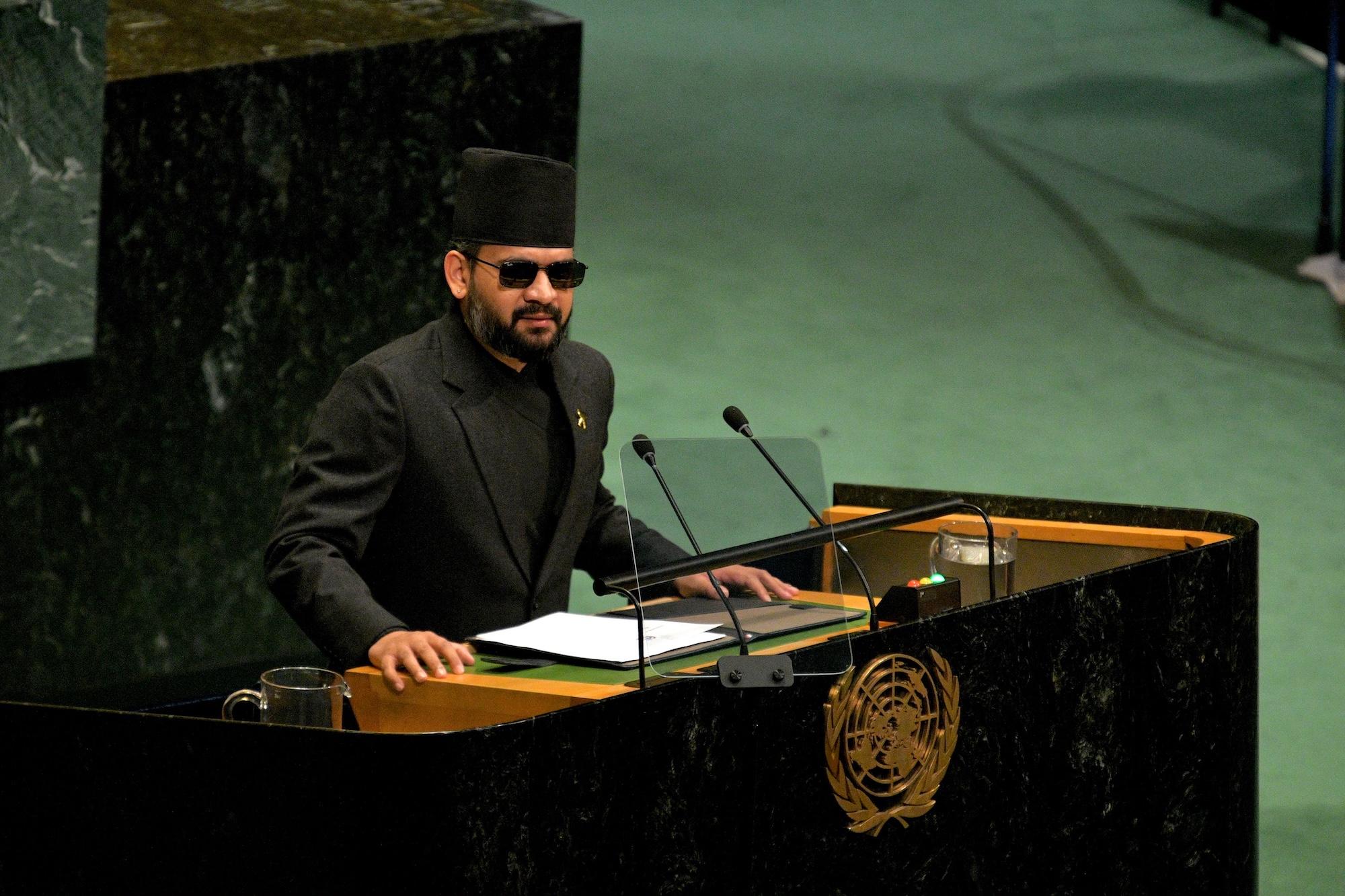
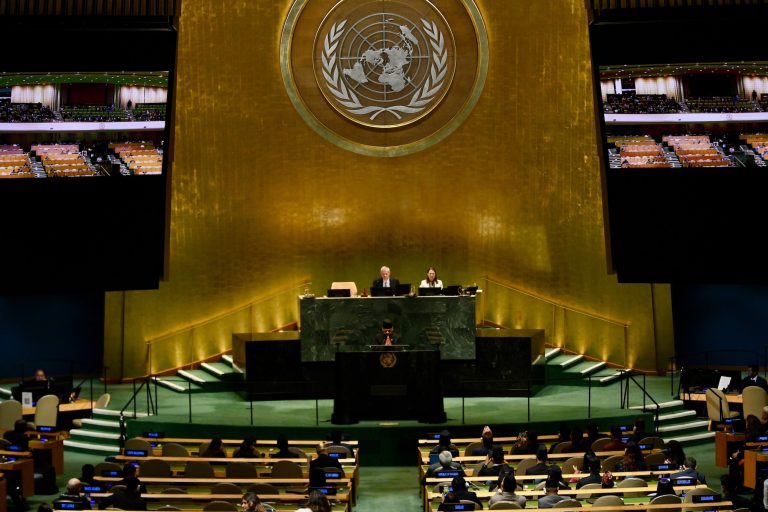
Nepal Prime Minister Balendra Shah addresses the 81st session of the United Nations General Assembly in New York, calling for climate justice and greater international action after devastating floods in Nepal. Photo by Rajan Kafle for NepYork.
NEW YORK — Nepal’s prime minister, Balendra Shah, used his first address to the United Nations General Assembly on Thursday to call for faster climate action, grant-based recovery financing and a regional Himalayan resilience mechanism after catastrophic floods that he said killed at least 1,400 people and left more than 6,000 missing.
Speaking during the general debate of the 81st session of the U.N. General Assembly, Mr. Shah described the recent Bhotekoshi-Trishuli disaster as a “warning to the world,” saying climate-driven hazards in the Himalayas were becoming a humanitarian and development emergency for Nepal.
“I come before you from Nepal — a distant country in the Himalayas — carrying a close warning for humanity,” Mr. Shah said. “I wish I could stand here today simply to speak about development, democracy, peace and the hopes of a young nation. Instead, I must speak about death and destruction of epic proportions.”
Mr. Shah said flash floods that struck Nepal’s mountain communities four weeks earlier had swept away bridges, roads, schools, homes and livelihoods, disrupting the country’s progress toward the Sustainable Development Goals. He said preliminary assessments put the recovery needs at about 10 percent of Nepal’s gross domestic product.
The prime minister thanked India, China, the United Nations, humanitarian agencies, philanthropies and other countries for providing assistance after the disaster. But he said Nepal would need sustained international solidarity for recovery and reconstruction, comparable to the support mobilized after the 2015 Gorkha earthquake.
Himalayan Crisis
Mr. Shah attributed the growing risks in the Himalayas to a warming climate, saying melting permafrost was destabilizing slopes beneath glaciers and increasing the danger of ice-rock avalanches, floods, landslides and cascading disasters.
The effects of the flooding extended across the Nepal-China border and downstream into India, he said, underscoring that climate hazards transcend national boundaries.
“Climate change does not recognize borders,” Mr. Shah said. “Glaciers and floods do not travel with a visa stamped on passports.”
Nepal produces less than 0.1 percent of global greenhouse gas emissions but faces a disproportionate climate burden, Mr. Shah said. He cited retreating glaciers, unstable mountain slopes and increasingly unpredictable rivers, warning that major disasters can erase years of hard-won development gains.
“For Nepal, climate catastrophe is not just a humanitarian event, but a development emergency,” he said, noting that disasters destroy public infrastructure, farms, jobs and clean-energy projects while forcing a low-income country to borrow to repair damage it did not cause.
Mr. Shah said Nepal was not seeking to blame individual countries or regions. Instead, he called on nations to honor the U.N. climate principle of common but differentiated responsibilities and respective capabilities.
“Those who have historically contributed more to the problem, and those with greater capacity to respond, must do more,” he said. “Climate justice cannot just remain a beautiful phrase in a United Nations document.”
Regional Mechanism Proposed
Mr. Shah proposed creating a Himalayan Climate Resilience Mechanism led by Nepal, India and China. The initiative, he said, could improve cross-border sharing of satellite data and technical expertise, monitor dangerous glacial lakes, strengthen early-warning systems and coordinate international assistance during disasters.
The Hindu Kush Himalaya region supports nearly 2 billion people through its water resources, ecosystems, agriculture and livelihoods, Mr. Shah said, adding that the region should be treated as a global life-support system rather than a peripheral concern.
“Let the Himalayas become a laboratory of international cooperation, rather than a frontier of fragmented information,” he said.
Mr. Shah also highlighted Nepal’s domestic climate and clean-energy efforts, saying forest cover had been restored to nearly half of the country’s territory. He said Nepal was expanding hydropower, promoting electric mobility and strengthening local adaptation measures, though he acknowledged that Nepal could not build resilience alone.
He framed the international response needed in six terms: “Relief. Rehabilitation. Reconstruction. And also: Responsibility. Reparation. Resilience.”
The first three, Mr. Shah said, are needed after a disaster. The latter three are essential to prevent climate disasters from becoming a permanent condition for vulnerable countries.
Call for Grants and Reform
Mr. Shah said climate-vulnerable countries needed adequate grant-based assistance rather than additional debt. He criticized the limited scale and difficult access requirements of international climate-finance mechanisms, including the Loss and Damage Fund and the Global Environment Facility.
“When the house is burning, we do not ask the family to complete fifty forms,” Mr. Shah said. “We act. That is what climate justice must mean.”
The prime minister broadened his address beyond climate change, arguing that the global economic and political order was failing poorer nations. He said disruptions in global supply chains had made it difficult for Nepalese farmers to obtain fertilizer and for the country to secure bitumen for roads and cooking fuel for households.
“We have built a world with flawless logistics for war and broken logistics for food,” Mr. Shah said.
He said countries across South Asia faced overlapping pressures from climate impacts and conflicts they did not cause, and called for a fairer international economic order and a stronger multilateral system that gives small, landlocked and least-developed countries a meaningful voice.
Mr. Shah said climate justice involved more than finance. It also required distributive justice over who bears the costs of climate change and procedural justice over who is represented in global decision-making.
Youth Mandate
Mr. Shah said Nepal’s new majority government, elected in March in what he described as the country’s fairest and most peaceful election, had received a democratic mandate shaped by a younger generation demanding integrity, accountability and opportunity.
He said his government’s priority was to build a state that delivers jobs, social protection and fair opportunities for Nepalis at home.
“The Nepal floods signal a future shaped by rising climate extremes,” Mr. Shah said. “Our baselines are no longer relevant. And we must move from ad-hoc responses to a culture of preparedness.”
He called for investment in resilience, insurance, innovation, stronger infrastructure and institutions, lower dependence on fossil fuels, and early-warning systems capable of saving lives.
Mr. Shah said Nepal would continue the discussion at a “Sagarmatha to the Sea” side event at the United Nations beginning Friday.
He concluded with a prayer for global well-being and an appeal for the world to follow the path shown by Buddha.
“Let us be ready to hear it, and ready to act,” Mr. Shah said, referring to future warnings from the Himalayas.