






The Pilgrim Lumbini Forgot to Count

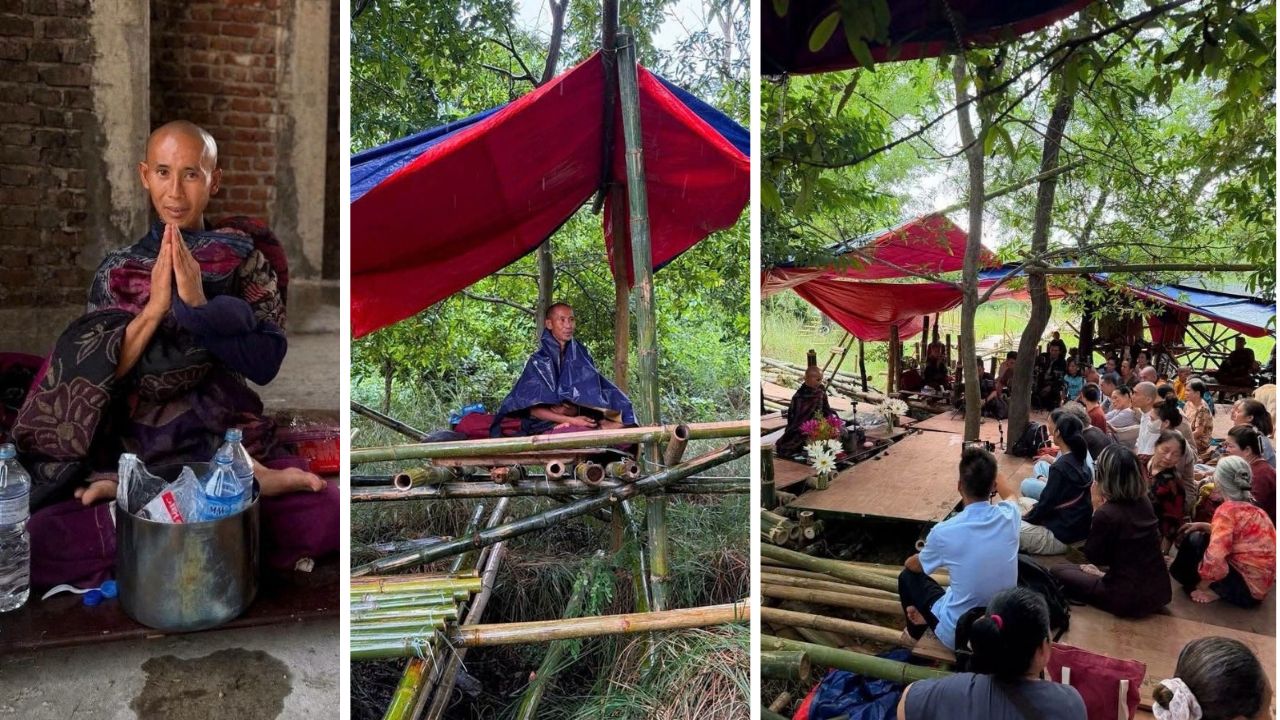
Photo courtesy of Tayson DeLengocky, D.O.
On Sept. 25, 2026, Dhutaṅga Yogi Thích Minh Tuệ completed one year in Nepal. No ministry marked the date, and no institution issued a statement. He and about 30 companions were where they have been for most of that year: out before first light with an alms bowl and close to nothing else.
Dhutaṅga names a set of 13 optional austerities that the Pali tradition has carried since its earliest layers. He keeps the ones most practitioners leave alone: He does not lie down to sleep but sits through the night, and he shelters in the open air, under trees and in cemeteries. He heads no organization, holds no temple and sells no teaching.
None of this began with the cameras. Before May 2024, he had already walked repeated north-south circuits of Vietnam — on the order of 10,000 kilometers or more, by later reconstructions — in near-total obscurity. Roadside footage that month made him one of the most watched people in the country within weeks.
What followed was brief and enormous. For weeks, he drew crowds from one city to the next, until concerns about public order ended the walk in early June; the state said he had stopped of his own accord. He spent several days out of sight and appeared in a short interview on state television. Six months later, on Dec. 12, 2024, he walked out of Vietnam into Laos with no date of return and has not been back.
What can be counted from that first shock: His Vietnamese Wikipedia page, created in mid-May 2024, became one of the most-read biographies on Vietnamese Wikipedia that year. Contemporaneous tallies put views in the first six weeks above 600,000, including a single-day spike on May 30 on the order of 90,000.
He crossed from Vietnam into Laos on Dec. 12, 2024, and continued through Thailand, Malaysia, Indonesia, Singapore, Sri Lanka and India. He entered Nepal on Sept. 25, 2025, and has now stayed longer than in any other country on the route.
Nine months into that stay, a second Vietnamese Buddhist walk arrived at Lumbini, and Nepal knew at once what to do with it.
The Walk America Watched
On Oct. 26, 2025, Bhikkhu Paññākāra set out from Fort Worth, Texas, with a group of monks and an Indian rescue dog named Aloka, and walked about 3,700 kilometers to Washington in 108 walking days. The Associated Press, NPR and other national and international outlets carried the story. The walk ended with a large interfaith gathering at Washington National Cathedral.
From Texas to Lumbini
The walk did not end in Washington. On June 14, 2026, the delegation reached the Buddha’s birthplace and walked from the Eternal Peace Flame to the Maya Devi Temple. Nepal’s Tourism Ministry released a video message of welcome. The Lumbini Development Trust formally received the monks, and its acting member-secretary, Gyanin Rai, said the arrival had enhanced Lumbini’s spiritual significance and would contribute to peace tourism. The Kathmandu Post covered the event. Days afterward, Nepali outlets reported that a courtesy meeting with President Ramchandra Paudel had been scheduled at the presidential residence in Kathmandu.
Thích Minh Tuệ was a few kilometers away, in the middle of his rains retreat. He had been practicing there for nearly nine months. Asked about him, Bhikkhu Paññākāra declined the comparison: Each had chosen his own path. The two men were born in the same year, 1981, in the same country.
The Pilgrim in Plain Sight
The two walks should not be ranked. One is a public mission with a starting line, a route and a message about peace, and institutions recognize that shape on sight. The other has no campaign, no spokesman and no scheduled ending. It practices and keeps practicing.
The contrast is worth stating out loud. For most of this year, Thích Minh Tuệ has been highly visible on the ground and to audiences on several continents while remaining close to invisible in Nepal’s national press.
The Nepali record is real but small. The Himalayan Herald published a feature describing roughly 30 Vietnamese dhutaṅga practitioners at Lumbini and naming him among them. The scholar-journalist Narendra Manandhar documented the group repeatedly, from Lumbini into the Kathmandu Valley; his observations reached The Nepal Weekly, Khabarhub and Nepal Bhasha Times.
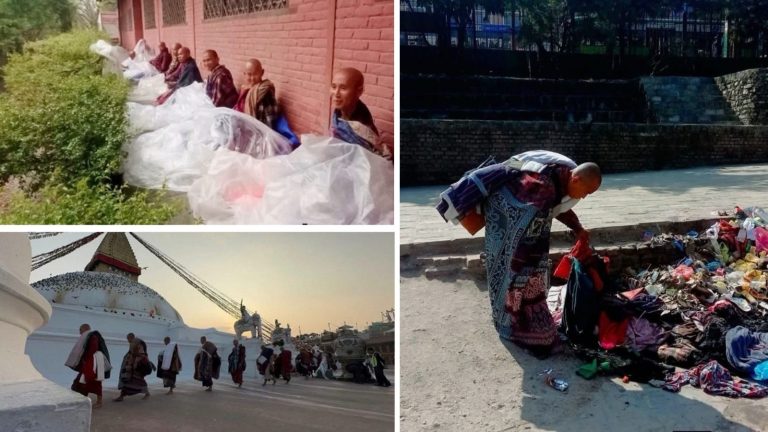
In July 2026, National Geographic ran a photograph of barefoot walkers circling Boudhanath Stupa, captioned as Tibetan monks. Manandhar later identified them as the Vietnamese practitioners. If that caption stood, Nepal’s sacred landscape traveled around the world with somebody else’s name attached to it.
One of Lumbini’s most watched long-term pilgrims is also among its least recognized.
What the World Is Watching
Here is the scale, with its limits attached. Across platforms between April 2024 and July 2026, research models by this author put platform-counted exposures in a range of about 8.5 billion to 11.1 billion, roughly 90 million of them in July 2026 alone, with about 0.6 billion attributed across 181 YouTube channels.
Those are exposures, not people; one viewer registers many times over. The same catalog counts 193 songs across 18 language layers and 239 poems by 44 named authors, composed mostly by people who have never met him.
The attention has become physical travel, and it did not start in Nepal. Since the international pilgrimage began on Dec. 12, 2024, supporters have arrived, often daily, wherever the group happened to be across eight countries: from Vietnam and its diaspora in North America, Europe and Australia, and from Korea, Taiwan and Japan, to offer alms or sit in silence.
In Nepal, that stream has now run for a year in one place. That pattern is reported from the ground and from the follower economy around him; it is not an official arrival series.
Counted Under Another Passport
In 2025, Lumbini recorded 140,969 visitors from countries other than India and Nepal, up 26.54 percent in a year, drawn from 106 countries. Vietnam supplied 8,615 of them, fifth behind Sri Lanka, Thailand, Myanmar and China.
That 8,615 undercounts something. A Vietnamese American who flies from Houston to stand at an alms round in Rupandehi enters Nepal’s statistics as an American. Nepal counts the passport at the desk and records nothing else: not language, not ancestry, not purpose, not whether the trip was built around a person or a place.
Some 6 million Vietnamese live outside Vietnam and sent home on the order of $16 billion to $18 billion in 2025. Nepal has no instrument that can see any of them arriving as Vietnamese.
The same ledger works in reverse. When a Nepali American lands in Kathmandu for Dashain, for a cremation or for a village school her father funded, the arrival is filed under the United States.
The repair is cheap: Add a few questions to the visitor survey about language at home, purpose of visit and nights stayed.
Money That Circulates and Is Never Collected
A study by this author models annual economic circulation around the phenomenon at $117 million to $499 million, centered near $280 million. That is a worldwide scenario — travel, content and merchandise — not Nepal’s recorded tourism revenue and not money received by the practitioner.
The merchandise began early and never stopped. Within days of the 2024 surge, newspapers were reporting T-shirt designs copied from his patched robe. The pattern now sells as clothing, bags and caps; his likeness appears on cheap prints, paintings and statues marketed internationally. He holds no trademark, has licensed nothing and receives no royalty on any of it.
One local illustration arrived this month, and it should be kept in its proper box. Local reports said that on Sept. 2, a 30-year-old Vietnamese citizen was stopped at Gautam Buddha International Airport in Bhairahawa carrying a large undeclared sum, later put at nearly $48,800, and that he was being transferred to the Department of Revenue Investigation.
Vietnamese-language sources identified him as a YouTuber who films the group in Nepal; the Nepali reports named no channel and did not mention the practitioners. No charge tying the money to any yogi has been shown in the public record.
What to Call a Year of Practice
A year of dhutaṅga practice at the birthplace itself needs no new label. It is living Buddhism, and it is the one thing Lumbini cannot prefabricate.
Reporting from Tilaurakot has put average time on site at about 39 minutes; local operators have described the pattern as hit-and-run tourism. An event brings people for a day. A practice that happens every morning gives them a reason to stay longer.
The Development Money Is Live
This is not a question for some later year. The Greater Lumbini Area Development Project is worth about Rs. 12.5 billion, with $85 million from the World Bank, and the work is underway.
Opening a three-day international conference on Sept. 18, 2026, the Culture, Tourism and Civil Aviation Minister, Khadak Raj Paudel, said Lumbini is not merely a tourist destination but a place for experiencing Buddhist teaching, peace, compassion and spiritual realization. UNESCO’s representative in Nepal, Jaco du Toit, told the same conference that Lumbini’s significance is bound to its spiritual traditions and its living communities.
They were describing what was already happening a few kilometers away.
The conference drew more than 150 participants from India, Sri Lanka, Indonesia, Myanmar, Britain, Japan, Australia and Thailand, among them monks and nuns, and produced a roadmap whose stated aims include extending visitors’ length of stay and strengthening the conditions for practice.
Gyanin Rai, the same Trust official who had welcomed the Walk for Peace in June, set part of it out. None of the reporting of the conference mentions the practitioners who had kept the discipline a short drive away every morning for a year.
That omission is the year in miniature, and it is being written into plans and budgets now.
Protection Before Promotion
The way to lose this is to organize it. Nepal should not advertise him, schedule him or let anyone sell access to him. What it can do asks for restraint more than money.
Protect peaceful practice and the right to decline an encounter. Set a visitor code with local monasteries against blocking alms rounds and intrusive filming. Measure motivation as well as arrivals, and see that villages beside the sacred sites share in what pilgrimage brings.
One last document, and it comes from home.
In 2026, the California Legislature adopted ACR 141, introduced by Assemblymember Tri Ta of the 70th District, which takes in Little Saigon. The Assembly passed it on March 26; the Senate concurred in May; it was chaptered on May 18.
Two clauses sit side by side. One credits the Walk for Peace across the United States, organized by Buddhist monks. Another states that the recent pilgrimage and example of mindfulness demonstrated by Thích Minh Tuệ has drawn international attention to the enduring power of Buddhist practice, humility and peaceful devotion. The resolution prints his name with the diacritics in place.
A legislature half a world from Lumbini found room for both Vietnamese walks in a single Vesak recital. Nepal has hosted one of them for a full year and has not named him in one official document.
No scandal in that, and no reason it cannot change.
Some people arrive in Lumbini on foot. Many more arrive through a screen, a song or a poem, and they are pilgrims, too.
In July 2026, with him in Nepal, modeled platform counts still ran to tens of millions of views in a month. Nepal gave a stranger a year of quiet, the rarest thing any of the eight countries on his route gave him.
Saying so out loud would cost nothing, and it would tell the world something true: The country where the Buddha was born is still a place where his path can be walked.