






Ronaldo, Harry and Leonardo: Why Are Nepal’s Elephants Named After Celebrities?

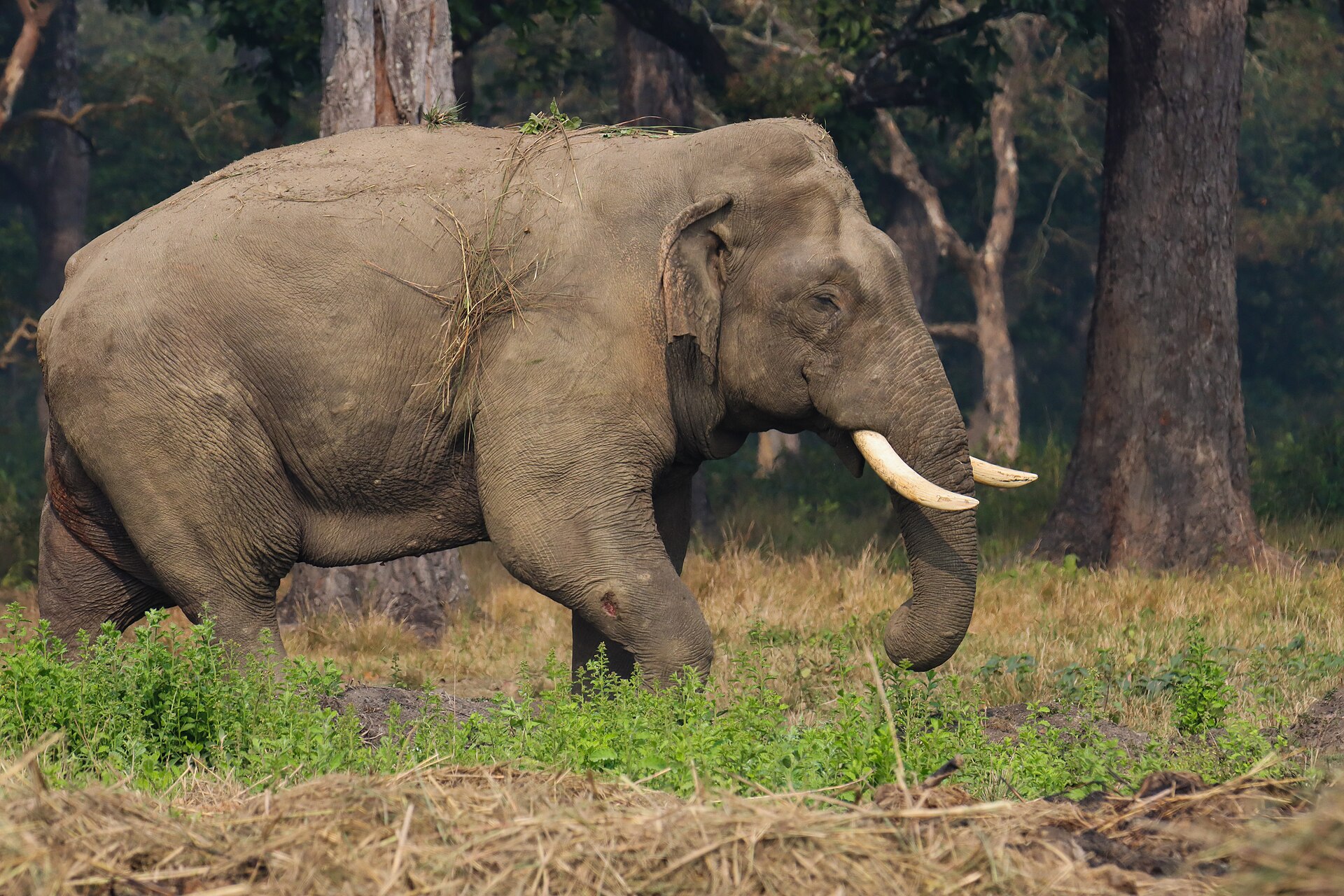
A wild bull elephant named “Ronaldo” at the Elephant Breeding Center in Chitwan National Park. Photo: Shadow Ayush/Wikimedia Commons.
CHITWAN, Nepal — The death of a wild elephant named Ronaldo in the buffer zone of Chitwan National Park has revived an unusual question in Nepal: Why are wild elephants so often given the names of famous athletes, celebrities and public figures?
Ronaldo, a 53-year-old bull elephant, was found dead along a road beside the Khageri Canal, about 600 meters south of the Tikoli Buffer Zone Community Forest office and on the route toward Beeshazari Lake. Officials at Chitwan National Park believe he died after coming into contact with an electrical current.
For years, Ronaldo had roamed Chitwan National Park and surrounding forest areas, including the Khorsor forest. But he was known for more than his movements through the forests.
His name came from one of the world’s most famous soccer players. And among conservation officials in Chitwan, Ronaldo was also remembered as a remarkably successful wild breeding bull.
Of the 69 elephant calves born at the Sauraha Elephant Breeding Center during the period when Ronaldo was active in the area, records show that 38 were his offspring.
So Ronaldo’s story was not only about a football star. It was also about one of Chitwan’s most prominent wild breeding elephants.
A Name From the World Cup
The elephant was first seen during the 2002 World Cup, when Brazil’s striker Ronaldo scored eight goals and won the tournament’s Golden Boot.
That was how the elephant acquired his name.
Manpuran Chaudhary, a branch officer at the Elephant Breeding and Training Center in Chitwan National Park, said the name was inspired by the football player but also came to reflect the elephant’s behavior and breeding ability.
“Just as Ronaldo could reach all parts of the field and score goals, this elephant would travel to find female elephants — sometimes to Sauraha, sometimes to the elephant sheds and sometimes toward villages,” Mr. Chaudhary said. “Just as Ronaldo had the ability to score goals, the elephant had a high reproductive capacity. That is why it was named Ronaldo.”
His breeding record became particularly associated with the Sauraha Elephant Breeding Center. Of the 69 calves born there during Ronaldo’s period of activity, 38 were recorded as his offspring.
Mr. Chaudhary said Ronaldo would also drive other bulls, including Dhurbe and Govinde, out of his territory.
“Although Ronaldo was a wild elephant, he was honest and wise,” he said.
Dhurbe became famous for a very different reason: the destruction and disturbances he caused in Chitwan National Park.
How Does an Elephant Get a Name?
In Nepal, elephant names do not always begin with a celebrity.
According to Mr. Chaudhary, when a calf is born, park officials are immediately notified. The name is traditionally decided on the 12th day after birth, after officials have considered an appropriate name.
The occasion is often marked with a celebration.
Elephants generally live between 60 and 75 years, Mr. Chaudhary said, although bulls tend to die younger than females. One reason is fighting among adult males.
Bulls can be quick to engage one another when they meet, and their anger does not easily subside, he said.
Mr. Chaudhary, who spent 27 years at Parsa National Park, said wild elephants are generally physically stronger than elephants born and raised under human care and can also be more capable breeders.
From the Palace to the Celebrities
Elephant names in Nepal are more than labels used for identification. Over time, they have reflected the country’s political, cultural and social history.
Ganesh Pant, a senior conservation officer at the Department of National Parks and Wildlife Conservation, said elephant calves were once given names sent from the royal palace.
“In the past, elephant calves were named according to names sent from the palace,” Dr. Pant said. “Later, names began to be drawn from conservationists, natural places, celebrities and other sources.”
In some cases, rescued elephants have also been given celebrity names to make them easier to identify, he said.
Today, the decision generally rests with the park warden or the relevant conservation official.
The elephant depicted on Nepal’s 1,000-rupee banknote is named Ram Laxman. A male elephant without tusks is commonly referred to as a “Makuna.”
Royal Names and Republican Names
Until Nepal abolished its monarchy, the royal family had a visible influence on elephant naming.
Names were sometimes suggested by the palace and selected according to the month in which an elephant was born and its sex. Male elephants were commonly given names ending in “Gaj” or “Prasad,” such as Birendra Gaj, Gyanendra Gaj and Dipendra Gaj.
Female elephants often received names ending in “Kali” or “Mala,” including Komalkali, Aishwaryamala, Himanikali, Shrutikali and Preranakali.
The naming process also had a ceremonial dimension. On the 12th day after a calf’s birth, a priest would be invited to conduct a ritual similar to a Hindu naming ceremony.
That tradition changed after Nepal became a republic.
National park officials, rather than the palace, began deciding the names. Political events, natural places, conservationists, government employees and protected areas increasingly became sources of names.
Names such as Loktantrakali, Sheshchandragaj, Khorsorgaj and Simsargaj emerged during this period.
The religious naming ceremony, however, has continued, Dr. Pant said. Some older elephants still carry names associated with the royal family.
Why Name an Elephant After a Celebrity?
Nepal has several examples of elephants named after internationally recognized figures.
One is Leonardo, named after the Hollywood actor and environmental advocate Leonardo DiCaprio. Another is Harry, reportedly named for Prince Harry when he visited Nepal in 2016. The calf was given the name during his visit to Bardiya National Park.
Elephants have also been named in honor of foreign diplomats, international conservationists and other distinguished visitors to Nepal. Names such as Helen, Martin and Philip have been used for elephants associated with foreign missions, conservationists and people working in biodiversity.
Local culture and religious beliefs also continue to influence naming. The suffix “Kali,” particularly for female elephants, remains common.
Names such as Pujakali, Popularakali, Devikali, Aishwaryakali and Rupakali are examples, Dr. Pant said.
In that sense, an elephant’s name can serve as something more than an identifier. It can preserve a fragment of a political era, a famous personality, a conservation campaign, a geographic place or an elephant’s own behavior.
Ronaldo, Romeo, Dhurbe and Govinde
Ronaldo is not the only well-known elephant in Nepal to have a name borrowed from a famous person.
Romeo was another. His name was reportedly inspired by an actor, and conservation officials remembered both Romeo and Ronaldo as highly successful breeding bulls. Both have since died.
Ronaldo’s breeding record was particularly notable. Of the 69 calves born at the Sauraha Elephant Breeding Center during his period of activity, 38 were recorded as his offspring.
That record made him more than a famous name. It connected him directly to the breeding history of Chitwan’s elephants.
Dhurbe and Govinde became famous for different reasons, particularly their behavior in Chitwan.
Ashok Ram, a senior conservation officer at Bardiya National Park, said Ronaldo and Dhurbe once fought in a major confrontation. Dhurbe subsequently disappeared from the area, while Govinde later appeared.
Names such as Romeo, Ronaldo, Dhurbe, Govinde and Yamagaj have become familiar to people who follow Nepal’s elephants. Dr. Ram said breeding capacity and aggressiveness can also influence how wild bulls are identified and named.
A Story Larger Than a Name
A famous name, by itself, is not a conservation achievement.
People may remember an elephant because its name is familiar. But the more consequential questions are whether its habitat remains protected, whether it is healthy, how conflicts between people and elephants are managed and whether the traditional routes used by elephants remain open.
“For Nepal, elephants are not simply wildlife,” Dr. Ram said. “They are an important part of the Terai’s ecosystem, biodiversity and tourism.”
Naming elephants should not be limited to publicity, he said. It can instead become part of broader efforts involving conservation, research, community participation and animal welfare.
Elephants move for many reasons, including reproduction, searching for food, following ancestral routes and finding mates, Dr. Ram said.
A Long History of Elephant Conservation
Elephants have been kept in Nepal since at least the Licchavi period, according to conservation officials. Some elephants are still kept privately.
Nepal established its elephant breeding center in 1985. Officials say Nepal began breeding elephants after India gave Nepal 16 elephants following Nepal’s gift of four rhinoceroses to India. Elephants were later also brought from Thailand.
Dr. Ram said Nepal initially had no separate formal procedure governing elephant names. Over time, names began to reflect conservationists, prominent people, rivers, protected areas and other natural places.
For wild elephants, breeding ability and aggressive behavior can also influence the names used to identify them, he said.
Elephants That Cross Borders
Nepal is estimated to have between 400 and 450 elephants, both wild and domesticated. Of those, roughly 230 to 250 are believed to be wild.
An estimated 100 to 150 wild elephants move seasonally across the Nepal-India border.
Nepal is also believed to have roughly 180 to 200 domesticated elephants. Some are under the management of the government and national parks, while others are used by private tourism operators.
Wild elephants are found in forests and protected areas across Nepal’s southern plains and Chure foothills, from east to west.
The western region, particularly Bardiya National Park and surrounding forests, has one of the country’s larger elephant populations, with more than 100 wild elephants estimated to be present.
In central Nepal, roughly 45 to 50 elephants are believed to inhabit areas around Chitwan National Park and Parsa National Park.
In the east, elephants are found around Bahundangi in Jhapa, the Koshi Tappu Wildlife Reserve and forests in Morang and Sunsari. The population is estimated at roughly 30 to 40, although the number changes as elephants move between Nepal and India.
In the far west, an estimated 25 to 30 wild elephants are found around Shuklaphanta National Park and forests in Kanchanpur and Kailali.
Because elephants regularly cross the international border, determining a permanent population in any one area is difficult.
The number of elephants in Nepal is not static, Dr. Pant said. Seasonal movements, habitat conditions, cross-border migration and the condition of protected areas all affect the population present at any given time.
Ronaldo’s Last Journey
The story of Ronaldo’s name began with the 2002 World Cup. His life, however, unfolded far from the football stadiums of Brazil — in Nepal’s forests, along its rivers and through the search for female elephants.
He traveled to Sauraha, the elephant sheds and areas near villages. He fought other bulls. He defended territory. And he played a significant role in reproduction.
His breeding record remains striking: 38 of the 69 calves born at the Sauraha Elephant Breeding Center during his period of activity were recorded as his offspring.
Then, at 53, he was found dead along the Khageri Canal road.
His name may remind one generation of the 2002 World Cup. But Ronaldo’s story reaches far beyond the football field. It is also a story about the changing relationship among Nepal’s forests, its people and its elephants.
According to park records, Ronaldo was linked to the deaths of 22 people during the decades he spent in the area.
The future of elephant conservation, however, will not be determined by names.
It will depend on protecting natural habitat, expanding and managing forests, reducing human-elephant conflict, controlling illegal hunting, managing disease and animal health, and conducting scientific research. Conservation programs must also involve local communities.
When communities directly experience both the value of wildlife and the benefits of conservation, conservation efforts are more likely to endure.
Ronaldo’s name, then, is no longer simply the identifier of a dead elephant.
It is part of a larger record of how Nepal names its elephants, remembers them and, ultimately, decides how to protect them.