





Who Pays the Price of Climate Disasters? Nepal Prepares for Diplomatic Leadership With a Call for Climate Justice

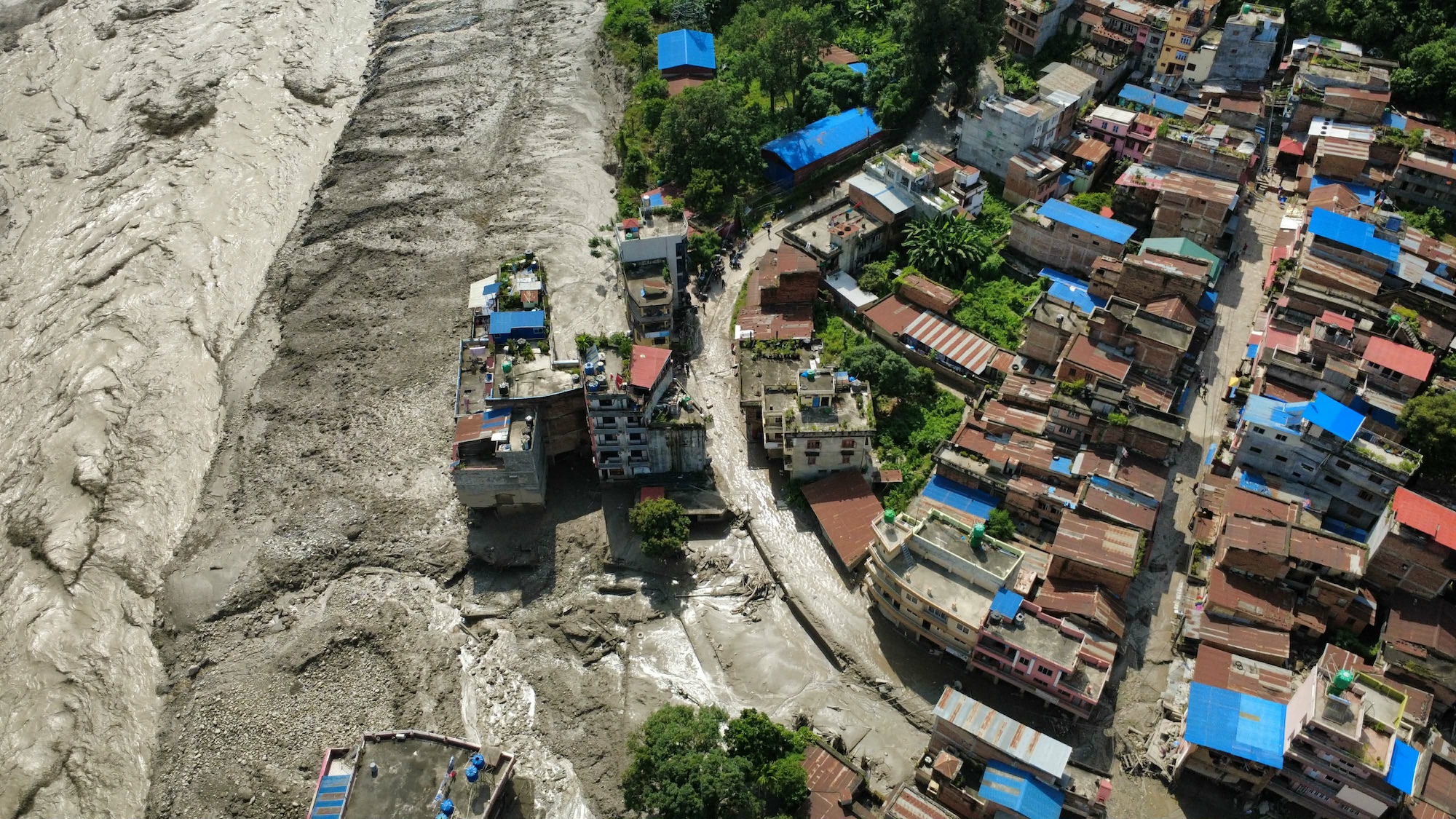
Floodwaters damaged homes and businesses in Trishuli Bazaar, Nuwakot, after a destructive surge from the Bhote Koshi River in Rasuwa. Photo: Dipendra Dhungana/Nepyork.
NEW YORK — After the devastating flood in the Bhotekoshi River in Rasuwa, Nepal is seeking a more active role in climate diplomacy by presenting its losses and risks to the international community as a country disproportionately affected by climate change.
On Aug. 26, a massive ice-and-rock avalanche from the high mountains, followed by a glacial lake outburst flood, affected areas around the Bhotekoshi River. Government officials and experts said the incident exposed growing instability in the Himalayan region, climate-related risks and limitations in early warning systems.
The Nepal government, political leaders and foreign policy experts have described the incident not simply as a flood or weather-related disaster, but as a sign of serious environmental imbalance in the Himalayas. They say countries such as Nepal, which contribute little to global greenhouse gas emissions, are bearing the unequal consequences of activities by high-emitting countries.
They have called for climate justice, action on loss and damage, and greater international responsibility.
Experts say Nepal must now move beyond presenting its suffering at international forums and turn its experience into scientific evidence, diplomatic strategy and regional cooperation.
Nepal Pays a Price It Barely Helped Create
A statement issued by the Foreign Ministry highlighted the fragile environmental conditions in the Himalayan region. According to the ministry, Nepal contributes only about 0.1% of global greenhouse gas emissions, yet it is experiencing the direct and devastating effects of climate change.
The ministry said low-emitting countries are paying an unequal price for the activities of high-emitting nations. It called for effective early warning systems in transboundary river basins and high mountain areas, climate-resilient reconstruction, and the establishment of climate change as an issue of climate justice at international forums rather than allowing it to remain limited to paper commitments.
The government has also stressed the need for more effective scientific studies and monitoring of potential glacial lake outburst floods, avalanches, landslides and floods in the high mountains. An initial technical report from the Department of Hydrology and Meteorology provided details on the timing of the incident and the movement of floodwaters.

Nepal Wants Climate Finance, but It Is Asking a Bigger Question
In an interview with Kantipur Television, Foreign Minister Shishir Khanal said the Bhotekoshi incident was not simply a water- or weather-related disaster. He described it as the result of serious environmental imbalance in the Himalayan region.
Khanal said Nepal and other small, low-emitting countries are paying the price for environmental damage caused by the high carbon emissions of major industrial nations such as China, the United States and India.
Nepal’s immediate financial request, however, must be distinguished from its broader argument for climate justice. Public debate could give the impression that Nepal is asking India, China or the United States to directly pay for the damage caused by the Bhotekoshi flood. That is not Nepal’s formal request.
Nepal’s Finance Ministry has sought assistance from the United Nations Loss and Damage Fund. The fund, established at COP27, is intended to help particularly vulnerable developing countries address loss and damage caused by climate change. This is the first time Nepal has sought assistance from the fund.
It would be incorrect to describe the request as a demand for direct compensation from a particular country for the Bhotekoshi disaster. Rather, Nepal is seeking assistance from an international financial mechanism established to support developing countries affected by climate change.
At the same time, Nepali officials have been raising a broader question of climate justice. Their argument is that countries historically responsible for the largest share of greenhouse gas emissions must assume responsibility toward countries such as Nepal, which have contributed little to emissions but are disproportionately affected by climate change.
This is not a matter of sending a bill for the damage caused by one flood to a particular country. It is a debate about cumulative emissions over decades, structural vulnerability and the international responsibility demanded by climate justice.
Khanal said Nepal should not limit its demands to grants or ordinary development assistance. Instead, he said, it must assert a right to compensation for climate-related damage. He also said the Finance Ministry had begun the necessary correspondence to pursue a compensation claim.
Khanal warned that accelerated glacier melt would affect more than Nepal. He said the food security, drinking water, agriculture, livelihoods and civilization of nearly 2.5 billion people who depend on river systems such as the Ganges and the Trishuli could face a long-term crisis.
He also called for countries in the region to rise above political differences and cooperate to address the shared climate crisis.
Nepal’s demands therefore have two dimensions. The first is immediate and institutional: securing assistance from international funds established to address loss and damage from climate-related disasters. The second is a long-term diplomatic argument: historically high-emitting nations must assume responsibility toward countries disproportionately affected by the climate crisis, and climate finance, technology transfer and loss-and-damage mechanisms must become more equitable.
Nepal is not seeking direct payments from India, China or the United States for the latest disaster. The larger question is how the burden of the global climate crisis should be shared fairly.
A Warning Reached Over a Million People, Yet the Disaster Still Unfolded
Addressing Parliament, Prime Minister Balendra Shah said the Bhotekoshi flood was a serious sign of the growing risks caused by climate change in the Himalayan region.
Because climate change is a global problem, he said, the responsibility for reducing and managing its effects also rests with the international community. He said countries that emit more greenhouse gases and have greater economic capacity should provide the resources and technology needed by countries at risk.

According to Shah, early warnings were sent by mobile phone to about 1.1 million people during the disaster. But he said climate-related disasters can develop unusually and rapidly, making it difficult to predict them fully.
Floodwaters filled tunnels at hydropower projects with silt, creating technical complications for rescue and relief operations, Shah said. He pledged that Nepal would raise the damage caused by the Bhotekoshi disaster, as well as the broader risks created by climate change, at international forums, including the United Nations.
Nepal Needs to Turn Disaster Into Evidence
Political and diplomatic analyst Yubanath Lamsal said temperatures in the Himalayan region are rising faster than the global average. This is melting snow and glaciers and destabilizing the land and rock structures of the mountains, he said.
Lamsal described the Bhotekoshi flood as only one symptom of a much larger crisis. He said five or six other areas in the Himalayan region face similar risks of major disasters.
“Nepal is a country on the front lines of climate change,” he said. “The situation in which Nepal has to suffer the consequences of a crisis created by others’ emissions must end.”
Nepal should not treat every major flood, landslide, avalanche or glacial lake incident only as a national issue of rescue and relief, Lamsal said. It must turn such events into scientific facts and diplomatic evidence.
The government should regularly collect data on the rate of glacier melt, the growing risks from glacial lakes, changes in rainfall patterns and river flows, and the damage disasters cause to communities, infrastructure, agriculture and the economy.
Such evidence could strengthen Nepal’s central argument: The country’s contribution to climate change is minimal, but it is suffering its effects disproportionately.

Climate Diplomacy Cannot Begin at the Conference Table
Nepal has for years raised the effects of climate change in the Himalayan region, glacier melt, glacial lake outburst risks, floods and landslides at the U.N. General Assembly and climate conferences.
But analysts say Nepal’s climate diplomacy has been weakened by changing priorities with each government, the late formation of delegations before international conferences and the failure to maintain issues raised at one conference through the next.
Climate diplomacy is not solely an issue for the Environment Ministry, Lamsal said. It is connected to foreign policy, the economy, energy, forests, agriculture, tourism, infrastructure, disaster management and national security.
He said Nepal needs a permanent, year-round climate negotiation structure. Such a body could prepare for international negotiations, collect scientific evidence, maintain dialogue with other countries, identify potential alliances and present a unified national position at international conferences.
The creation of a high-level climate negotiator or climate ambassador is another possibility. Experts say Nepal needs a permanent mechanism to conduct climate diplomacy throughout the year rather than forming delegations only for the few days of an international conference.
That would require a dedicated budget for scientific research, international legal studies, negotiation training, data collection and the development of international networks.
From Vulnerable Nation to Early-Warning Pioneer
Experts say early warning systems could be one practical area in which Nepal can take international leadership.
Warnings issued before a flood can allow people to move to safer areas. Identifying the possibility of a glacial lake outburst can give vulnerable communities time to prepare. Information about landslide risks can help authorities protect roads, bridges and settlements.
But early warning systems in mountainous areas are complex. Glacial lakes, glaciers, avalanches, river flows, weather and geographical risks are interconnected. Nepal could develop a specialized Himalayan early warning system linking satellite technology, weather forecasting, river-flow measurements, glacial lake monitoring, local communication systems and direct community participation.
Rather than simply seeking financial support for early warning systems, Nepal should propose developing a global model for effective early warning systems in mountain countries, Lamsal said. That could help establish Nepal as a country offering solutions rather than one merely seeking assistance.
For Nepal, Climate Finance Means Grants, Not More Debt
Loss and damage caused by climate change is another important diplomatic priority for Nepal.
Although Nepal’s historical contribution to the climate crisis is minimal, experts say its Himalayan geography makes it highly vulnerable to climate-related risks. They warn that if Nepal must borrow money for post-disaster reconstruction, one crisis could create another economic crisis.
Nepal should therefore strengthen its demand that much of climate finance be provided through grants, that vulnerable countries receive priority and that access to funding be faster and simpler.
At the U.N. climate conference COP29, held in Baku, Azerbaijan, in November 2024, developed countries agreed to take the lead in mobilizing at least $300 billion annually in climate finance for developing countries by 2035. The conference also set an aspirational goal of scaling climate finance for developing countries from public and private sources to as much as $1.3 trillion annually.
For Nepal, grants are more important than loans for adaptation, disaster risk reduction, early warning systems, climate-resilient infrastructure, agriculture and the protection of local communities, Lamsal said.
Nepal Has Already Begun Building Its Climate Case
Nepal’s effort to raise climate justice and Himalayan risks more forcefully at international forums after the Bhotekoshi disaster is not entirely new. During its one-year presidency of the U.N. Economic and Social Council, or ECOSOC, in 2025-26, Nepal identified climate resilience, Himalayan risks and development finance among its key priorities. Nepal’s ambassador and permanent representative to the United Nations, Lok Bahadur Thapa, led the council as its president.

Under Nepal’s presidency, ECOSOC advanced four major priorities: transforming agricultural and food systems, digital inclusion and youth entrepreneurship, climate resilience, and development finance. The issues were directly connected to the shared challenges facing developing, least-developed, landlocked and climate-vulnerable countries such as Nepal.
During the Asia-Pacific Forum on Sustainable Development in Bangkok in 2025, Nepal organized a special event under the theme “From Everest to the Oceans: Disappearing Glaciers and Rising Sea Levels in a Warming World.” The discussion linked rising temperatures in the Himalayan region and accelerating glacier melt with rising sea levels.
The effort showed that Nepal has been presenting the Himalayan climate crisis not only as a national problem or a limited concern of mountain countries, but as an integral part of the global climate crisis. Nepal’s argument is that glacier melt, glacial lake outbursts, floods, landslides and rising sea levels may appear in different geographical regions, but they are all linked to rising global temperatures.
Nepal’s ECOSOC presidency allowed it to connect development, climate change and the mobilization of financial resources on a single multilateral platform. It brought financial access, technology transfer, capacity-building and climate resilience for developing and least-developed countries to the center of international discussions.
The climate justice issue raised after the Bhotekoshi disaster can be viewed as the next phase of that diplomatic continuity. During its ECOSOC presidency, Nepal linked climate resilience and Himalayan risks with the global development agenda. It is now using a disaster such as the Bhotekoshi flood to advance more clearly the issues of loss and damage, climate finance, early warning systems and the responsibility of historical emitters.
From Everest to the Oceans, a Wider Climate Alliance
Nepal could also connect its climate diplomacy on the Himalayan region with the risks faced by marine and coastal countries.
Glacier melt in the mountains and rising sea levels are different manifestations of the same global climate crisis, experts say. Nepal could develop a new international initiative by building a shared agenda between mountain countries and small island and coastal states.
At the first Sagarmatha Sambaad, held in Kathmandu in May 2025, the “Sagarmatha Call for Action” proposed creating a shared voice stretching from the mountains to the oceans and from the highlands to the islands. Experts say Nepal must now turn that idea into a sustained diplomatic initiative.
The “Everest to oceans” concept could establish the connection between mountain and marine crises in international debates. It could also present Nepal not only as a country affected by the climate crisis, but as a country seeking to lead international efforts to find solutions.
The Himalayas Demand Cooperation Across Borders
Nepal’s climate diplomacy should not be limited to seeking financial assistance from developed countries, experts say. It must build a shared agenda with South Asian countries, Himalayan states, least-developed countries, small island nations and other countries of the Global South.
Climate dialogue with India and China is particularly important for Nepal. The Himalayas, river systems, water resources, energy, disaster risks and climate impacts in border areas are shared concerns among all three countries.
These issues can be advanced as shared risks and shared solutions rather than through political competition, Lamsal said. He added that Nepal could increase its influence in international negotiations by building alliances with countries facing similar climate risks.
Before Asking the World for Help, Nepal Must Prepare at Home
Before seeking compensation or assistance from the international community, Nepal must strengthen its own preparations, Lamsal said. He said the government still lacks a clear vision, institutional structure and actionable strategic framework for addressing the climate crisis and mobilizing potential international resources.
He called for an immediate national climate action plan covering environmental, economic, social and physical infrastructure concerns. The plan should include both immediate rescue, relief and reconstruction in affected areas and a long-term framework for protecting the entire Himalayan ecosystem.
Experts say the plan should prioritize regular scientific monitoring of glaciers, glacial lakes, landslides and floods in the high mountains. It should also establish effective early warning and information-sharing mechanisms for transboundary river systems.
Climate-resilient reconstruction and the social and economic recovery of affected communities should be important parts of the plan. Nepal also needs to create a national record of climate-related loss and damage, experts say.
The government should prepare clear projects and financial frameworks to mobilize international climate funds, technology and technical assistance. Nepal’s climate diplomacy should also operate year-round through a permanent structure rather than temporarily around conferences or changes in government.

Nepal Wants to Move From Climate Victim to Diplomatic Leader
The Bhotekoshi disaster has brought Nepal not only the immediate challenges of rescue and reconstruction, but also the need to redefine its diplomatic strategy around rising risks in the Himalayan region, the security of transboundary river systems and climate justice.
Nepal has long described itself as a country suffering the effects of climate change. It must now turn that experience into evidence, that evidence into diplomatic action, and that diplomatic action into international cooperation and financial commitments.
But Nepal’s argument must also remain clear. Seeking assistance from established international funds after a disaster such as Bhotekoshi is one matter. Raising the long-term responsibility of historically high-emitting countries is another. Presenting the two as a single claim could obscure the real objectives of Nepal’s climate diplomacy.

Experts say Nepal’s priorities should be clear: placing the Himalayan region at the center of the global climate agenda; linking the 1.5-degree Celsius target to the protection of the mountains and human life; seeking adequate, grant-based financing for loss and damage; advancing an international initiative on early warning systems for mountain countries; and building a shared “Everest to oceans” climate alliance.
This work cannot be limited to one conference or one government’s term, experts say. Nepal can institutionalize its climate diplomacy only through a permanent structure, adequate funding, scientific evidence, skilled negotiators, high-level political leadership and strong alliances with the Global South.
Nepal’s challenge is no longer simply to tell the world about its crisis. It is to establish a leadership role in international efforts to find shared solutions to a climate crisis stretching from the mountains to the oceans.
This coverage was made possible by a grant from URL Collective, a nonprofit supporting local, diverse media.