

Why the U.S. Did Not Send a Search-and-Rescue Team to Nepal: Luke Ortega Explains (Interview)

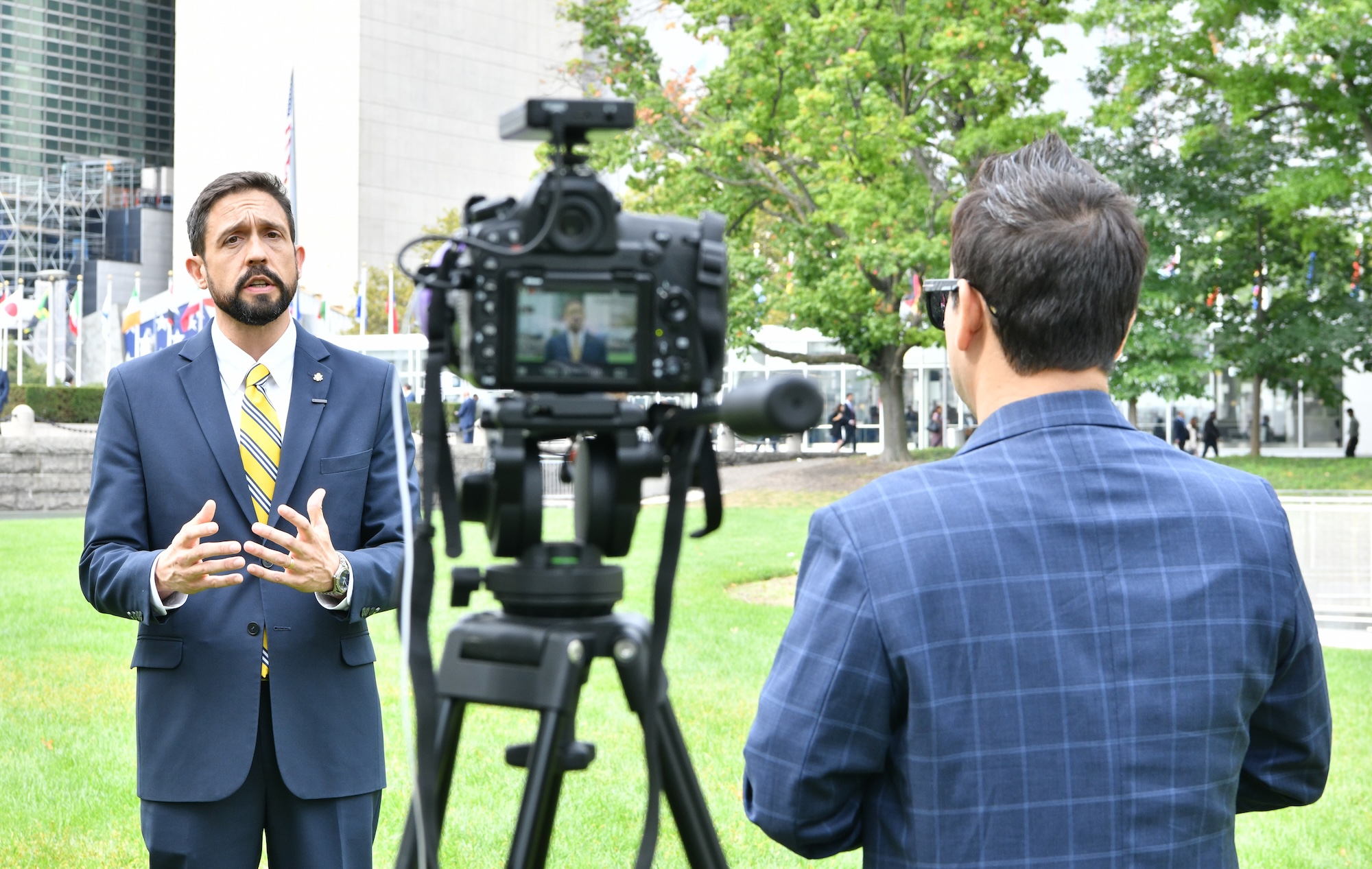
Luke Ortega, deputy spokesman for the U.S. Department of State, speaks with NepYork Editor-in-Chief Kishor Panthi about the U.S. response to Nepal’s devastating floods, humanitarian assistance, missing Americans and Nepal’s call for climate justice. Photo by Rajan Kafle for NepYork.
The United States has provided more than $36 million in assistance to Nepal following the devastating floods that struck the country on Aug. 26, with support ranging from immediate humanitarian aid and food assistance to permanent bridges, medical and sanitation supplies, disaster-recovery drones and forensic assistance to help locate and identify missing people. In an interview with NepYork Editor-in-Chief Kishor Panthi, Luke Ortega, currently serving as Deputy Spokesman for the U.S. Department of State, discussed the U.S. response, the decision not to deploy a search-and-rescue team, additional relief for communities affected by the disaster, climate justice and the status of about 70 Americans who remain unaccounted for.
KISHOR PANTHI: Could you tell me about the U.S. response to the disaster in Nepal following the devastating floods?
LUKE ORTEGA: Yes. Following those devastating floods in Nepal on August 26, the United States responded rapidly and efficiently, working with the authorities of Nepal in order to respond to that tragic disaster.
I want to give a sense of just what that response looked like coming from the United States. We have been able to provide more than $36 million in support to Nepal to respond to that flooding. And I want to explain what that means.
We were able to initially provide about a million dollars in immediate humanitarian assistance to affected communities that were impacted by the flooding. We were also able to look toward the medium term and to be able to provide $3 million in food assistance that’s going to help to feed more than 10,000 families for three months.
We’ve provided as well approximately $10 million that we were able to announce just this week in order to produce custom-made bridges that are going to be permanent bridges made by U.S. companies to help replace some of that infrastructure that was damaged.
We’ve also increased an additional $8 million in terms of humanitarian supplies, sanitation, shelter, immediate health needs, and we’ve been able to provide $13 million in drone support to be able to support Nepal moving forward.
And I want to note as well a really key element of this, which is a million dollars that has come for forensic support for things like DNA kits. We take this very seriously in the United States. There are 70 Americans who remain unaccounted for following this flooding, and this forensic support, along with the participation of specialists from the Federal Bureau of Investigation, the FBI, will be able to help get families both in the United States and Nepal the answers they need.
KISHOR PANTHI: So many schools have been destroyed, and health posts have also been destroyed. Are you planning to send more relief to Nepal? Because this relief is focused on infrastructure development, such as bridges. Are you planning to send more relief for schools, health facilities and other infrastructure?
LUKE ORTEGA: Well, I want to emphasize that much of the humanitarian support that’s already been delivered is directed to try to help families that have been impacted by this flooding.
About $185,000 of the funding that went through Catholic Relief Services to Nepal was specifically aimed at helping children and families who had been impacted and creating resources for them in order to be safe in the immediate term there.
This is really an issue that has touched the hearts of Americans around the country. I’ve had the opportunity to talk to Americans around the country following this devastating flood, and it is something that has been really impactful for so many Americans who want to be able to help.
I want to emphasize that all of the U.S. support that is being delivered is done so in consultation, in conversation, with the authorities of Nepal, where they are able to identify the areas with need, and then the United States is acting and being proactive as well to be able to meet those needs.
KISHOR PANTHI: The United States couldn’t send a rescue team to Nepal. If the U.S. had been able to send a rescue team, do you think more lives could have been saved? Why didn’t you send a rescue team to Nepal?
LUKE ORTEGA: So, I want to again emphasize that the support that has come from the United States has come in consultation with the authorities in Nepal.
Initially, that’s true. The United States offered a search-and-rescue team, and at the time it was determined by the authorities in Nepal that that was not necessary for their needs there. We respected that, and we continued to provide really significant support in the immediate days following that terrible flooding.
I’ve mentioned some of the big-dollar things, but there’s a lot of very practical things that happen as well. The United States was able to deliver, for example, front-end loaders. If you think of sort of small bulldozers to help clear roads and move away some of that mud and debris, we were able to provide, for example, solar power generators to provide reliable electricity to communities that were impacted by the flooding.
And it was wonderful to see the whole embassy community, our embassy in Kathmandu, as well as our partners within the Nepali community, coming together to be able to provide three truckloads of support to impacted communities that they were able to locally provide to them as well.
KISHOR PANTHI: Does the United States view the recent disaster in Nepal as a global warning, as Nepal’s Prime Minister Shah framed it?
LUKE ORTEGA: Our priority is to be able to respond to disasters rapidly, to be able to respond to them effectively, and that’s something that I think we’ve been able to demonstrate in the case of the flooding in Nepal.
We’ve seen that as well with the Ebola outbreak in Africa, as well as with significant earthquakes in Colombia and Venezuela. The United States has been able to send, within hours after these terrible events, support directly, and that has to do with the way that we have worked to modernize, to streamline and to improve our ability to respond to disasters by really centralizing all of the actors involved in this.
Get them all around the same game table to be able to identify needs and respond rapidly to them, and we’re proud to be able to support Nepal in this moment.
KISHOR PANTHI: The Nepali prime minister’s speech was focused on climate change and climate justice yesterday. About 70% of his speech was focused on climate justice and climate change. Nepal is seeking climate justice. Will the United States help Nepal in its efforts to obtain climate justice?
LUKE ORTEGA: We continue to engage with Nepal authorities at the highest levels. Secretary of State Marco Rubio has spoken to leaders in Nepal. Our diplomats there at our embassy have been able to speak to the prime minister and to those around him.
We remain in constant contact there, and we really want to be able to identify concrete needs and then to be able to provide support to Nepal to be able to meet those needs.
KISHOR PANTHI: Do you have any message for the families of Americans who are unaccounted for? There are around 70 Americans who are unaccounted for.
LUKE ORTEGA: That’s right. I want to make sure that these numbers are clear. We are aware of 70 Americans who are unaccounted for. We’re also aware of 18 Americans who’ve been able to make it to safety. And at this point, we’re unable to confirm American deaths as a result of this flooding.
But as I mentioned, this is part of the reason why at the State Department, we are working in order to provide that forensic support to get those answers. We understand that at this point they may be hard answers, but they are important answers for families to get.
We are working to be in proactive contact with Americans who have been impacted, and I want to encourage any Americans who need to be in contact with the State Department to reach out to us at travel.state.gov to be able to get into contact with us and to get into contact with the office that works with American citizens impacted by this unfortunate event.
KISHOR PANTHI: The Nepali community in the United States is seeking Temporary Protected Status, or TPS, following the disaster in Nepal. The United States designated TPS for Nepal after the 2015 earthquake as well. So, right now, they are seeking TPS again. I know the Department of Homeland Security will make the decision on this, but I think it will also consider a report from the U.S. Department of State. Do you have any comment on this?
LUKE ORTEGA: I have nothing to announce about this particular area. As you mentioned, this will fundamentally be a decision for the Department of Homeland Security.
As I mentioned, I have had the opportunity to engage with Americans around the country, including in cities with significant populations of people from Nepal. We understand the pain that so many people are feeling, and that’s why the United States has mobilized this support to be fast and effective, to provide the assistance that we can.