



Stench of Decomposing Animals and Human Remains Raises Risk of Health Crisis in Flood-Hit Nepal


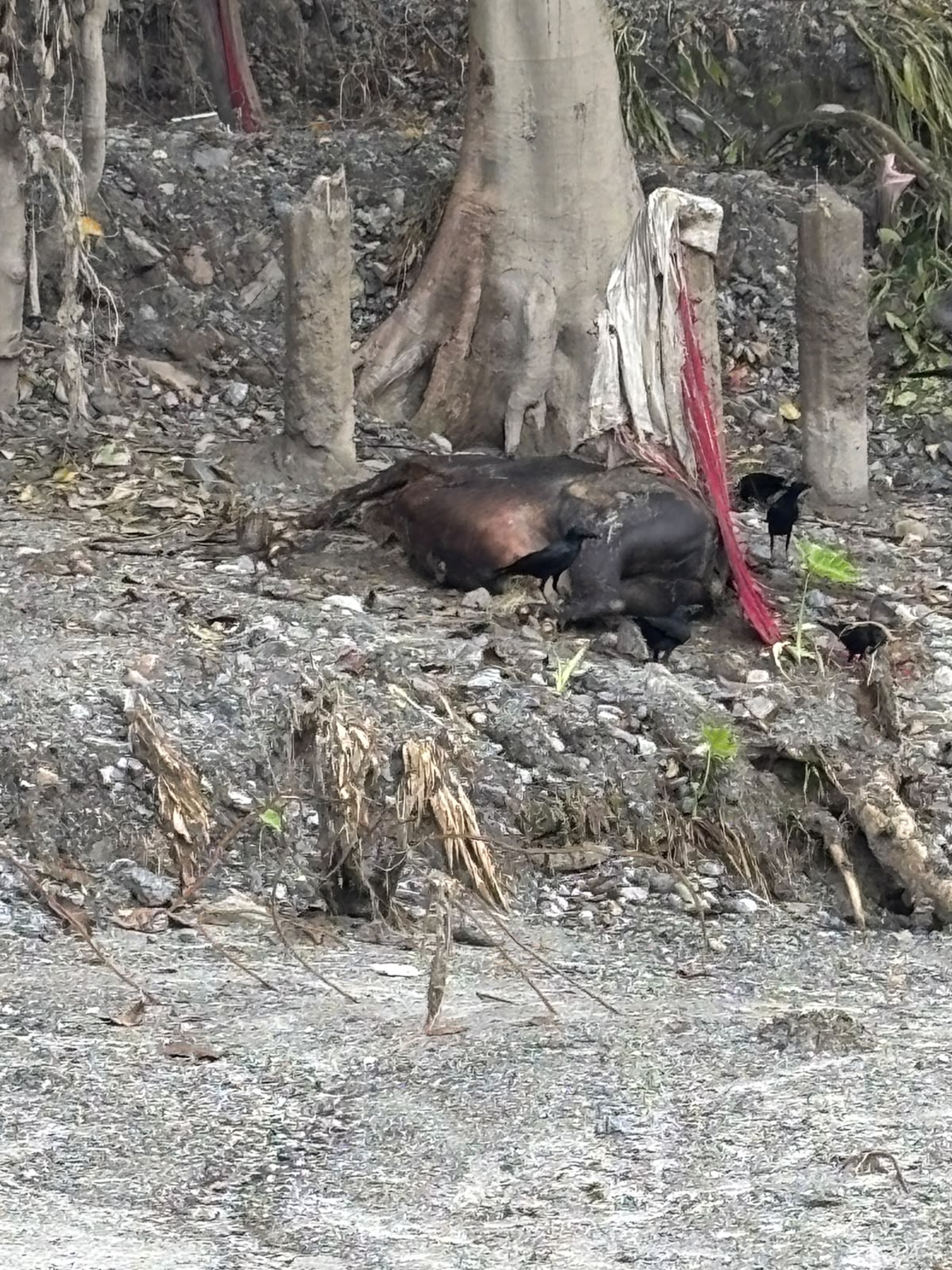
Crows gather around the carcasses of decomposed livestock in Betrawati, Rasuwa, after the flood. The failure to dispose of the remains has increased the risk of foul odors and the spread of infection in the affected area. Photo: Danda Gurung
A journalist’s account from the disaster zone
RASUWA, Nepal — In Betrawati, a market town in Nepal’s Rasuwa district swept away by floods, homes, roads, livelihoods and nearly all signs of human existence have been buried in mud.
The stench of decomposing livestock, unrecovered human remains and ruined food supplies — compounded by the lack of relief reaching some affected settlements — is raising the risk of a secondary health crisis.
Journalist Danda Gurung, who recently returned from Betrawati and other flood-hit areas of Rasuwa, said the devastation was worse than any disaster he had previously witnessed.
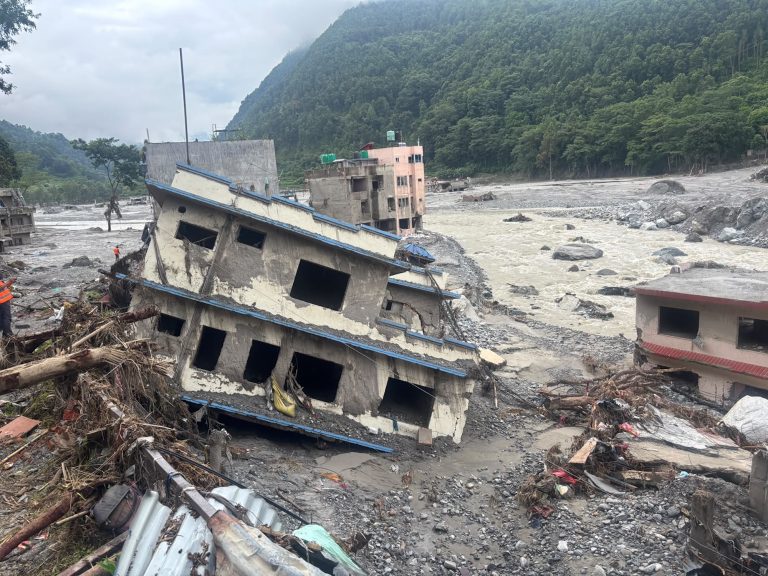
In Betrawati, the flood turned the market into a wasteland. Most homes were swept away, and some structures disappeared entirely. Temples, schools, financial institutions and other public and private buildings were also destroyed.
“Yesterday’s Betrawati market has become a riverbed today,” Gurung said. “No house is intact. In some places, there is no trace of the structures that once stood there.”

Rescue Remains Difficult
Gurung said the flood left large amounts of mud and debris across Betrawati. Some houses have been buried up to their second or third floors. Rescue workers and local residents have struggled to enter many areas because of unstable mud and marshy ground.
The bodies of 24 people were recovered from a single house several days ago, he said. A woman was rescued alive nearly 10 days after the flooding, an incident that highlighted both the difficulty of the rescue operation and delays in reaching affected people.
“Rescuing someone alive after 10 days is a reason for happiness,” Gurung said. “But the fact that she could not be rescued for 10 days also reflects a failure.”
He said some people may still be buried in the mud. Because damaged homes are difficult to enter and search, authorities have not been able to establish the exact number of missing people.
Local residents have grown exhausted while searching through the mud for the remains of relatives, Gurung said. The failure to remove animal carcasses buried by the flood has caused a severe stench and increased the risk of disease.

Risk of Secondary Health Crisis
The mud, decomposing livestock and unrecovered human remains have spread a foul odor across the affected area. The destruction of food supplies and the lack of adequate waste management have also increased the risk of food shortages and disease, Gurung said.
“Some animal carcasses have decomposed, and crows are feeding on them,” he said. “They have not been properly managed. This could lead to an epidemic.”
The affected communities also lack adequate drinking water and food, he said. Conditions are particularly poor at temporary holding centers where displaced residents are staying.
“There is a cemetery-like silence in the affected area,” Gurung said. “People are believed to still be buried in the mud while the bodies of livestock decompose.”
12-Hour Journey to Deliver Aid
Damage to sections of the main road and bridges linking Bidur and Rasuwa has made it difficult to reach the district, Gurung said. Roads running along the river have been destroyed in several places, forcing travelers to use remote mountain roads.
It took his team about 12 hours to reach Betrawati, he said.
With the main road blocked, relief supplies must be transported along remote mountain roads. Large trucks have become stuck at several points, requiring local residents to push or pull them. Some trucks carrying relief supplies have been forced to turn back to Bidur, Gurung said.
“Delivering relief to Rasuwa is extremely difficult right now,” he said. “Large trucks are getting stuck in several places. Some trucks carrying relief supplies have been unable to move forward and have returned to Bidur.”
According to Gurung, a local ward chairperson said no relief had reached Ward No. 1 of Rasuwa nearly 12 days after the flood. Although relief supplies had been collected at a central location, they had not been distributed to individual wards, he said. About 400 flood victims were still without food, according to the local official.
Gurung said the account was based on the ward chairperson’s statement.
The inability to transport relief by road and the lack of regular helicopter deliveries have left residents of remote settlements in an increasingly desperate situation, he said.
Shortages of Water and Shelter
Gurung said Bidur can be reached relatively easily from Kathmandu in about two to two and a half hours, but the situation in Rasuwa is different. Damage to roads and bridges has made it difficult to deliver relief, drinking water and food to affected communities.
Some settlements across the Trishuli River in Nuwakot and Dhading are also facing serious problems, he said. Conditions at temporary holding centers are particularly poor, with shortages of drinking water, food and other basic services.
Death Toll and Missing Persons Unclear
The government reported that more than 1,350 bodies have been recovered and that nearly 4,000 people remain out of contact. However, Gurung said his observations from the disaster zone suggested that the number of missing people could be higher.
The exact number remains unclear because entire families in some areas have been killed or displaced, leaving no one to report deaths or disappearances, he said.
Some people who had traveled to India or other parts of Nepal for work may have returned to their home areas without their families’ knowledge, further complicating efforts to identify the missing, Gurung said.
The United Nations has reported that about 85,000 people were affected by the floods.
“The videos and photos we have seen on social media are only a small glimpse of the real situation,” Gurung said. “The reality on the ground is even more devastating and heartbreaking.”
‘Water Can Reduce Everything to Nothing’
Gurung, who witnessed Nepal’s decade-long civil war and the devastating 2015 earthquake, said the destruction caused by the floods appeared worse than either of those disasters.
Water has destroyed entire settlements, wiping out homes, farmland, public structures and social life all at once, he said.
“When water causes destruction, it reduces everything to nothing,” Gurung said.
Residents of Betrawati are grieving and living in fear and uncertainty, he said. Many have lost their homes, farmland, livestock, relatives and livelihoods. Their immediate priority is not planning for the future but staying alive and searching for missing family members, he said.

Climate Change Questions
Gurung said the disaster — which has been linked to falling ice, changes in glaciers and glacial lakes, and landslides — should be viewed through the lens of climate change.
Nepal contributes little to global carbon emissions, yet its communities are suffering the consequences of climate-related disasters, he said.
“We have protected nature and worshipped the mountains and forests,” Gurung said. “Yet countries that emit more carbon are causing countries such as Nepal to face a humanitarian crisis.”
The disaster should be viewed not only as a natural catastrophe but also as an issue of climate justice, he said.
Need for Safe Reconstruction
Gurung said scientific studies are needed to determine whether settlements should be rebuilt in their original locations or moved to safer areas.
The survivors of the disaster are still in deep grief and are not yet in a position to think about resettlement or reconstruction, he said. They have lost not only their homes but also their farmland, livelihoods and social networks, making recovery particularly difficult.
Some residents do not want to leave their ancestral homes. The government must therefore develop practical and sensitive policies, Gurung said.
A home is tied to a family’s history, emotions and identity, he said. Any relocation plan should prioritize safe resettlement rather than forced displacement.
Settlements along rivers, on riverbanks and in landslide-prone areas should be assessed scientifically before reconstruction begins. Gurung also called for early-warning systems, hazard mapping and effective emergency-response mechanisms that reach local communities.
Children’s Education and Mental Health
The education and mental health of children affected by the floods must be addressed immediately, Gurung said. Schools have been damaged, and many children have lost their homes and family members. Special programs will be needed to help them return to school, he said.
According to the United Nations Children’s Fund (UNICEF), about 22,000 children have been affected, including 10,000 of school age. Temporary classrooms, educational materials, psychosocial counseling and safe shelter should be provided, Gurung said.
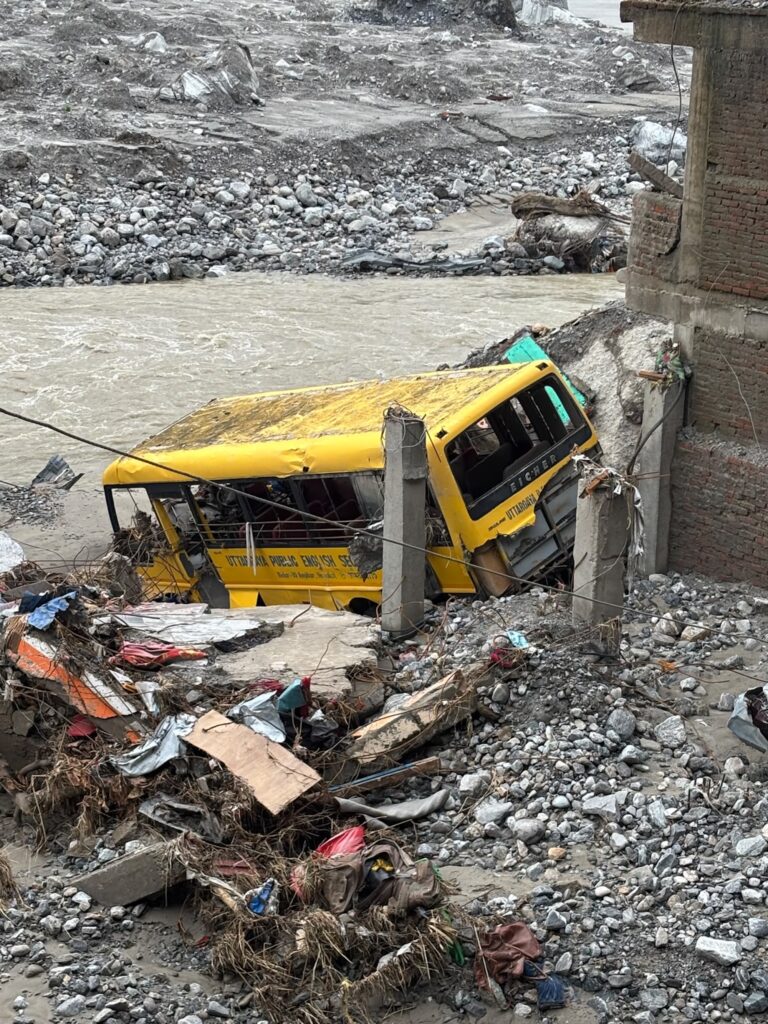
“This is not simply an event in which a few thousand people lost their homes,” Gurung said. “It must also be viewed from the perspective of how to protect an entire society and human civilization.”
He said authorities must immediately focus on rescue operations, the management of human and animal remains, safe drinking water, food, health care and shelter. Only after those needs are addressed can affected families begin rebuilding their livelihoods and working toward safe resettlement and long-term reconstruction.