






Families in Nepal Bid Farewell to Flood Victims With Grass Effigies as Bodies Remain Missing


An elderly father performs the final rites over a kusha grass effigy made to symbolize his son, who went missing in the flood, at Pashupati Aryaghat in Kathmandu. Photo: Dipendra Dhungana
KATHMANDU, Nepal — Nine days after a devastating flood struck Nepal’s Bhote Koshi River on Aug. 26, thousands of families are still waiting for news of their loved ones.
According to Nepal’s National Disaster Risk Reduction and Management Authority, 1,259 people have died and 5,053 remain missing in the disaster. The identities of more than 1,000 recovered bodies have yet to be confirmed.
As the death toll rises and search efforts continue, many families face an especially painful reality: They have not found the bodies of their loved ones.
There is no body. No final glimpse of a familiar face. For some families, there is not even formal confirmation of death.
After days of searching without results, some families have begun performing last rites according to Hindu tradition using effigies made from kusha, a sacred grass.
The mourners gather, but there is no body. The funeral fire burns, but the loved one is absent. There are tears, but no opportunity for a final farewell.
According to New York-based Hindu priest Uddhav Shastri, Hindu tradition allows families to perform funeral rites using a kusha effigy when a body cannot be found. But before proceeding, the family’s senior members must conclude that the missing person is no longer alive, he said.
“Once the family is certain that the person has died and there is no hope that he is alive, the key members of the family must sit together and reach the conclusion that the person has died and will not return,” Shastri said.
The effigy is then treated as a symbol of the deceased and cremated, he said.
“An effigy in the shape of a person is made from kusha and burned as if it were the person’s body,” Shastri said.
Kusha is regarded as sacred in Hindu rituals and is used in a range of religious ceremonies. When a body cannot be recovered, the grass effigy serves as a symbolic substitute during funeral rites, Shastri said.

“According to the scriptures, the prescribed rites are not complete until the body is cremated,” he said. “When the body cannot be found, the effigy is used as a symbol and the rites are performed.”
Still, completing the ritual does not end the family’s pain. Without a body, relatives are left to rely on memories of their loved ones — their voices, faces and the days they spent together.
“They remember the person’s voice, face and the days they spent together, and bid farewell while treating the kusha effigy as that person,” Shastri said.
A Father Lights His Son’s Funeral Fire
A scene at Pashupati Aryaghat, a cremation site in Kathmandu, reflected the depth of that pain.
A 70-year-old father stood quietly, staring toward the cremation area. In front of him was a kusha effigy representing his 42-year-old son, Subas.
The father was performing his son’s final rites — but his son was not there.
Subas, who worked in the trekking industry, had been taking tourists to Tibet’s Mount Kailash and Lake Manasarovar when he went missing in a devastating flood in Rasuwa district. His body had not been found after the flood.
The search continued. His family waited. No news came.
Finally, relatives made a kusha effigy and performed Subas’ funeral rites according to Hindu tradition.
For his elderly father, the moment was far more than a religious ceremony. He was grieving the death of his son while also confronting the anguish of never seeing his body.
Subas is survived by his wife and two children.
For them, the flood did not simply take a family member. It left the future of the entire family uncertain.

Five Family Members Bid Farewell
Amid similar grief, journalist Nirajan Paudel’s family has performed funeral rites for five missing relatives using kusha effigies.
Paudel’s father, Basudev; mother, Goma; uncle, Himalaya; aunt, Uma; and sister, Himani, were swept away from their home in Betravati, Vidur Municipality-7, in Nuwakot district.
After five members of the same family went missing, security personnel and local residents conducted a sustained search. Relatives waited, hoping they would be found alive.
But there was no sign of any of them. After seven days of searching, the family made kusha effigies and began the funeral and mourning rites.
For Paudel, the farewell remains incomplete.
“I spoke with my mother just two days before the flood,” he said, overcome with emotion. “My wife would regularly ask about household matters and our well-being. During our regular conversations, we would talk about food, health and ordinary daily activities.”
That routine conversation has become his final exchange with his mother.
The flood took not only five members of Paudel’s family but also the familiar world of his birthplace. Neighbors and relatives were among those affected by the disaster.
Paudel has not been able to return to his village since the flood.
“I have not been able to gather the courage to go and see that place, where there is not even ground left to stand on,” he said.

The Farewell Does Not End the Waiting
Burning the kusha effigy completes one stage of the religious rites. But the waiting in the family’s heart does not end so easily.
Shastri said Hindu scriptures also provide procedures for cases in which a person who has been presumed dead later returns alive. If a body is found after funeral rites have been performed using a kusha effigy, the body can be cremated without repeating the entire ceremony, he said.
“If the body is found after the rites have been completed, the body must be cremated, but the rites do not need to be performed again,” Shastri said. “The same person does not need to undergo the rites twice.”
These religious practices give families a way to complete the rituals required by their faith. But emotional grief has no fixed timetable.
Whether it is the elderly father at Pashupati Aryaghat lighting a funeral fire for a kusha effigy in place of his son, or Paudel bidding farewell to five family members without their bodies, the pain is the same.
They have said goodbye without ever seeing their loved ones one last time.
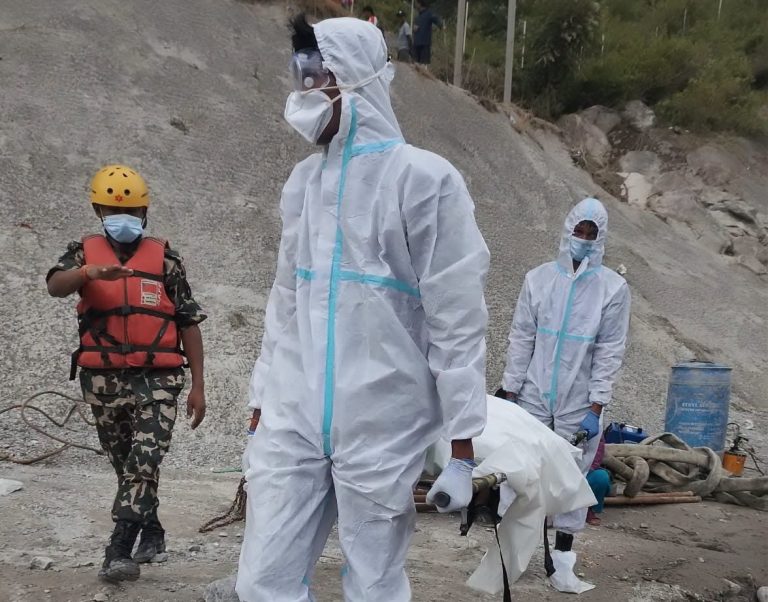
Behind the figures — 1,259 deaths, 5,053 missing people and more than 1,000 unidentified bodies — are thousands of unfinished stories.
For some, a son may still come home. For others, a mother may still call from the other end of the phone to ask how they are doing. For some, a husband and father of two may still be imagined as someone who is simply away on a journey and will return.
The kusha effigy has been burned. The mourning rites have begun. The religious ceremony has moved forward.
But the heart still struggles to accept the final farewell.
The bodies have not been found. And where there is no body, grief often survives alongside hope.
This coverage was made possible by a grant from URL Collective, a nonprofit supporting local, diverse media.