






Nepal Flood Rescue Effort Continues as 939 Bodies Recovered, Nearly 4,000 People Remain Unaccounted For


Nepali Army personnel conduct search-and-rescue operations in flood-affected areas of Rasuwa. Photo: Nepali Army
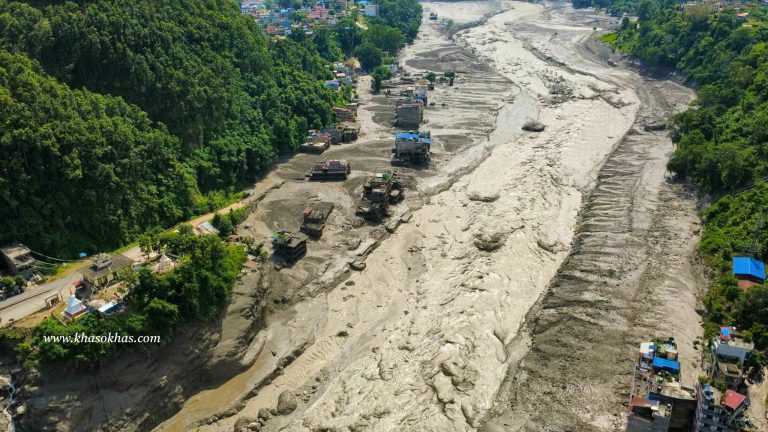
Nepali authorities intensified search and rescue operations Monday after catastrophic flooding along the Bhotekoshi River in northern Nepal killed hundreds of people, destroyed bridges and roads, and left nearly 4,000 people out of contact.
The National Disaster Risk Reduction and Management Authority said 939 bodies had been recovered in flooding centered in Rasuwa district, near Nepal’s border with China. Another 3,925 people remained out of contact as rescue workers searched affected settlements, hydropower facilities and river corridors.
The disaster authority said a roughly 1-square-kilometer block of ice collapsed in the northern section of the Lhende Khola, a river along the Nepal-China border, on Aug. 26. The collapse generated tremors comparable to a magnitude 5.2 earthquake and triggered severe flooding downstream in the Bhotekoshi and Trishuli river areas, causing widespread damage.
The National Disaster Risk Reduction and Management Authority said 939 bodies had been recovered as of 7 p.m. Monday, local time, while 3,925 people remained out of contact following the flooding centered in Rasuwa district, near Nepal’s border with China. Rescue workers continued searching affected settlements, hydropower facilities and river corridors.

Authorities have deployed more than 21,000 security personnel for the operation, including about 8,900 members of the Nepali Army, 7,900 police officers and 4,200 Armed Police Force personnel. The government has also activated a command post and 15 emergency coordination groups to oversee medical care, communications, roads, electricity and other recovery needs.
More than 11,300 people have been rescued so far, authorities said. The Nepali Army has conducted 499 helicopter missions, including 88 flights Sunday, and evacuated 3,657 people by air — 3,404 Nepalis and 253 foreign nationals. Private-sector operators have conducted 29 additional flights from Kathmandu.
Nepali, Indian and Chinese rescue teams have been deployed to hydropower projects in the region, including Trishuli 3A, Trishuli 3B, Upper Trishuli, Chilime, Rasuwagadhi and Langtang, the agency said. The mountainous region has numerous hydropower plants and is also used by foreign trekkers and visitors traveling near the Chinese border.
The government said 592 foreign nationals remained out of contact, along with 164 Nepalis who had been traveling with foreign tourists. Officials also reported that three people connected to Langtang National Park and three quarantine-office personnel were among those missing.
3,458 Displaced People Sheltering in 27 Temporary Camps
At least 3,458 people displaced by the flooding are sheltering in 27 temporary holding camps in Rasuwa and neighboring Nuwakot district, according to the disaster authority.
Nuwakot has 15 camps housing 2,278 people, while Rasuwa has 10 camps sheltering 1,180 people, the report said. The figures do not account for all temporary arrangements, and the agency did not immediately explain the discrepancy between the number of camps listed by district and the overall total of 27.
Relief collection centers are operating in Kathmandu, Nuwakot and Rasuwa. Supplies have been delivered by air and road and include tents, blankets, bedding, water purifiers, hygiene kits, food, medicines, protective equipment, fuel and rescue gear.
The government said it had allocated $600,000 for search, rescue and relief operations in Rasuwa, Nuwakot and Dhading districts, covering 15 affected local governments.

However, local authorities said many communities still faced severe shortages. In parts of Rasuwa, officials reported an urgent need for tents, staple foods such as rice and lentils, and solar batteries. Tarakeshwar Rural Municipality in Nuwakot reported that some affected areas had not received relief because shelters were unavailable. Several communities in Dhading said they urgently needed drinking water.
Officials said they were using a digital tracking system to manage incoming aid and reduce duplication. Air-delivered supplies are being handled at an emergency warehouse at Tribhuvan International Airport, while road-delivered goods are being managed at collection centers in Samakhusi in Kathmandu, Battar in Nuwakot and Dhunche in Rasuwa.
Health Concerns Grow as Officials Monitor Fever and Diarrhea Cases
The floods have severely strained Nepal’s health system in the affected region.
A total of 279 patients have been treated at 16 health facilities, the disaster agency said. Of those, 168 had been discharged, 79 remained under treatment and 29 had been transferred to other hospitals. Three people died while receiving treatment.
The largest number of patients was reported at Rasuwa District Hospital in Dhunche, which treated 81 people. Tribhuvan University Teaching Hospital in Kathmandu treated 63 patients, while the National Trauma Center treated 49, according to the agency’s data.
Three health facilities in Rasuwa were listed as completely destroyed: Syabrubesi Health Post, Timure Health Post and the Timure health desk in Rasuwagadhi. The Mailung Community Health Unit was also listed among the damaged facilities. Access to hospitals in Dhading and Trishuli was disrupted.
Nepal’s Epidemiology and Disease Control Division is monitoring reports of fever and diarrhea, which can spread rapidly after floods because of contaminated water, crowded shelters and poor sanitation.
The disaster authority said medical and sanitation supplies sent to affected districts included oral rehydration salts, antibiotics, paracetamol, masks, gloves, water-purification materials and hygiene kits. Authorities also sent more than 1,100 body bags from Kathmandu, according to the relief inventory.
41 Bridges Washed Away as Floods Cut Roads and Communications
The flooding damaged transportation networks across the region, cutting off communities and hindering rescue operations.
Authorities said 41 bridges had been washed away and four others were damaged. The Prithvi Highway section between Mugling and Malekhu remained completely blocked because erosion had undercut slopes at Krishnabhir and Parebheer.
On other routes, road crews were clearing mud and debris, assessing damaged bridges and opening alternative roads. A bridge over the Tadi River at Devighat was washed away, and authorities said a 75-meter Bailey bridge would need to be installed.
An alternative route reconnecting Dhading’s district headquarters to the national road system was operating through Dhadingbesi, Parewatar, Nepaltar, Gajuritar, Pipaltar, Adamtar, Belinitar and Keurinitar to the Prithvi Highway, the report said.
A separate alternative route to Rasuwa was open to small four-wheel-drive vehicles between Bidur and Dhunche, though repairs were continuing.
Communications services were gradually being restored. Nepal Telecom said all 110 of its damaged towers were operational again. Ncell, a private telecommunications company, reported that 75 of its 78 damaged towers had returned to service.
Emergency teams installed dedicated telephone lines at district emergency operations centers in Rasuwa and Nuwakot and distributed 30 satellite phones to support coordination in areas where conventional networks were disrupted.
Authorities said 45,000 liters of diesel, 20,000 liters of gasoline and 9,000 liters of aviation fuel were available in the affected areas.
Authorities Urge Airspace Caution
The disaster authority urged the public to use helicopters only for urgent search, rescue and relief transport as alternative road routes reopen. It also warned that drones may be flown in rescue areas only with advance approval from district authorities or the Ministry of Home Affairs, citing airspace safety concerns.
The agency said it continued to coordinate search, relief and infrastructure-recovery work in Rasuwa, Nuwakot and Dhading. It cautioned that figures could change as rescue teams reach isolated areas, authorities identify recovered bodies and families report contact with relatives who were previously unaccounted for.