


New York’s Nepali Community Holds Candlelight Vigil for Nepal Flood Victims


Members of the Nepali community in New York gathered Thursday evening at Diversity Plaza in Jackson Heights for a candlelight vigil honoring people killed in catastrophic flooding and landslides along the Nepal-Tibet border.
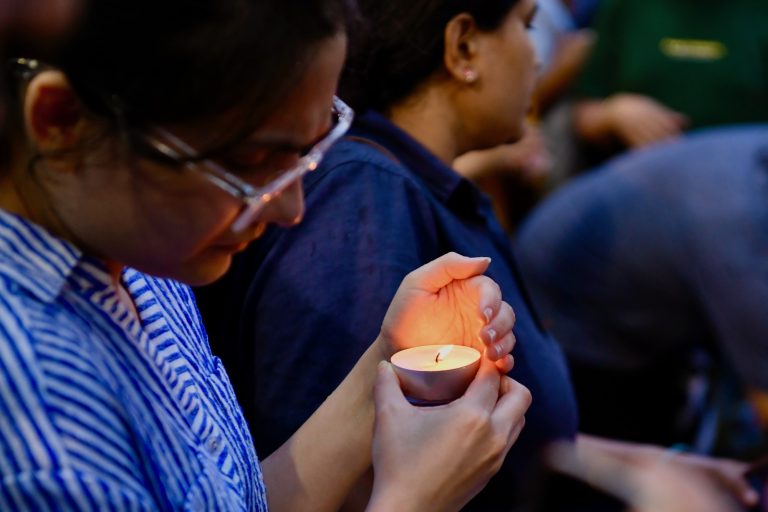
The memorial, jointly organized by 32 Nepali community organizations in New York, drew community leaders, representatives of social and district-based associations, and local residents. Participants lit candles arranged to spell “Nepal” and formed the shape of Nepal’s national flag.

The gathering was held as search-and-rescue operations continued in the Himalayan border region following Wednesday’s devastating flood and mudslide disaster. More than 390 people have been reported dead across Nepal, while more than 1,000 others remain missing. Roads, bridges, homes, and communications infrastructure were swept away or severely damaged in the affected areas.

Participants observed a moment of silence for those killed and offered prayers for the recovery of the injured, as well as the safe location and rescue of people who are still out of contact.

Speakers expressed condolences to bereaved families and urged Nepalis living abroad to stand with disaster survivors through financial, material, and moral support.

“Even though we live far from Nepal, we are with the affected families,” speakers said during the program. “All Nepalis must come together to help during this time of grief.”

They emphasized that relief assistance should be delivered transparently and effectively to people in the greatest need. Several speakers called for individual and organizational donations to be coordinated through a unified channel, noting that a more organized approach could improve the delivery and distribution of relief.

Community members also appealed to Nepalis in Nepal and abroad to contribute according to their ability, setting aside differences of caste, religion, region, and political affiliation to focus on humanitarian assistance.

“There is no such thing as too little or too much,” speakers said. “A glass of water, a small contribution, or an effort to support rescue work can have great meaning in the life of a victim.”

Among those addressing the gathering were Dinesh Bhandari, president of the Nepali Janasamparka Samiti New York Chapter; Basu Lamichhane, president of the Non-Resident Nepali Association New York Chapter; Satendra Shah, president of NRNA America; AP Sherpa, president of the Federation of Indigenous Peoples of Nepal in America (FIPNA); Laxmi Thapa, secretary of NRNA America; and community activists Krishna Lamichhane and Devaki Pant; and Sonam Tenzing and Rajan Tamang of Rasuwa Samaj.

Representatives with ties to Rasuwa and nearby flood-hit areas said search-and-rescue efforts were continuing, expressing hope that the status of missing people would be clarified as soon as possible. They also urged relief organizers to coordinate with the Nepali government and relevant agencies so assistance reaches affected communities efficiently.

The disaster has affected both Nepali residents and foreign visitors in the border region. Nepal’s tourism authorities reported that hundreds of foreign nationals were among those missing, while the U.S. State Department said it was aware of about 90 Americans who may have been affected. The department stated that three U.S. citizens had been safely rescued and that it had no confirmed reports of American deaths as of Thursday.

Authorities warned that casualty and missing-person figures could change as rescue teams reach isolated areas, restore communications, and verify reports. The flooding was linked to a glacier collapse that unleashed water, mud, and debris through mountain communities near the Nepal-China border.

Thursday’s vigil at Diversity Plaza was intended to honor the dead, demonstrate solidarity with affected families, and encourage continued relief support from the Nepali diaspora.
All photos: Rajan Kafle