






From Climate Justice to Himalayan Emergency: How Nepal Has Raised the Climate Crisis at the U.N. General Assembly

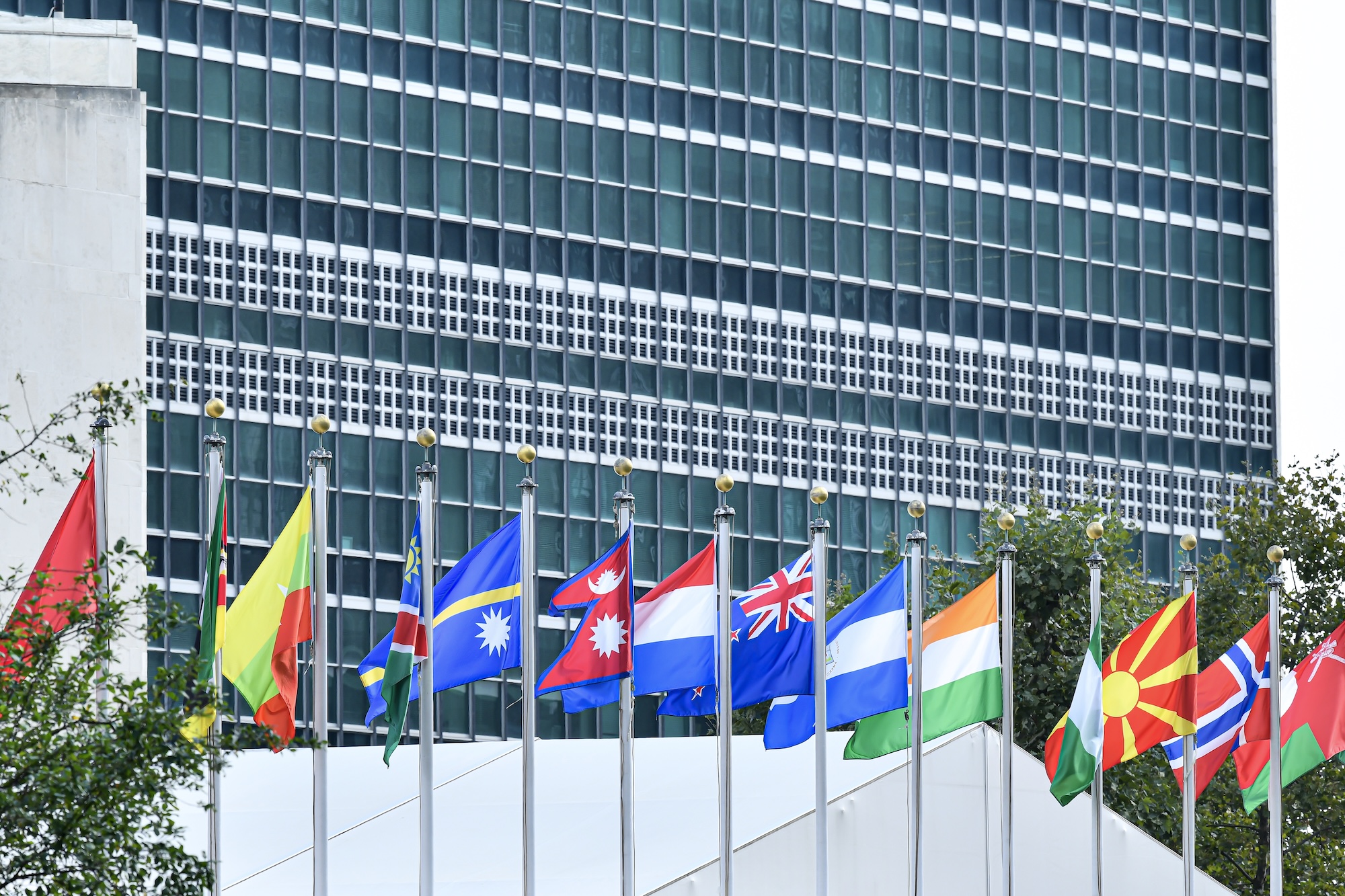
The Nepali flag flies alongside the national flags of other countries at the United Nations headquarters in New York. Photo: Rajan Kafle/Khasokhas.
Nepal’s Prime Minister Balendra Shah’s expected appearance at this year’s U.N. General Assembly comes as Nepal is still digging out from catastrophic flash floods that tore through Himalayan valleys after an ice-rock avalanche and glacier collapse near the Nepal-Tibet border on Aug. 26. The disaster has killed more than 1,300 people, left thousands missing and washed away homes, bridges, roads and hydropower sites along the Bhote Koshi and Trishuli rivers.
Scientists have pointed to a warming Himalaya and unstable ice as contributing factors. Shah has said Nepal must “strongly raise before the international community the disasters we are experiencing as a consequence of climate change.” A Foreign Ministry source said Shah will prioritize the climate crisis, climate justice, climate action, the Himalayan emergency and climate finance in his U.N. address.
Nepal’s climate diplomacy at the General Assembly is not new. The country has raised the issue since the mid-1990s. After the 1992 Rio Earth Summit, Nepal signed the U.N. Framework Convention on Climate Change, and the theme gradually gained weight. Only in the past 15 years, however, has it become a major and regular agenda item.
In recent years, Nepal has repeatedly described the Himalayas as the “Third Pole.” Officials have argued that glaciers are melting rapidly and that Nepal, despite its negligible emissions, faces some of the worst impacts of climate change. They have pressed for climate finance and climate justice. The theme was even more prominent in addresses from 2020 through 2025.
Climate Justice and Climate Action
At the 80th session in 2025, Ambassador Lok Bahadur Thapa, Nepal’s permanent representative and head of delegation, listed “climate justice and climate action” as a core priority. In his full address, he said climate change had “disproportionately affected vulnerable populations” and that Nepal had “firsthand experience of glaciers melting in our Himalayas that are seriously threatening the lives and livelihoods of millions downstream.”
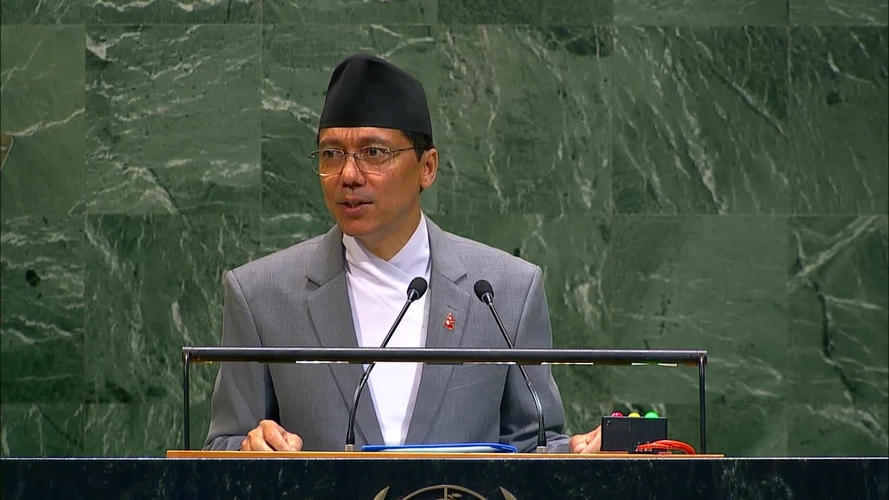
He recalled that Nepal convened the Sagarmatha Sambaad, or Mt. Everest Dialogue, in May 2025 under the theme “Climate Change, Mountains and the Future of Humanity.” The meeting adopted the Sagarmatha Call for Action, “reaffirming our shared commitment to the Paris Agreement and the 2030 Agenda.”
Thapa said Nepal was “among the few countries to have submitted our third Nationally Determined Contribution — NDC3,” aiming by 2035 “to reduce emissions by nearly 27% and expand renewable energy eightfold.” As the world faced “a climate catastrophe,” he said, “this is not just a crisis of emissions — it is a crisis of equity, of survival, of justice.” He added, “Polluters must take responsibility with actions,” and called for the Loss and Damage Fund to be capitalized, along with scaled-up, predictable and accessible climate finance, technology transfer and capacity-building for least developed and mountainous countries.
Thapa’s speech ran about 2,136 words. The portion focused on climate justice, climate action, the Himalayan crisis and climate finance was about 272 words, or about 13%. The word “climate” appeared about 12 times.
Calling the Himalayas the ‘Third Pole’
At the 79th session in September 2024, then-Prime Minister KP Sharma Oli called climate change “the gravest threat to our planet, people, and prosperity.” In his full address, he said Nepal was “particularly hard hit,” ranking as “the 20th most disaster-prone country in the world.”
“Of utmost concern,” he said, “is the alarming rate at which the pristine Himalayas, often referred to as the Third Pole, are losing their vast snow reserves.” That loss, he said, “threatens water availability for billions of people living downstream.”
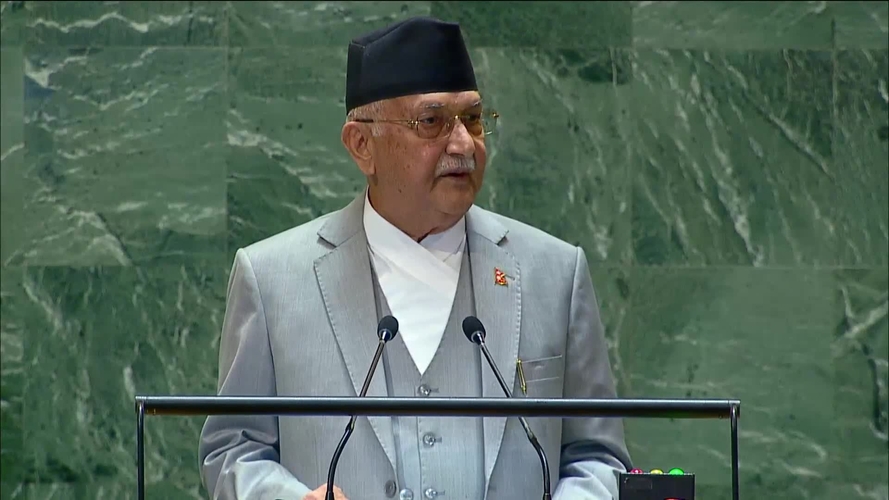
Nepal contributed to “the health of our planet through its forests, mountains and rivers,” he said, yet continued “to bear the brunt of climate change.” In that context, he said, “we call for climate justice.”
Oli described Nepal’s Himalayas as “a natural climate stabiliser” that helped “maintain a cooling system in a region situated in the hottest zone of the planet between the tropics of Cancer and Capricorn.” He said “the mountain agenda should receive due attention in climate negotiations.” Nepal, he added, was “steadfast in its commitment to the Paris Agreement and aims to achieve net zero target by 2045, five years earlier than the global target.” He said adequate climate financing, including the Loss and Damage Fund, was “crucial to support climate-resilient measures and infrastructure for adaptation in developing countries, not least in LDCs.”
Oli’s 2024 speech ran about 2,017 words. The climate-focused portion was about 271 words, or about 13%. The word “climate” appeared about 12 times.
‘The Clock Is Ticking’
At the 78th session in 2023, then-Prime Minister Pushpa Kamal Dahal, also known as Prachanda, said climate change had “assumed a crisis proportion and the clock is ticking.” In his full address, he warned that “inaction or little action will surely invite disastrous consequences for humanity.”
“Climate-vulnerable mountainous countries like Nepal have been bearing the severe brunt of climate change,” he said. “The Himalayas are the source of fresh water for over two billion people. Global warming has induced rapid receding of ice in our Himalayas. It has not only eroded the health of our mountains but also endangered the lives and livelihoods of millions of people living downstream.”
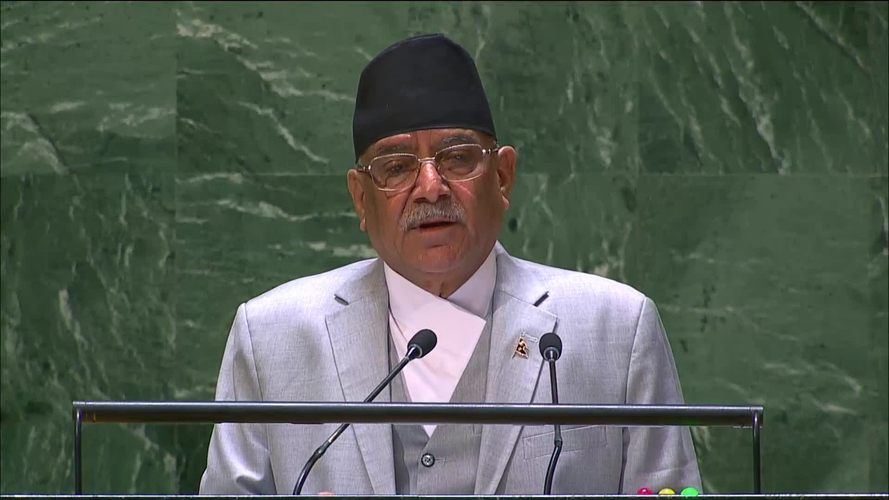
He said Nepal remained “fully committed to the effective implementation of the Paris Agreement” and had “set an ambitious target of reaching a net-zero scenario by 2045.” Easy access to climate finance, he said, would be “the key to low-carbon and climate-resilient development pathways,” along with “early operationalization of the loss and damage fund, fulfilling the target of the 100 billion US Dollars commitment as well as doubling up of the adaptation climate finance.”
It was “an irony,” he said, that Nepal, “with 45 percent of its area as forest with rich biodiversity and 15 percent of its land as high mountains, releases least Green House Gas Emission but contributes significantly to ecological preservation, has unfairly suffered from climate crisis.” That mismatch, he said, “must be addressed through a compensation mechanism to the countries that positively contribute to the greening of the planet.”
Dahal’s speech ran about 1,896 words. The climate-focused portion was about 327 words, or about 17%. The word “climate” appeared about nine times.
A ‘Disproportionate Burden’
At the 77th session in 2022, then-Foreign Secretary Bharat Raj Paudyal said Nepal was “bearing the disproportionate burden of climate change and facing climate shocks such as frequent landslides, storms, floods, and wildfires.” In his full address, he said melting glaciers and drying snow-fed rivers were “adversely affecting the lives and livelihoods of people downstream and rendering us one of the most vulnerable countries.”
The region, he said, had seen “heartbreaking loss of lives and properties due to unusually heavy downpours, melting of the glaciers and resulting floods.” Nepal had “localized the adaptation plans,” he said, and remained “fully committed to the Paris Agreement,” with a target of “reaching a net-zero scenario by 2045 as announced by the Prime Minister of Nepal Rt. Hon. Mr. Sher Bahadur Deuba during the COP 26.”
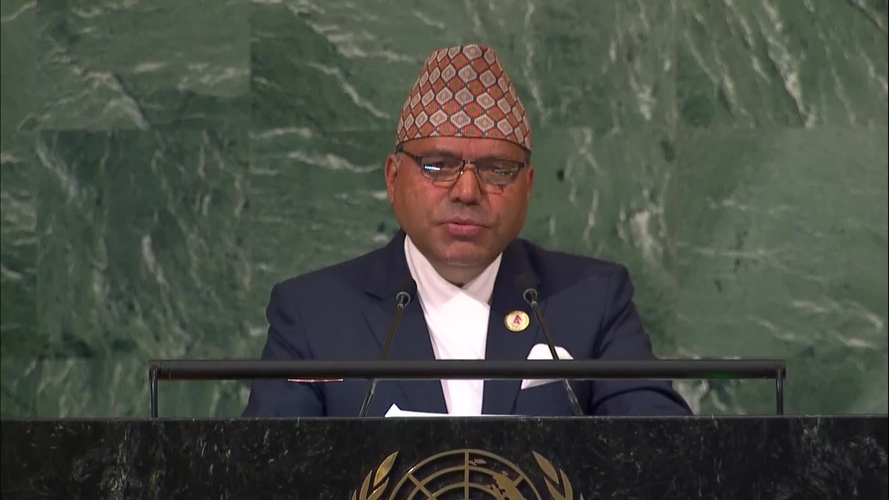
“Climate change is a global problem, and it needs global action,” he said. “The large emitters — which account for over 80 percent of all global emissions — must take bold steps to keep the 1.5° Celsius climate goal alive.” He added that “the commitment of 100 billion US dollars of climate financing must turn into a reality” and that “COP 27 needs to move from pledges into action.”
Paudyal’s speech ran about 2,422 words. The climate-focused portion was about 195 words, or about 8%. The word “climate” appeared about eight times.
An ‘Existential Threat’
At the 76th session in 2021, then-Foreign Minister Narayan Khadka said that “whether it is the rising of sea levels or melting of Himalayan glaciers, hurricanes, storms, floods or fires, climate change has become an existential threat to humanity.” In his full address, he said Nepal was “home to eight of the world’s 14 highest peaks including the top of the world- Sagarmatha, the Mount Everest,” and that snow-fed Himalayan rivers “sustain one fifth of the global population.”
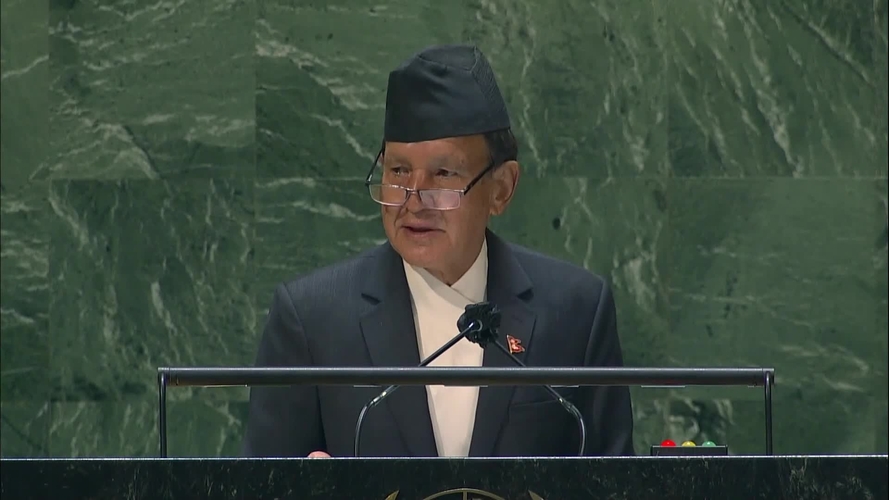
“Nepal is at the sharp end of climate change despite its negligible share in greenhouse gas emissions,” he said. He reiterated a commitment to “climate-resilient development pathways by 2030 and net-zero emissions by 2050.” Climate justice, he said, required that “the principle of common but differentiated responsibilities, equity and respective capabilities should be at the center of the climate agenda.”
He said the Glasgow COP26 “must provide a breakthrough” and that developing countries’ climate ambition “must be met with easier access to adequate financial and technological support for adaptation and mitigation.”
Khadka’s speech ran about 2,850 words. The climate-focused portion was about 257 words, or about 9%. The word “climate” appeared about 11 times.
A ‘Natural Cooling System’
At the 75th session in 2020, then-Prime Minister Oli delivered a virtual address because of the COVID-19 pandemic. In his [full statement](https://www.un.int/nepal/statements_speeches/statement-prime-minister-and-leader-nepali-delegation right-honorable-mr-k-p), he said the “climate crisis continues to pose an existential threat” and that “the silence of the large emitters should not lead to the failure of responsibilities.”
“Nepal has dedicated more than 60 percent of its territory to the service of ecosystem,” he said. “Our forests and mountains work as environmental purifiers.” Nepal’s Himalayas, he said, “function as natural climate stabilizer” and “contribute to maintain natural cooling system as they lie in the hottest zone of the planet between the tropic of Cancer and Capricorn.”
“It is an unpleasant irony,” he said, “that we substantially contribute to sustaining the ecosystem and emit negligibly, yet we bear the severest brunt of climate change.” Global warming, he said, had “eroded the health of our high mountains,” and fast-melting ice “may lead to the outburst of glacial lakes resulting in huge loss of lives and properties downstream.” He called for “full and effective implementation of the Paris Agreement, robust climate action and easy access to climate financing.”
Oli’s 2020 virtual speech ran about 2,490 words. The climate-focused portion was about 338 words, or about 14%. The word “climate” appeared about 10 times.