


Nvidia CEO Jensen Huang Donates $10 Million, Pushing Nepal Flood Relief Fund Above $65 Million


Jensen Huang, CEO of Nvidia. Photo: Raysonho, Wikimedia Commons (CC0)
Nvidia CEO Jensen Huang has donated $10 million to Nepal’s Prime Minister Disaster Relief Fund to support people affected by the devastating floods in the Bhotekoshi River basin in Rasuwa district, Finance Minister Swarnim Wagle said Thursday.
Wagle thanked Huang, Nvidia’s founder and chief executive, for the contribution, which he said helped push total donations to the Prime Minister Disaster Relief Fund above $65 million.
“On behalf of the government of Nepal, I’d like to express my sincere gratitude to Mr. Jensen Huang for donating $10 million to the Prime Minister’s Disaster Relief Fund,” Wagle said in a video message. “I hope this sizable contribution, notable by any philanthropic standard, will inspire many others to also contribute to this noble cause.”
Death Toll Rises to 1,259 as 5,053 Remain Missing
The latest situation report from Nepal’s National Disaster Risk Reduction and Management Authority, issued Thursday at 6 p.m., said 1,259 bodies had been recovered following the deadly floods and related disasters, while 5,053 people remained missing. Another 5,384 people were reported injured.
Rescue teams have so far rescued 12,038 people. The report said 3,926 people had been rescued by helicopter, including 3,653 Nepali citizens and 273 foreign nationals. A total of 785 air operations have been conducted, including 95 flights on Thursday.
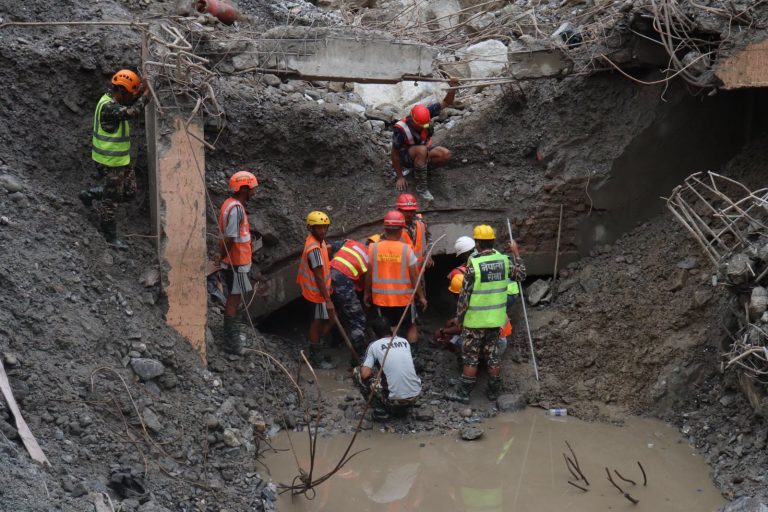
A total of 304 injured people have received treatment at 18 health institutions. Of those, 200 have been discharged, 70 remain under treatment, 30 have been referred to other hospitals and four have died while receiving treatment.
The latest report said 4,521 displaced people are currently sheltering in 38 holding centers across Rasuwa, Nuwakot and Dhading. The centers are housing 1,141 people in Rasuwa, 3,181 in Nuwakot and 199 in Dhading.
Search-and-Rescue Operations Continue
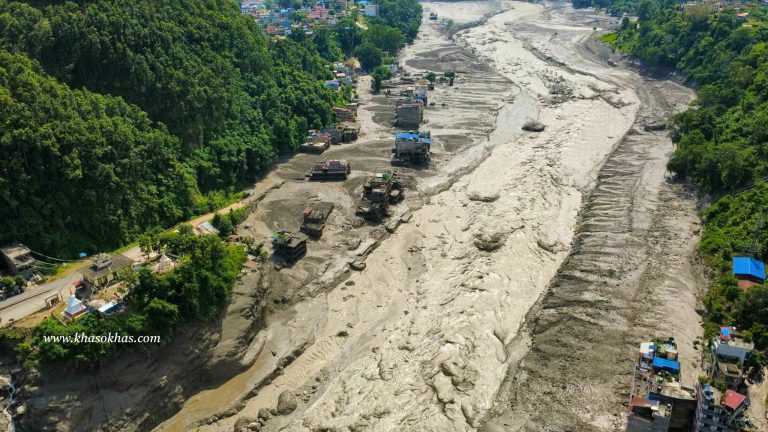
The flood struck the Bhotekoshi River in Rasuwa district on Aug. 26, killing people and destroying homes, property and livelihoods. Communities in Rasuwa, Nuwakot, Dhading, Gorkha and other districts were affected, according to an appeal issued by the Embassy of Nepal in Washington.
The government has prioritized search and rescue, relief, safe evacuation, rehabilitation and emergency response. Government agencies, local governments, security forces and other organizations have been mobilized to address immediate humanitarian needs and support longer-term recovery.
Nepali, Indian, Chinese and South Korean rescue teams continue to conduct joint search-and-rescue operations at several hydropower project sites affected by the disaster, including Rasuwagadhi, Langtang, Chilime, Upper Trishuli-1, Trishuli 3A, Trishuli 3B and Mailung Khola.
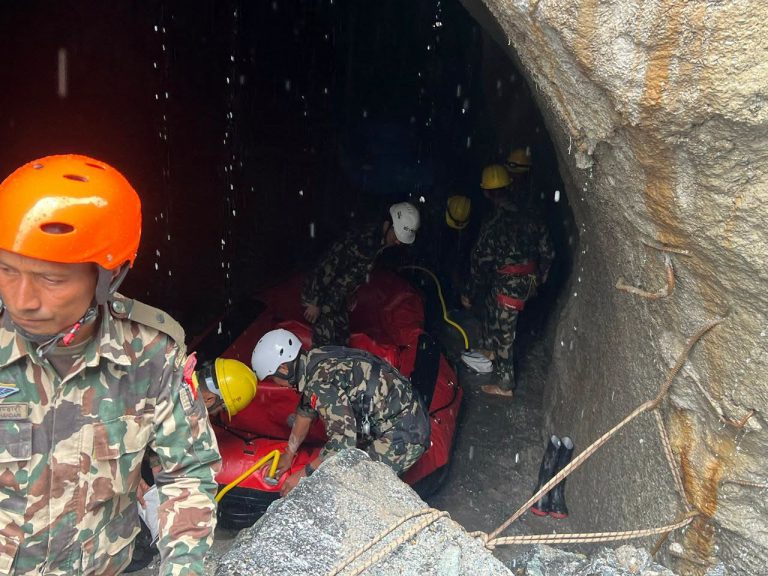
At the Sanjen/Langtang hydropower project, rescue teams have entered about 200 meters into a tunnel and recovered two bodies or body parts. At Upper Trishuli-1, rescuers reached a blocked access area and recovered one body.
The report said 21 hospitals across various districts are currently holding unidentified bodies, while 95 identified bodies have been handed over to their families.
More Than 21,000 Security Personnel Deployed
The government has deployed 21,402 security personnel for search, rescue and relief operations. The Nepal Army has provided medical treatment to 3,206 people, while the Armed Police Force has treated another 1,874 people.
Relief supplies have been transported from Kathmandu to affected areas by 69 trucks, 38 Bolero utility vehicles and nine helicopter flights. Eleven additional trucks carrying relief supplies were dispatched Thursday.
The Armed Police Force has also transported relief materials within Nuwakot and Rasuwa through 163 air flights.
The government has provided 10 million Nepalese rupees each to Rasuwa and Nuwakot and 5 million rupees to Dhading. It has also allocated 135 million rupees for 15 affected municipalities.
Communications and Roads Slowly Recover
Telecommunications services have been restored across most of the flood-affected corridor between Dhading and the Rasuwa border. Nepal Telecom has restored 116 of its 120 mobile towers, while Ncell has restored 75 of its 78 towers.
Some areas, including Timure, Chilime Khola and Trishuli 3B for Nepal Telecom and Timure, Trishuli and Uttargaya-1 for Ncell, still lack mobile service. The government is also preparing to deploy additional low-Earth-orbit satellite terminals in affected areas.
Road access remains a major challenge. Traffic is completely obstructed at Krishnabhir along the Mugling-Malekhu section of the Prithvi Highway, while authorities are working to excavate the hillside and construct a new road.
Three alternative routes connecting Kathmandu through Abukhaireni, Dhadingbesi and Benighat have been identified.
The 55-meter Devighat Bridge over the Tadi River was washed away, and the Nepal Army has begun transporting materials from Gajuri for construction of a Bailey bridge.
On the Bidur-Betrawati road, 7.5 kilometers of a 10-kilometer section has been cleared, while the remaining 2.5 kilometers was completely washed away.
Government Appeals for Donations
The Office of the Prime Minister and Council of Ministers has appealed to individuals, organizations, businesses, private-sector entities and well-wishers in Nepal and abroad to contribute to the Prime Minister Disaster Relief Fund.
The government said contributions will support rescue operations, relief assistance, safe evacuation and the long-term rehabilitation of people affected by the Bhotekoshi flood.
In a separate appeal, the Embassy of Nepal in Washington urged Nepalis in the United States and in countries under its concurrent accreditation — Mexico, Costa Rica, Belize, El Salvador, Honduras, Panama, Guatemala and The Bahamas — to support the relief effort.
The embassy also called on Nepali diaspora groups, businesses, philanthropists, and U.S. and international organizations to contribute according to their capacity.
The embassy urged donors to use official channels only and to verify bank account names, QR codes and other payment details to help ensure that donations are handled securely and transparently and reach their intended purpose.