






New Yorkers Below 200% of Federal Poverty Level May Qualify for Free Hospital Care, N.Y. Attorney General Issues Guidance

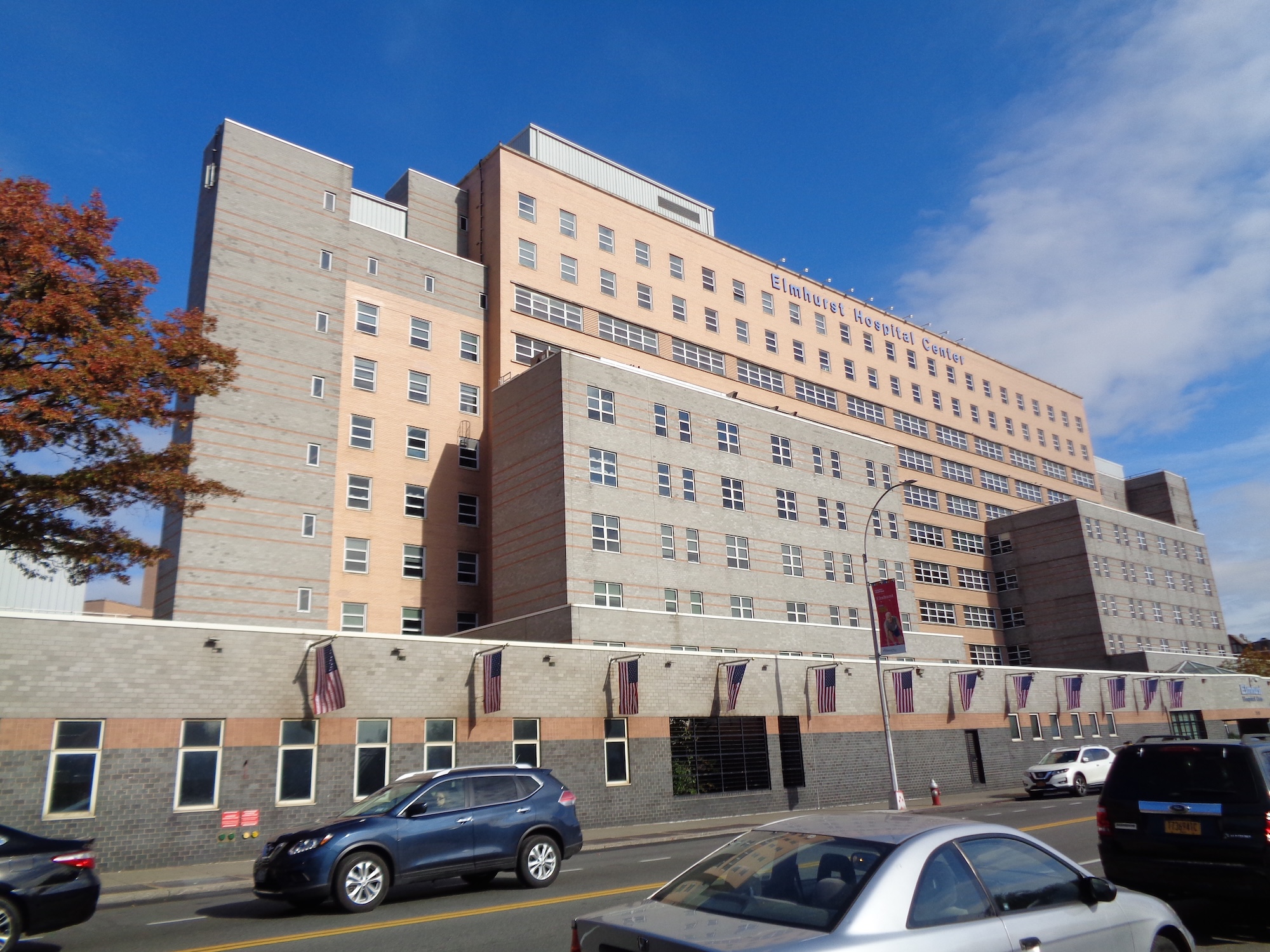
Elmhurst Hospital Center at Broadway and 78th Street in Elmhurst, Queens. Photo by Tdorante10, via Wikimedia Commons, licensed under CC BY-SA 4.0.
New York Attorney General Letitia James released new guidance Thursday to help residents understand and apply for financial assistance for hospital bills as federal health care cuts are expected to leave hundreds of thousands of New Yorkers without the state’s zero-premium Essential Plan coverage.
New York law requires every hospital in the state to maintain a financial assistance program for eligible patients who cannot afford their bills. The programs may provide free care, discounted services and monthly payment plans. However, the attorney general’s office said many residents do not know the protections exist or how to apply.
The guidance explains eligibility requirements, application procedures and protections available to immigrant patients and others facing medical debt.
“No New Yorker should have to choose between their health and their financial security,” James said. “As federal cuts strip health coverage away from hundreds of thousands of New Yorkers, I urge anyone struggling to pay a hospital bill to use this guidance to understand their rights.”
Who may qualify
Patients with household incomes of up to 400% of the federal poverty level may qualify for hospital financial assistance. Under the 2026 income guidelines, a one-person household earning less than $31,920 may qualify for free care, while those earning up to $63,840 may be eligible for a discount. For a two-person household, the income thresholds are $43,280 for free care and $86,560 for discounted care. The limits are $54,640 and $109,280, respectively, for a three-person household; $66,000 and $132,000 for a four-person household; and $77,360 and $154,720 for a five-person household.
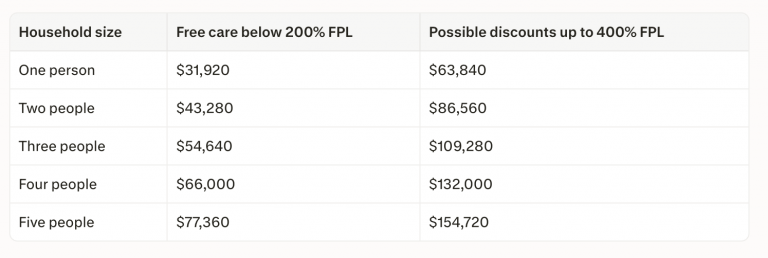
Hospitals must waive all charges for eligible patients whose household income is below 200% of the federal poverty level. Patients whose income falls between 200% and 400% of the federal poverty level may qualify for discounts calculated on a sliding scale.
Eligibility is not limited to uninsured patients. People with insurance may also qualify if they have exhausted their benefits or spent more than 10% of their household income on out-of-pocket medical expenses during the previous year.
The law covers emergency care as well as medically necessary inpatient and outpatient hospital services. For nonemergency care, patients generally must live in the hospital’s designated primary care area. Hospitals must provide written information about their financial assistance policies when patients are admitted, registered or discharged, and with their bills or financial statements. Additional information is available from the New York State Department of Health.
Immigrant patients protected
The guidance emphasizes that hospitals cannot ask about or consider a patient’s immigration status when deciding whether the patient qualifies for financial assistance.
Applying for hospital financial aid is not considered a public benefit and does not affect a person’s immigration status. Hospitals are also prohibited from reporting applicants to immigration authorities, according to the attorney general’s office.
Hospitals cannot deny emergency or medically necessary care because of an unpaid bill. They also cannot limit financial assistance based on a patient’s medical condition or deny admission or treatment because the patient has outstanding medical debt.
Applications and payment plans
New Yorkers may apply for assistance at any point beginning on the date they receive services and continuing through the billing and collections process. Hospitals must use a standard application developed by the state Department of Health. The application is available in English and 16 other languages.
Patients may obtain a financial assistance application by downloading it from the New York State Department of Health website, requesting one from the hospital’s financial assistance office or billing department, or downloading it directly from the hospital’s website.
Hospitals may request documentation such as pay stubs, tax returns, public benefit statements, proof of household size, identification, insurance information or medical bills. They cannot require information about assets such as a house or car, and they cannot automatically deny assistance because an applicant is unable to provide certain documents.
A hospital must decide on a completed application within 30 days and provide the decision in writing. Patients who are denied assistance, or who believe they received too small a discount, have the right to appeal.
Eligible patients must be offered a monthly installment plan. The monthly payment cannot exceed 5% of the patient’s pretax monthly income, and the plan cannot charge more than 2% annual interest.
Debt collection restrictions
Hospitals cannot send a bill to a debt collector while a financial assistance application is under review. They also cannot refer the bill to a debt collector for at least six months after sending the patient’s first bill, even if the patient has not applied for assistance.
James urged residents who believe a hospital failed to offer financial aid, improperly rejected an application or unlawfully referred a bill to collections to contact the Office of the Attorney General’s Health Care Helpline. The helpline can be reached at 1-800-428-9071.
Essential Plan changes
The guidance comes as federal funding reductions change eligibility for New York’s Essential Plan. Beginning July 1, 2026, the income limit fell from 250% to 200% of the federal poverty level, according to a previous attorney general’s office announcement.
The change is expected to affect about 450,000 New Yorkers who previously received zero-premium coverage and may now need marketplace plans with higher premiums, deductibles and out-of-pocket costs.
The attorney general’s office said hospital financial assistance could provide an important safety net for residents facing coverage gaps or unaffordable medical expenses. New Yorkers losing Essential Plan coverage may qualify for a special enrollment period through the New York State of Health marketplace until Sept. 1, 2026.
James’ office said the new guidance is part of its broader efforts to address health care costs. The office reported that its Health Care Helpline recovered more than $1.5 million for New Yorkers in 2025 and has pursued settlements and enforcement actions involving health insurance billing, mental health access and hospital care.
The guidance also directs New Yorkers to seek help from hospital financial assistance offices, patient advocates, social workers and community organizations that assist with medical bills. The attorney general’s guidance states that patients should apply even if they are unsure whether they meet every eligibility requirement, because hospitals may offer other discounts or assistance.