




Nonresident Nepali Citizens Can Get Free Two-Year Residence Visas, but Many Don’t Know It

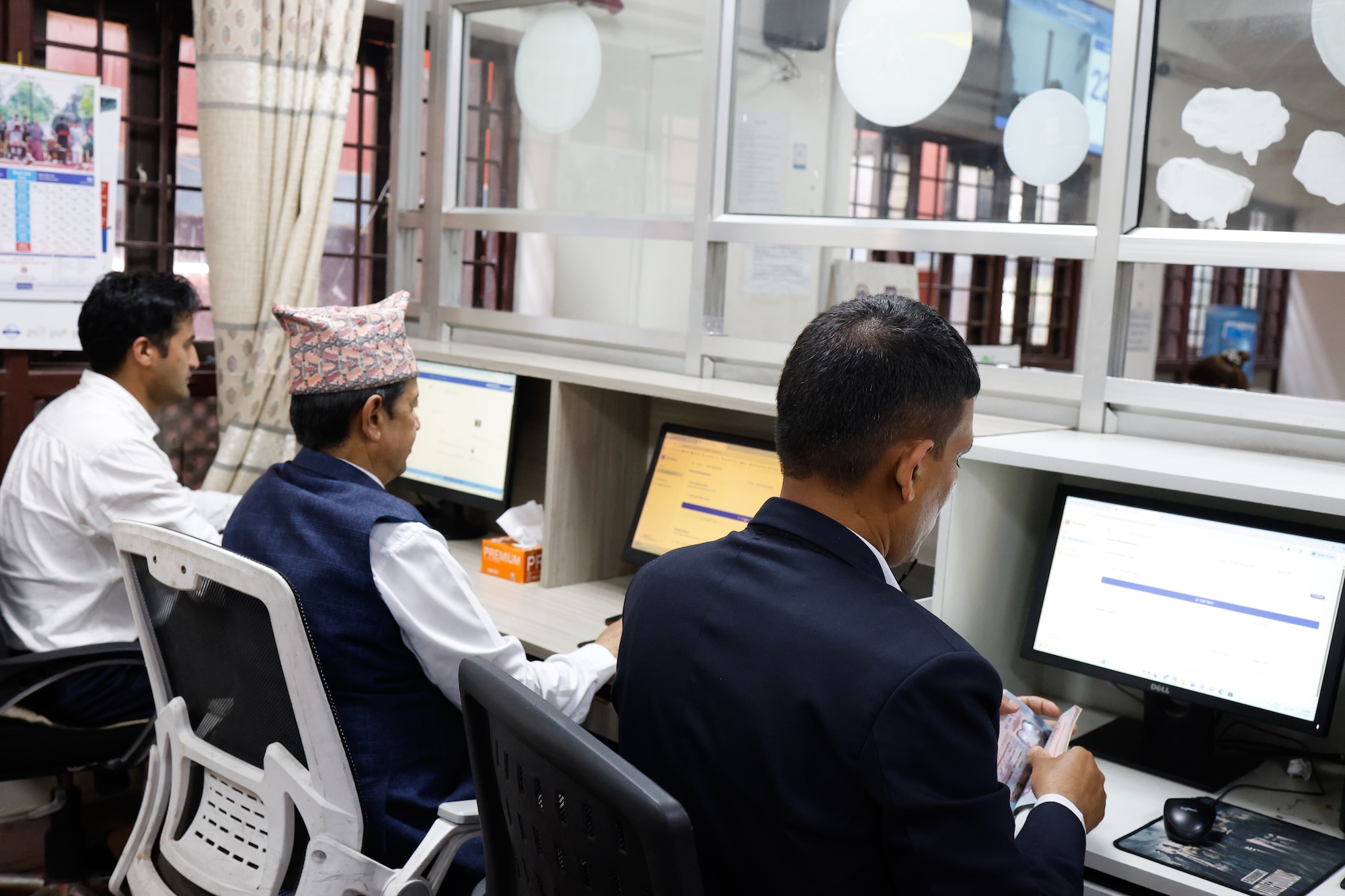
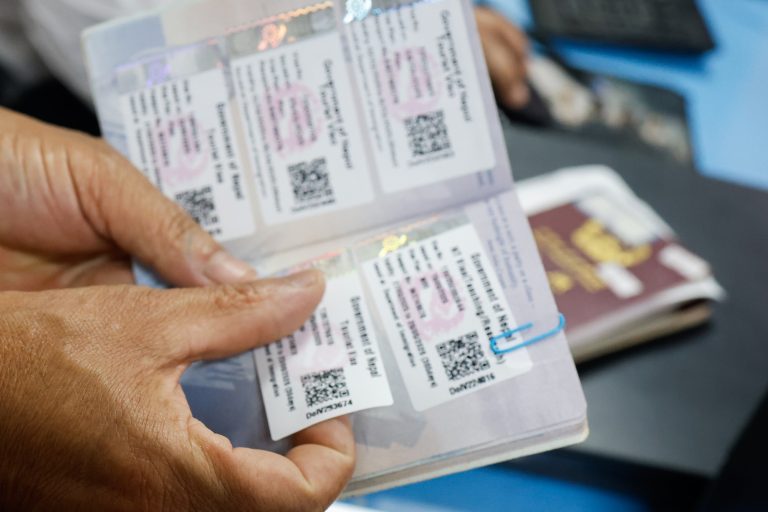
Department of Immigration officials issue a visa sticker in Nepal. Photo by Dipendra Dhungana.
KATHMANDU, Nepal — For decades, Nepalis living abroad have campaigned for a principle they often express as “Once a Nepali, always a Nepali.” At the center of that effort has been the demand to preserve their connection to Nepal, including greater recognition of their rights after acquiring foreign citizenship.
Under Nepal’s previous citizenship law, Nepali citizens automatically lost their Nepali citizenship after acquiring citizenship in another country. As a result, people of Nepali origin who became foreign citizens faced legal and administrative hurdles in their country of birth. Those obstacles affected everything from purchasing property and claiming inheritance to conducting financial transactions, operating businesses and traveling to and from Nepal.
To address some of these concerns, Nepal’s Constitution of 2015 introduced a provision for nonresident Nepali citizenship under Article 14.
The provision allows people who previously held Nepali citizenship — or whose parents or grandparents were Nepali citizens — and who later acquired foreign citizenship in countries outside the South Asian Association for Regional Cooperation, or SAARC, to obtain nonresident Nepali citizenship. The status is intended to provide economic, social and cultural rights, though it does not grant political rights.
After years of legal and administrative delays, the government began distributing nonresident Nepali citizenship through district administration offices following amendments to the Nepal Citizenship Act of 2006 and its regulations.
But obtaining the citizenship did not immediately eliminate immigration-related complications. Differences between immigration laws and the Non-Resident Nepali Act of 2008 meant that many nonresident Nepalis continued to face visa requirements and fees when visiting or staying in Nepal.
The Department of Immigration began issuing free visas to foreign nationals holding nonresident Nepali citizenship on Jan. 12, 2025. The arrangement received a clearer statutory foundation through amendments to the Non-Resident Nepali Act under the Good Governance Promotion and Public Service Delivery Act, 2025, which took effect on March 31, 2025.
A Free Visa for Up to 10 Years, and a Two-Year Residence Visa
Before the amendment, the law allowed foreign citizens of Nepali origin and eligible family members to receive nonresident Nepali visas for periods of up to 10 years. But it did not explicitly guarantee that the visas would be free, nor did it establish a separate two-year residence visa for people holding nonresident Nepali citizenship.
The 2025 amendment clarified and expanded those benefits.
Under Section 11(1) of the amended law, nonresident Nepali citizens, foreign nationals of Nepali origin holding nonresident Nepali identity cards, and their family members are eligible for free nonresident Nepali visas for up to 10 years.
Section 11(1a) provides a separate benefit: Foreign nationals holding nonresident Nepali citizenship can receive a free residence visa valid for two years at a time, with multiple-entry privileges.
Section 11(2) allows the validity of visas issued under Section 11(1) to be extended as necessary. The amended law also explicitly includes holders of nonresident Nepali citizenship in its definition of nonresident Nepalis.
The distinction between the two visa categories is important. The 10-year provision covers a broader group of eligible nonresident Nepalis and their families, while the two-year residence visa specifically applies to people holding nonresident Nepali citizenship.
Applications for Nonresident Nepali Visas Have Increased
Data obtained from the Department of Immigration show a steady increase in the number of people receiving nonresident Nepali visas in recent years, including principal applicants and their dependent family members.
In 2020, the department recorded 509 recipients: 502 principal applicants and seven dependents.
The total increased to 1,482 in 2021, including 1,407 principal applicants and 75 dependents. In 2022, the number reached 2,329, comprising 2,189 principal applicants and 140 dependents.
In 2023, a total of 2,498 people received the visas, including 2,314 principal applicants and 184 dependents. The number rose to 2,664 in 2024, with 2,449 principal applicants and 215 dependents.
The department recorded 3,460 recipients in 2025, including 3,258 principal applicants and 202 dependents.
The latest figures for 2026 show 3,080 recipients: 2,835 principal applicants and 245 dependents.
Savings and Easier Travel to Nepal
The amended provisions offer both financial and practical benefits to eligible nonresident Nepalis.
The removal of visa fees eliminates a recurring expense for people who previously had to pay for residence visas. The two-year multiple-entry provision also allows citizenship holders to travel in and out of Nepal without having to obtain a new visa for each visit during the visa’s validity period.
The arrangement is particularly useful for people who maintain family, property or business ties in Nepal but live permanently in another country. It gives them greater flexibility to spend extended periods in their country of origin and return abroad when necessary.
Despite the benefits, many nonresident Nepali citizenship holders remain unaware of the provision and how to apply for the free residence visa.
How to Apply for the Free Two-Year Visa
Applicants generally need to prepare their nonresident Nepali citizenship certificate, a valid foreign passport and a passport-size photograph. Those applying for eligible family members may also need documents establishing their relationship.
Applicants must then visit the Department of Immigration’s online portal and select the appropriate visa category to complete the application.
After submitting the form, they must present the resulting confirmation and required original documents to the Department of Immigration or the relevant immigration office for verification.
Once the documents have been verified, immigration officials can issue a free, two-year residence visa with multiple-entry privileges under Section 11(1a) of the Non-Resident Nepali Act.
Broader Rights Remain Unresolved
Although the free visa provision represents a significant benefit, nonresident Nepalis say the broader question of their rights remains unresolved.
Many have continued to call on the government to fully implement the constitutional provisions on nonresident Nepali citizenship and ensure the economic, social and cultural rights promised under the law.
The Constitution provides for those rights, but implementation has been uneven. Some provisions still require additional legislation or regulations, while administrative hurdles continue to limit the practical exercise of existing rights.
For many members of the Nepali diaspora, the free two-year residence visa is an important step toward maintaining closer ties with their homeland. But they say it is only one part of a larger effort to ensure that acquiring foreign citizenship does not sever their legal and practical connection to Nepal.