





Nepali Groups Urge Nepal Government to Seek New TPS for Nepalis in U.S. After Devastating Floods


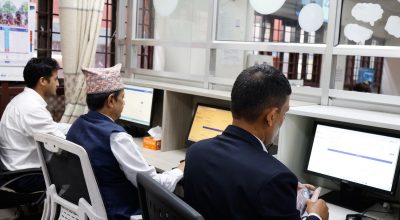
Nepal’s Foreign Minister Shishir Khanal is in New York for the 81st session of the United Nations General Assembly. Photo by Rajan Kafle/NepYork.
NEW YORK — Two U.S.-based advocacy organizations are urging Nepal’s government to request the United States for a new Temporary Protected Status designation for Nepali nationals following devastating floods and mudflows that have left more than 1,400 people dead, thousands missing and billions of dollars in estimated damage.
United for TPS Nepal and Asian Americans Advancing Justice Southern California wrote a letter Sept. 21 to Nepal’s Foreign Minister Shishir Khanal, asking the government to support efforts underway in the U.S. Congress to obtain temporary immigration protection for eligible Nepali nationals.
The groups are seeking a new TPS designation based on the current conditions in Nepal, rather than a continuation or redesignation of the country’s previous TPS program. They say the protection would allow eligible Nepali nationals already in the United States to remain and work legally while Nepal recovers from the Aug. 26 disaster.
The advocacy campaign comes as Nepal faces a major recovery and reconstruction effort after catastrophic flooding along the Bhote Koshi and Trishuli river systems. UTPSN’s latest disaster assessment, updated Sept. 21, lists 1,451 confirmed deaths and more than 5,786 people missing, while cautioning that the figures remain fluid.
The organization estimates direct damage at $1.8 billion, economic losses at $883 million and recovery and reconstruction needs at $4.78 billion. About 20,000 homes may require rebuilding or relocation, according to the assessment.
The disaster has also damaged roads, bridges, schools, hydropower facilities and other critical infrastructure. UTPSN reports that 69 kilometers of roads were damaged, 33 motorable bridges were destroyed and four others partially damaged. Fifty-three of 64 suspension bridges assessed were damaged.
The assessment says 18 schools were physically damaged, including 11 that were destroyed. It also says 18,916 students are enrolled in 69 schools located within 500 meters of affected riverbanks, with 23 of those schools assessed as extremely risky.
Humanitarian Needs Remain Extensive
The disaster’s impact extends beyond deaths and physical destruction.
UTPSN’s assessment says 541 unaccompanied or separated children required protection, while 230 children were reported missing or swept away in an education-sector assessment. It estimates that 2,600 children under age 5 could require treatment for severe wasting and that 10,500 pregnant and breastfeeding women need nutrition assistance.
Another 43,000 women and girls are identified as needing immediate humanitarian assistance. The assessment records 32,963 people directly affected in 8,317 households, while a broader government-approved estimate puts the affected population at 84,270 people across 17 municipalities in six districts.
Destroyed transportation links have complicated the movement of people and relief supplies and slowed restoration of housing, schools, power and livelihoods, according to the assessment.
Congressional Effort Seeks Bipartisan Support
UTPSN and AJSOCAL have also launched a campaign in Washington seeking congressional support for a letter urging the Department of Homeland Security and the White House to consider a new TPS designation for Nepal.
The congressional letter is being led by Reps. Judy Chu, D-Calif., Grace Meng, D-N.Y., and Raja Krishnamoorthi, D-Ill.
An appeal distributed by the organizations said that, as of the morning of Sept. 21, 22 additional members of Congress had signed the letter, including two Republicans. UTPSN separately said the number of additional congressional signers had reached 36. The organizations describe the effort as bipartisan.
The organizations are seeking additional support before 5 p.m. Eastern time Wednesday, Sept. 23.
They are also asking U.S.-registered nonprofit organizations to endorse the congressional letter. The organizations said nonprofit groups can provide basic information to add their names to the final version, while personal contact information would remain confidential.
Potential Beneficiaries
UTPSN and AJSOCAL say a new designation could benefit Nepali nationals who were covered by the previous TPS program as well as people who arrived in the United States after Nepal’s first TPS designation in 2015.
Their organizational appeal estimates that 30,000 to 50,000 Nepali nationals could potentially benefit, including people currently in the United States on nonimmigrant visas or other temporary or uncertain immigration statuses. The appeal says about 25,000 Nepalis are currently in the United States on F-1 student visas alone.
A separate letter to Nepal’s foreign minister gives a more conservative estimate of 20,000 to 30,000 potential beneficiaries.
The organizations emphasize that TPS would not provide permanent residency. Rather, it is temporary humanitarian protection intended for nationals of countries facing extraordinary conditions that make safe return difficult.
Remittances Become a Key Part of the Argument
The advocacy organizations argue that a new TPS designation could also support Nepal’s recovery by allowing eligible Nepali nationals in the United States to maintain lawful employment and continue sending money to relatives.
Nepal received $16.19 billion in workers’ remittances in fiscal year 2025-26, according to the UTPSN assessment. Remittances represented 35.8% of the country’s gross domestic product, and the total increased 28.1% in U.S. dollar terms from the previous fiscal year.
UTPSN estimates that Nepalis in the United States sent $1.28 billion to Nepal in 2023, representing an estimated 11.6% of Nepal’s total remittance inflows that year.
The groups say remittances should not be viewed as a replacement for government reconstruction spending or international aid. Instead, they describe them as an additional source of household income that can help families pay for basic needs and rebuild after a disaster.
They also cite research on the aftermath of Nepal’s 2015 earthquake. According to the UTPSN assessment, earthquake-affected households received about 16% more in remittances one year after the disaster and about 10% more two years afterward, after controlling for other factors.
An organizational appeal also cites a World Bank report saying remittances from the United States to Nepal increased by 16% during 2016 and 2017, the two years following Nepal’s initial TPS designation in 2015.
Recovery Is Expected to Take Years
The organizations say Nepal’s reconstruction needs are likely to extend well beyond the immediate emergency response.
UTPSN’s assessment points to the country’s experience following the 2015 earthquake, when housing reconstruction alone was estimated at $3.27 billion. More than 300,000 houses were eventually built through a World Bank-supported program documented by 2021.
The current disaster has created another multibillion-dollar reconstruction burden, with 13 hydropower projects and 4,800 business establishments affected, along with about 1,806 hectares of crop area.
The assessment says Nepal’s experience following the 2015 earthquake demonstrates that rebuilding housing, infrastructure and livelihoods can take years.
The disaster has already affected the country’s energy system. UTPSN says Nepal halted power exports after hydropower losses and began relying on emergency imports. India approved imports of up to 654 megawatts for 18 hours a day through Dec. 31, 2026, according to the assessment.
Nepal Is Asked to Engage Washington
In their letter to Foreign Minister Khanal, UTPSN and AJSOCAL ask Nepal’s government to support the congressional initiative and engage the U.S. government directly.
The organizations argue that returning Nepali nationals to areas where homes have been destroyed, communities displaced and essential services disrupted could worsen humanitarian hardship and interfere with recovery efforts.
They also say that allowing Nepali nationals to work legally in the United States would help maintain financial support for families affected by the disaster.
The groups point to Nepal’s earlier TPS experience following the 2015 earthquake, when the Nepali government sought the designation and the United States subsequently granted it.
They acknowledge that Nepal’s overall remittance growth during the subsequent years cannot be attributed specifically to TPS holders in the United States, but argue that the history demonstrates the importance of overseas financial support to disaster-affected families.
UTPSN’s fact sheet similarly says the current request is based on the new conditions created by the Aug. 26 disaster and is not a continuation or reinstatement of Nepal’s previous TPS designation. It says a new designation could preserve the lawful earning capacity of eligible Nepali nationals already in the United States during Nepal’s recovery.
The congressional sign-on campaign remains open until 5 p.m. Eastern time Wednesday, Sept. 23, while the organizations continue seeking support from lawmakers, nonprofit organizations and the Nepal government.
A decision on whether to designate Nepal for TPS would ultimately rest with the U.S. government under the requirements of federal immigration law.