


After Floods, Nepal Said Its Rescue Capacity Was Sufficient When Offered Help, Then Situation Changed, State Department Says

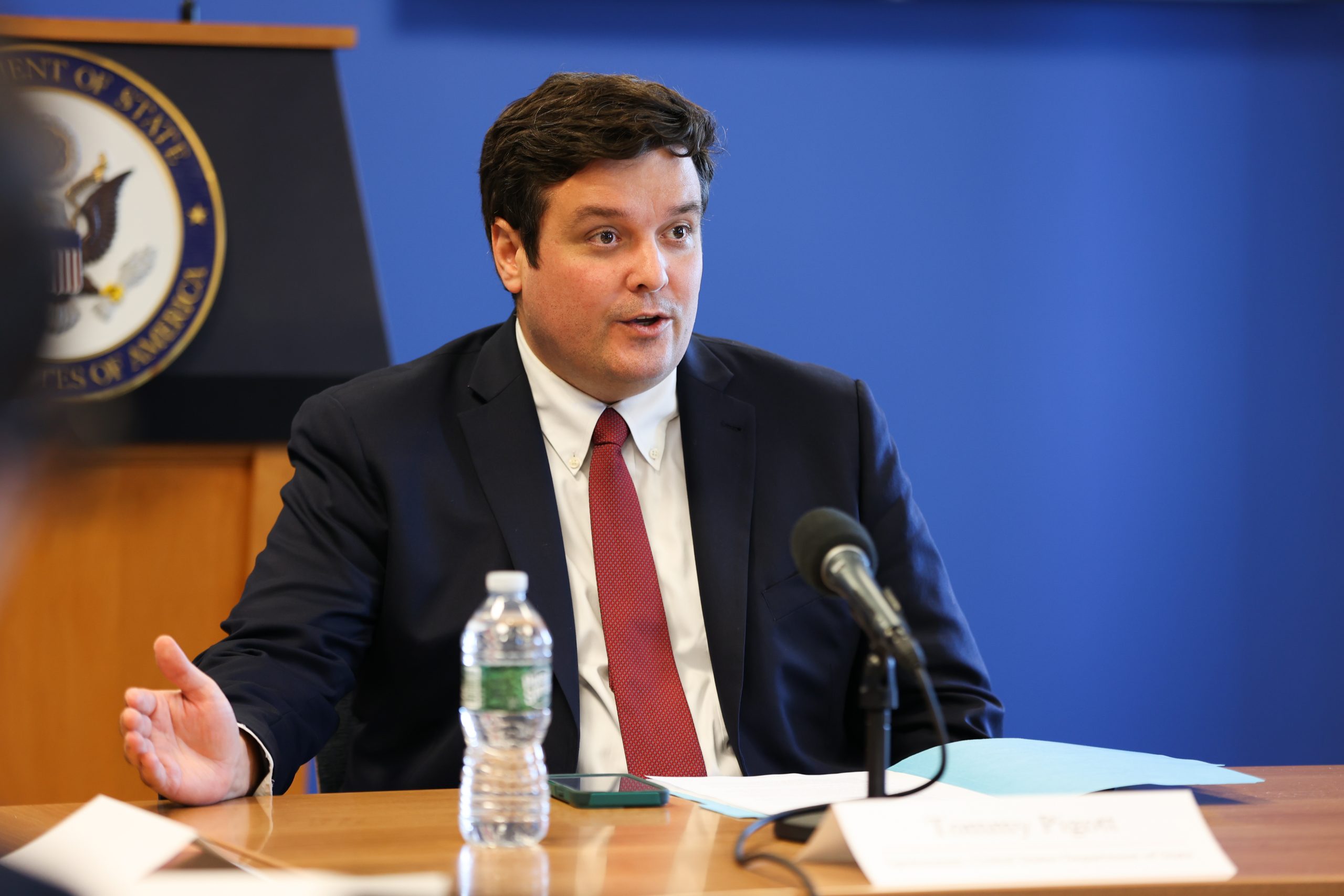
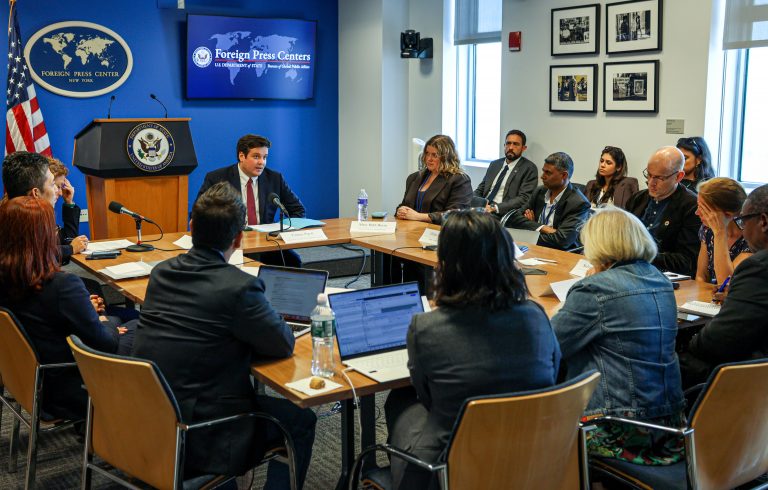
U.S. State Department spokesman Tommy Pigott speaks during a press briefing organized by the Foreign Press Centers in New York. Pigott said the United States has provided more than $5 million in humanitarian, health and forensic assistance following devastating floods in Nepal. Photo: Foreign Press Centers, U.S. Department of State
NEW YORK — The United States has provided more than $5 million in lifesaving humanitarian, health and forensic assistance following devastating floods in Nepal, and the amount is expected to rise as officials identify additional needs, State Department spokesman Tommy Pigott said Monday.
Pigott said the Trump administration’s top priority in Nepal was the safety and security of Americans. About 70 Americans remained unaccounted for following the floods, he said.
“The United States extends deepest care and solidarity to all those affected by the devastating floods in Nepal and their families,” Pigott said at a press briefing organized by the Foreign Press Centers in New York.
He said the United States approved assistance on the first day of the disaster and that an initial $500,000 in humanitarian assistance arrived within days of the flooding.
“The United States did respond on day one,” Pigott said, disputing a suggestion that the U.S. response had not begun immediately. “These offers were made on day one.”
More Aid Was Offered Than Nepal Initially Requested
NepYork asked Pigott about reports attributing the disaster to climate change and Nepal’s calls for climate justice, including whether the United States would support such a request. Pigott did not address the climate-change characterization or say whether the United States would support it.
“I haven’t said that. You’re saying people are saying that,” he said after the question about reports linking the disaster to climate change. He focused instead on the U.S. humanitarian response, saying assistance had been activated quickly after the floods.
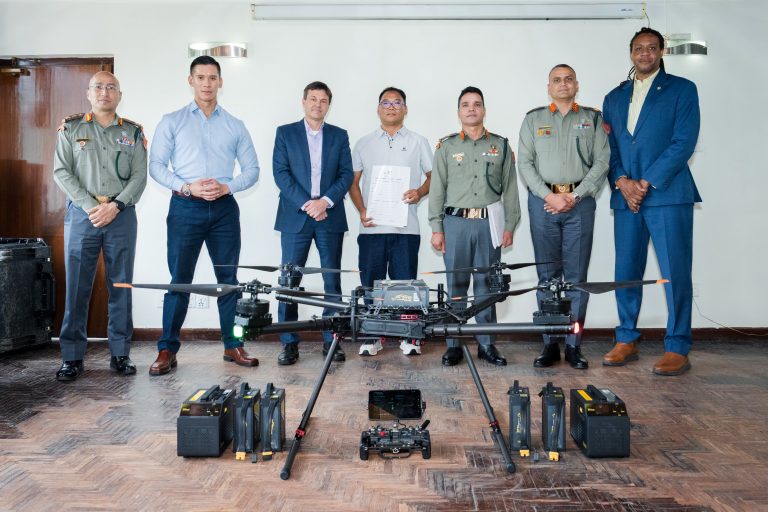
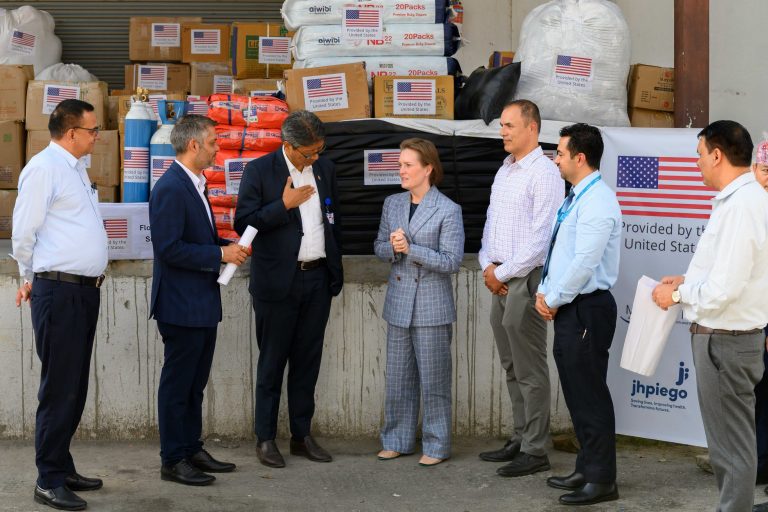
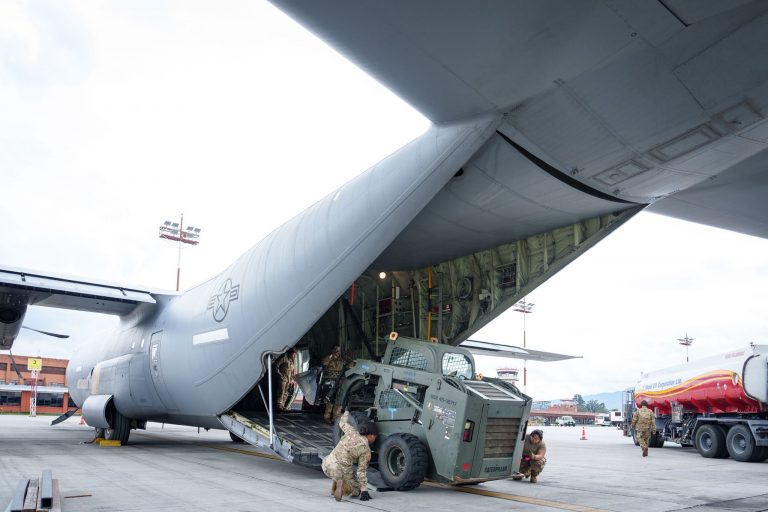
The aid package includes forensic support, humanitarian and health assistance, as well as nonmonetary support, Pigott said. That support has included front-end loaders and specialized transportation options intended to reach areas that are difficult to access, particularly after the destruction caused by the floods.
Asked by NepYork about the U.S. offer of rescue teams, Pigott said the United States had proactively offered more assistance than Nepal initially requested.
“When it comes to the rescue teams, we proactively offered more assistance than was requested by the government of Nepal. That included search and rescue teams. Initially, the government of Nepal informed us that they believed that their own capacity was enough in order to have search and rescue. We did see that change following in the days prior. So our response is based off of requests from the government of Nepal,” Pigott said.
He said President Donald Trump had made clear that the United States was “willing, able and ready to provide whatever they need.”
Pigott said the assistance total was likely to increase “quite substantially” as the United States and Nepal continue identifying needs related to the flooding.
About 70 Americans Remain Unaccounted For
Pigott said locating Americans affected by the disaster remains the U.S. government’s first priority.
“Our focus remains on first, as with any government, the whereabouts of our citizens, approximately 70 Americans,” he said.
He linked an additional $1 million in forensic support to continuing recovery operations and efforts to account for those Americans. He said the United States would continue supporting recovery efforts, including through equipment such as front-end loaders and transportation options for hard-to-reach locations.
The first U.S. humanitarian assistance arrived within hours of the activation of the funds, Pigott said, describing that as evidence of the speed of the response.
He said the United States would continue seeking answers for Americans affected by the disaster, even when those answers are difficult, while also providing humanitarian assistance to Nepal.
U.S. Says Response Is Being Coordinated With Nepal
Asked why Secretary of State Marco Rubio called the president of Nepal’s ruling party rather than the prime minister, Pigott cautioned against speculation.
“I would always caution against reading between the lines,” he said. “I think that’s where rumors start that maybe aren’t founded in anything.”
Pigott said the U.S. government has maintained “extremely robust” communication with Nepal’s government at all levels. The U.S. Embassy in Kathmandu has been working around the clock to communicate with Nepali authorities, he said.
The coordination has enabled the United States to identify needs and respond to them, he said. He described the assistance effort as one led by Nepal’s government.
“It’s a response led by the government of Nepal,” Pigott said. “As they continue to identify needs that we can help them with, we’re continuing to do that.”
State Department Refers TPS Question to Homeland Security
NepYork also asked whether the State Department supported granting Temporary Protected Status to Nepalis in the United States following the disaster. Pigott said the matter was under the authority of the Department of Homeland Security.
“TPS — that is a DHS function,” he said. “So I refer to DHS and appropriate authorities to make those determinations as necessary.”
The floods struck Nepal on Aug. 26 following a major flood event along the Bhote Koshi River and its downstream river systems, causing extensive damage in Rasuwa, Nuwakot, Dhading and other affected districts. The disaster destroyed or damaged homes, roads, bridges, hydropower facilities and other critical infrastructure.
As of Sept. 22, Nepal’s National Disaster Risk Reduction and Management Authority (NDRRMA) reported 1,451 recovered bodies, including human remains, and 5,705 people reported missing, among them 636 foreign nationals.
The scale of the disaster has left thousands of families waiting for information about missing relatives, while authorities continue recovering and identifying remains. International forensic teams from India, China, Singapore, South Korea and the United States are currently assisting local authorities with DNA collection and fingerprint identification efforts.
The devastating Rasuwa-Bhotekoshi flood caused an estimated $2.69 billion in damage and economic losses, while Nepal will need approximately $4.76 billion for recovery and reconstruction, according to a preliminary Rapid Disaster Needs Assessment.