


U.S. Delays Resuming Diversity Visa Processing as 10-Day Court-Ordered Window Ticks Away

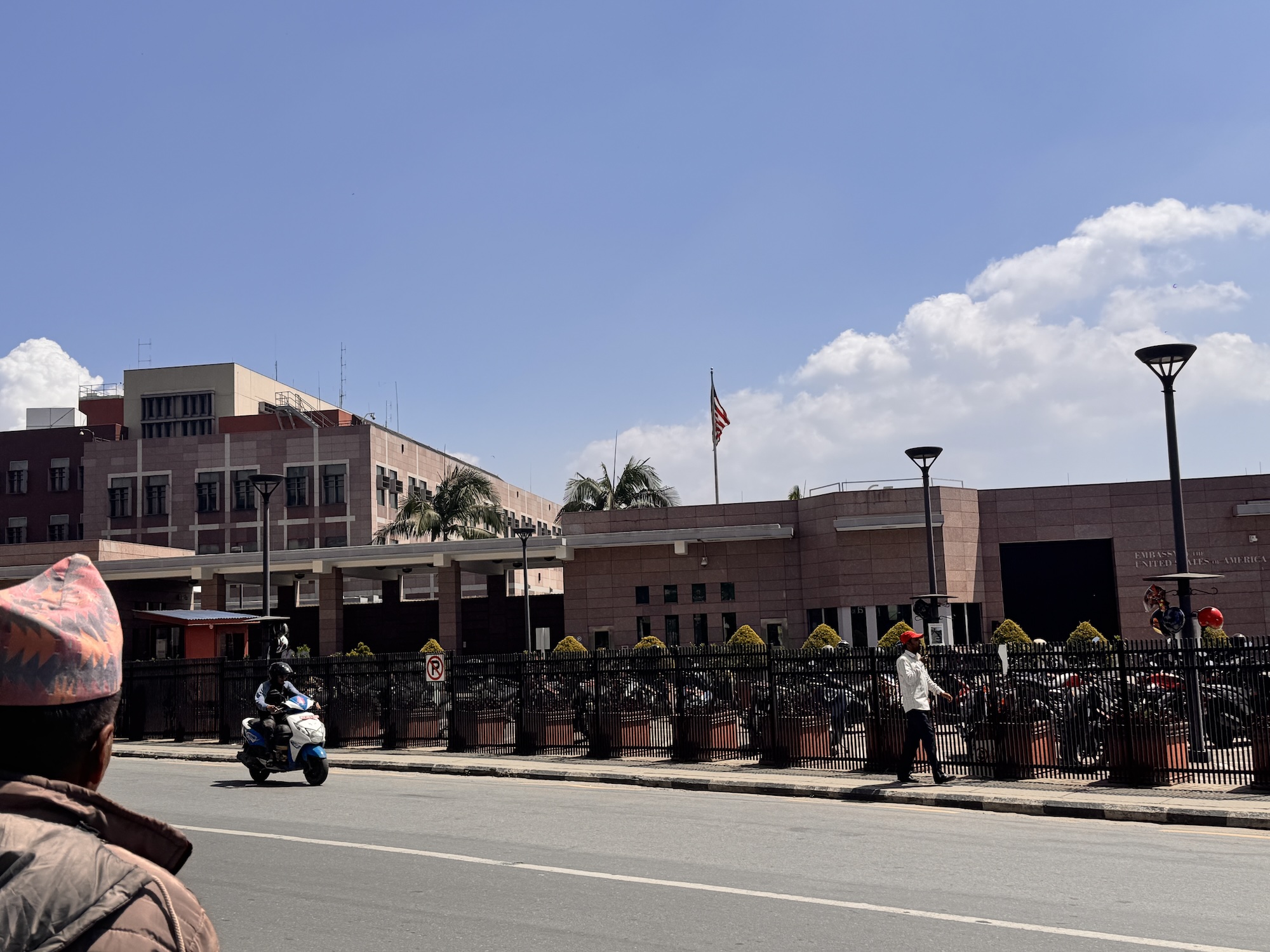
U.S. Embassy Kathmandu building in Nepal. The embassy serves as the official U.S. diplomatic mission in Nepal.
The U.S. Department of State has not resumed scheduling or conducting Diversity Visa interviews, even as a court-ordered 10-day window for processing certain fiscal year 2026 applications moves toward its end, the government said Monday.
The department said it is working to develop a system that would allow officials to adjudicate and issue Diversity Visas after the federal fiscal year ended Sept. 30. It is also preparing guidance for U.S. embassies and consulates, according to a status report filed Oct. 5 in the U.S. District Court for the Northern District of California.
The update came in Medani v. Trump, a lawsuit brought by Diversity Visa applicants, including Roksana Medani.
U.S. District Judge Edward J. Davila ordered the Department of State on Sept. 30, “to the extent practicable and in good faith,” to take all reasonable steps during an additional 10-day period to reconsider fiscal year 2026 applications that were refused solely under the department’s Diversity Visa pause or 75-country pause and to resume ordinary adjudication of pending applications.
The judge found that the department’s delayed compliance with an earlier court order had materially reduced applicants’ chances of receiving visas before the end of the fiscal year.
But as of Monday, the department had not resumed scheduling or conducting interviews.
A Program Running Out of Time
Nearly 52,000 Diversity Visas were available for fiscal year 2026 after statutory reductions to the annual allocation. Based on State Department issuance figures reported before and after the December pause, approximately 11,408 visas had been reported as issued by the time the fiscal year closed.
The department issued 7,319 Diversity Visas during the first three months of fiscal year 2026 — 2,386 in October, 3,000 in November and 1,933 in December — before the issuance pause took effect.
After the court’s Aug. 28 order, the department reported approximately 4,089 additional Diversity Visas approved for issuance, according to a subsequent status report filed with the court.
The figures leave thousands of selected applicants still awaiting adjudication as the court-ordered 10-day period approaches its end.
Unlike many other immigration programs, the Diversity Visa program operates on a strict fiscal-year timetable. Under federal law, fiscal year 2026 ended Sept. 30, creating an unusually narrow window for the government to complete cases covered by the court’s remedial order.
From 55,000 to About 52,000
Congress has authorized up to 55,000 Diversity Visas each fiscal year under Section 203(c) of the Immigration and Nationality Act.
For fiscal year 2026, however, the available number was lower. The State Department said the annual limit was first reduced to approximately 54,850 because of the allocation of up to 5,000 visas under the Nicaraguan Adjustment and Central American Relief Act, or NACARA.
A provision of the National Defense Authorization Act for Fiscal Year 2024 further reduced the number by requiring certain visas made available under the law to be deducted from the annual Diversity Visa allocation. The resulting estimated DV-2026 limit was approximately 52,000 visas.
The visas are divided among six geographic regions, and no country may receive more than 7 percent of the available Diversity Visas in a single fiscal year.
For DV-2026, the State Department selected approximately 129,516 prospective applicants, including principal selectees and their spouses and children, from more than 20.8 million qualified entries.
Nepal was among the countries with a significant number of selectees. The State Department listed 3,933 prospective applicants chargeable to Nepal, including principal selectees and their spouses and children.
Before the pause, 29 Nepali applicants received Diversity Visas in October, 347 in November and 204 in December, for a total of 580 during the first three months of the fiscal year.
The December Pause
The first months of fiscal year 2026 showed a relatively steady pace of issuance. Then, on Dec. 23, the State Department announced a pause in Diversity Visa issuances while it reviewed screening and vetting procedures.
Applicants could continue submitting applications and attending interviews, but the department said no Diversity Visas would be issued during the pause.
For applicants, the pause consumed time that could not simply be recovered later. Diversity Visa eligibility is tied to the fiscal year, and visas generally must be issued by Sept. 30. Unlike some other immigration categories, unused Diversity Visa numbers do not simply carry over into the next fiscal year.
The pause therefore affected not only the pace of processing but also the amount of time remaining for applicants to complete the process.
Aug. 28 Changed the Course
The situation changed on Aug. 28, when Judge Davila issued a preliminary injunction in Medani v. Trump.
The order temporarily vacated two Department of State policies and directed the agency to reconsider applications refused solely under those policies and resume ordinary processing of pending cases. It also addressed a separate U.S. Citizenship and Immigration Services policy affecting adjustment-of-status applicants.
The State Department subsequently acknowledged that, as of Aug. 28, the December 2025 Diversity Visa issuance pause was no longer in effect in accordance with the court’s order.
The court later found that the government’s compliance with the preliminary injunction had been “less than substantial.”
According to the court, the department waited 10 days before instructing diplomatic and consular posts to comply with the injunction. Judge Davila said the delay was particularly significant because “with each day that passes, hundreds of selectees lose their opportunity to receive a Diversity Visa before the end of the fiscal year.”
The department attributed the slower pace in part to a new training initiative concerning the public charge rule. Under the initiative, regional posts that had not completed required training generally were not permitted to resume immigrant visa processing, subject to certain exceptions.
Judge Davila criticized the department for failing to promptly inform the court about the training initiative and its effect on compliance with the injunction.
The court acknowledged the improvement but concluded that the earlier delays had materially reduced the time available to applicants before the end of the fiscal year.
The 10-Day Lifeline
On Sept. 30, the final day of fiscal year 2026, Judge Davila ordered the additional 10-day remedial period.
During that period, the State Department must, “to the extent practicable and in good faith,” take all reasonable steps to reconsider fiscal year 2026 applications refused solely because of the Diversity Visa pause or the separate 75-country immigrant visa pause and resume ordinary adjudication of pending applications.
The order was not a blanket extension of the Diversity Visa program. It was a remedy for the government’s delayed compliance with the court’s earlier injunction.
The plaintiffs had asked the court to preserve all unused fiscal year 2026 Diversity Visa numbers — estimated at roughly 40,000 — so they could be issued after the fiscal year.
Judge Davila rejected that broader request. Instead, he created the limited 10-day remedial window corresponding to the period during which the Department of State failed to instruct all diplomatic and consular posts to comply with the injunction.
The State Department received notice of the Sept. 30 order and filed an administrative motion for a temporary stay on Oct. 1, saying it needed additional time to develop and implement solutions to bypass system safeguards that prevent Diversity Visa adjudication and issuance after the end of the fiscal year.
The department said it was working on those solutions, including system testing, and had transmitted interim guidance to U.S. embassies and consulates on Oct. 1.
No New Interviews
In Monday’s status report, the department said it had not resumed scheduling cases because consular officers currently would be unable to make decisions on applications after conducting interviews.
The department said interviews without immediate adjudication would also require a system for tracking applications for later review.
“No new interviews or reinterviews” had been scheduled or held since the previous status report filed Oct. 2, the government said.
No Diversity Visa applications had been approved for issuance or refused since that report, according to Monday’s filing.
The department said it intended to resume scheduling and interviews once the technical solution and related guidance were completed.
The government also said it had sent interim guidance to U.S. embassies and consulates on Oct. 1 and instructed diplomatic posts not to issue standard end-of-year messages or other communications suggesting that the 2026 Diversity Visa program had ended or that visa numbers were no longer available to selected applicants.
What Happens by Oct. 10?
The court-ordered period is now approaching its end, creating a final and extraordinary window for covered fiscal year 2026 cases affected by the government’s earlier policies and delayed compliance.
The court requires the Department of State to continue filing status reports by noon Pacific time every Monday, Wednesday and Friday during the additional adjudication period.
The government has asked the court to clarify whether its temporary stay of enforcement also pauses that reporting requirement. It also asked the court to order it to file a report on the resumption of Diversity Visa processing by Oct. 12.
If the department’s interpretation of the court’s order is incorrect, the government said, it will continue filing reports on the existing schedule. A status conference is scheduled for Oct. 15.