






Nepal Flood Disaster: Nepali Family in New York Waits for News of Missing Relatives


A community member holds a candle during a vigil in Jackson Heights on August 27, gathering in solidarity with families awaiting news of travelers missing in the Timure disaster along the Nepal-China border. (Photo by Rajan Kafle for NepYork)
In a New York home far from Nepal’s flooded northern borderlands, Laxmi Bhatta is trying to turn scattered clues into hope: an immigration departure record, two cellphone-location pings, reports of people seen in the forest, and helicopter crews unable to land.
The family’s search comes as Nepal responds to devastating flash floods, including in northern Rasuwa district near the Nepal-China border, where difficult terrain and damaged infrastructure have complicated rescue efforts.
According to the latest Nepal Police update released at 4 p.m. Saturday local time, 669 bodies have been recovered and 2,301 people have been injured or rescued. The National Disaster Risk Reduction and Management Authority said 2,426 people remained out of contact in its latest update.
Bhatta’s cousin, Chet Prasad Bhatta, 45, and Chet’s brother-in-law, Madhusudan Pathak, 35, are among those who have lost contact after a tourism group traveling toward Tibet’s Mansarovar area was caught in the disaster zone near Timure, close to the Nepal-China border.
The men were part of a 16-member travel group that, according to an official visa group roster, includes 10 U.S. citizens, five Nepali citizens, and one Canadian citizen. The group passed through Nepal immigration at about 8:35 a.m., Bhatta said, citing a separate departure record provided to the family.

But relatives say they have received no confirmation from Chinese authorities that the group crossed into Tibet.
“That is the biggest unanswered question,” Bhatta said in a phone interview. “If there had been information from Tibet immigration, we would at least know whether they crossed over or not. But we have not received anything from that side.”
The uncertainty has left relatives in Nepal, the United States, and elsewhere trying to coordinate search information while rescue operations face dangerous weather and difficult terrain.
Phone Signals Raise Hope
Family members said the last available cellphone-tracking information placed the missing men near Timure, an area along the route toward the border.
According to Bhatta, the phones belonging to Chet Prasad Bhatta and Madhusudan Pathak were traced to locations near one another, although the signals appeared at different times. One of the devices was reportedly last tracked at around 10 a.m., while another showed a connection at about 2 p.m.
The fact that the phones appear to remain active has given the family reason to hope that the two men may still be near the locations where the signals were detected.
“The phones were showing locations,” Bhatta said. “Our guess is that they may be around the area where the phones were tracked. That is why we have been requesting the Tourism Board and the government to focus the search there.”

The location data alone, however, does not establish that the men are safe or that they are carrying their devices. In disaster situations, phones can remain powered on or be moved by other people. Still, for family members trying to direct rescuers to an inaccessible area, the information has become one of their few concrete leads.
Relatives say people have been seen from above in the forested area near Timure. Some survivors may have moved uphill toward the jungle after floodwaters and landslides made lower areas unsafe, Bhatta said.
Helicopters Cannot Land
The rescue effort has been repeatedly constrained by the terrain around Timure, according to Bhatta’s account.
Helicopters have made multiple flights into the area, but dense forest, unstable ground, and the lack of a safe landing zone have prevented crews from reaching some of the people believed to be stranded.
“There is no place for the helicopter to land,” Bhatta said. “The trees are very close together, and a helicopter needs a clear place to land. That space is not available.”
She said muddy, marsh-like terrain has further complicated the operation. Even if a potential landing area is identified, the ground may not be stable enough for a helicopter or for people to move through safely.
The situation is especially grave because survivors may be exhausted, injured, or unconscious. Relatives fear that people who have been stranded for days without food and water may not be physically able to walk long distances through the forest.
“Even if someone is alive, if they are unconscious or badly weakened, they cannot just walk up through the jungle,” Bhatta said.
Family members have traveled to the region to help identify survivors and press authorities for more targeted flights. Bhatta said relatives made two helicopter trips and helped rescue teams identify people who could be reached.
Madhusudan Pathak’s brother Ram Pathak, who lives in Columbus, Ohio, has also traveled to Nepal to support the family and assist with efforts to locate and rescue his missing brother.

“He Will Come Back. He Knows the Risks. He Cannot Be Gone Like This.”
Chet Prasad Bhatta’s brother, Nanda Prasad Bhatta, lives in Austin, Texas. Laxmi Bhatta said Nanda Prasad Bhatta has been devastated by his younger brother’s disappearance.
Laxmi described Chet as a central figure in the family—responsible, hardworking, and someone who looked after relatives across generations.
“He is the pillar of the house,” Laxmi said, describing what Chet’s older brother has told the family. “His brother cannot accept that this could happen. He keeps saying, ‘He will come back. He knows the risks. He cannot be gone like this.’”
The emotional strain is particularly intense for their parents, who had been living with Chet after their sons settled in the United States. Laxmi said family members are trying to protect the elderly parents from the full weight of the uncertainty while maintaining hope that their son will be found.
Chet had experience in a field related to travel and high-altitude conditions, Laxmi said. He is the managing director of Classic Vacations Nepal Pvt. Ltd. and has worked for many years in the travel industry, where he has been familiar with the risks associated with difficult terrain, high altitudes, lack of oxygen and emergency situations. That experience has reinforced the family’s belief that he may have found a way to survive or reach a safer location.
“He was very conscious about risk,” Laxmi said. “He understood these things. His family believes he may have gone somewhere safe and is waiting to be found.”

The 16-Member Travel Group
An official visa document identifies the 16 individuals traveling together toward the Tibet border. The manifest lists 10 U.S. citizens: Anil Goel, Kesava Rao Tadipatri, Venkatakrishna Bangalore Raghunath Rao, Vivek Shankar Srivastav, Sudhindra Yapalparvi, Venkataraman Balasubramanyam, Kirti Kumar Acharya, Laxminath Gopisetty, Pranesh Vadhirajan, and Srinivas Sudhir Rangu.
Joining them were five Nepali citizens—Chet Prasad Bhatta, Madhusudan Pathak, Sange Sherpa, Tenjing Sherpa, and Sonam Tesi Sherpa—along with Canadian citizen Mahendra Gupta.
Laxmi said relatives were also in contact with the family of Venkataraman Balasubramanyam, whose wife, Usha, has been communicating with other affected families. The visa roster confirms that Venkataraman was part of the same group.
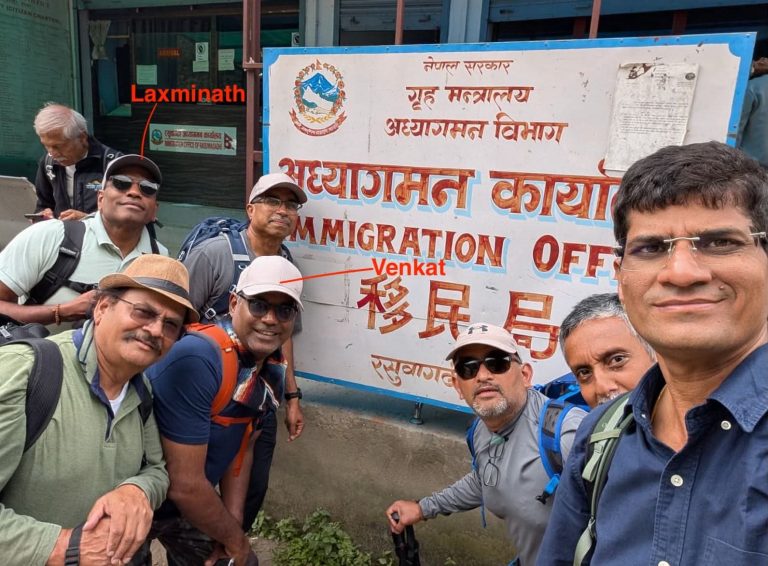
The family has shared photographs believed to show members of the group near immigration before they became unreachable. One traveler reportedly called his wife while the group was taking photographs and said he would call back after they finished. That call, relatives said, was among the last communications received before contact was lost.
“We Need Them Reached”
For Laxmi and her relatives, the crisis has become a painful cycle of waiting for calls, checking phone-location data, and trying to learn whether helicopters can make another flight.
They say the rescue operation cannot end with the people who are easiest to reach.
“There are people visible from above in the jungle,” Laxmi said. “They need food, water, and rescue. We need the authorities to find a way to reach them.”
Editor’s Note: This story is based on conversations with family members of missing persons and reflects information relayed by relatives during an evolving disaster response. The identities, number of missing people, cellphone-location data, rescue figures, and official cross-border status have not been independently verified with Nepal’s tourism authorities, immigration officials, rescue agencies, or relevant diplomatic authorities.