


Judge Extends DV-2026 Visa Processing for 10 Days After Fiscal Year Ends

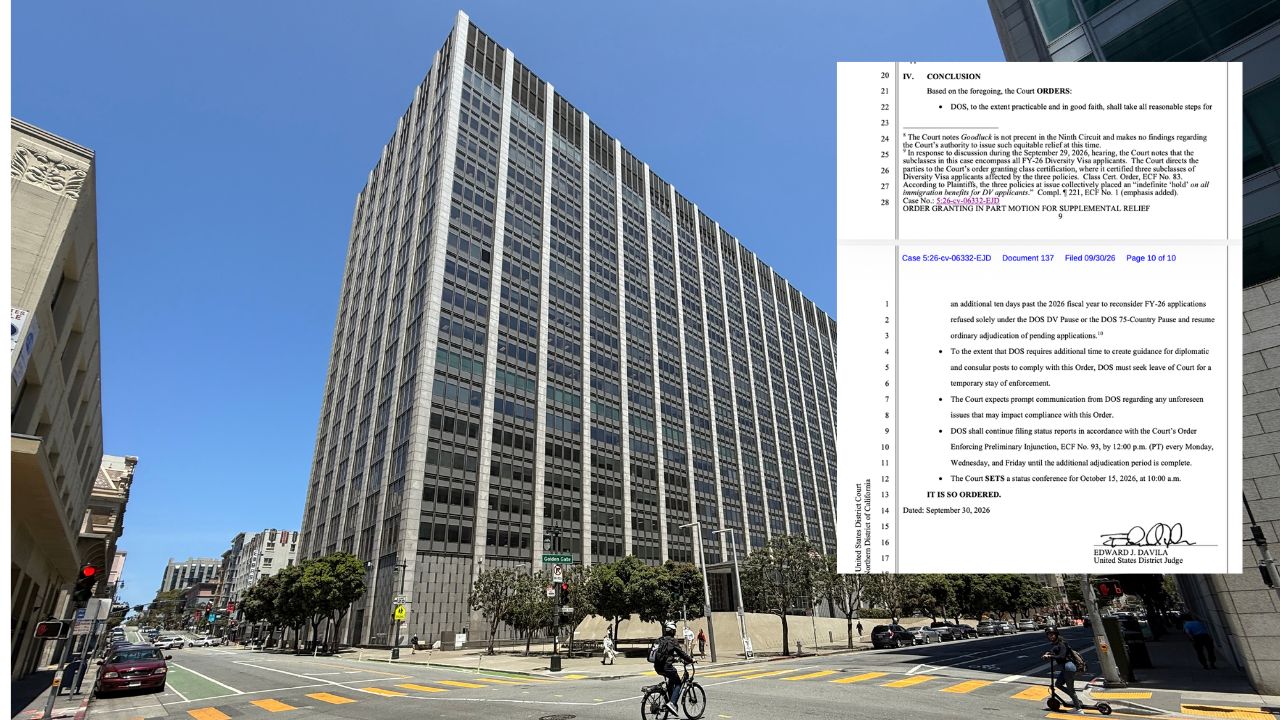
Phillip Burton Federal Building & United States Courthouse, home to the U.S. District Court for the Northern District of California, in San Francisco. Photo by Marincyclist/Wikimedia Commons, CC BY-SA 4.0.
U.S. District Judge Edward J. Davila has ordered the Department of State to continue processing certain fiscal year 2026 Diversity Visa applications for an additional 10 days after the close of the fiscal year, finding that the agency’s delayed compliance with an earlier court order materially reduced applicants’ chances of receiving visas.
In an order filed Wednesday in Medani v. Trump, Judge Davila directed the Department of State, “to the extent practicable and in good faith,” to take all reasonable steps during the additional 10-day period to reconsider fiscal year 2026 applications refused solely under the department’s Diversity Visa pause or 75-country pause and to resume ordinary adjudication of pending applications.
The Diversity Visa fiscal year ends Sept. 30. The order therefore permits the department to continue adjudicating covered cases beyond the statutory fiscal-year deadline as a remedy for what the court determined was delayed and inadequate compliance with its Aug. 28 preliminary injunction.
Court Finds Delayed Compliance
Judge Davila’s Aug. 28 preliminary injunction temporarily vacated two Department of State policies and directed the agency to reconsider applications refused solely under those policies and resume ordinary processing of pending cases. The order also covered a separate USCIS policy affecting adjustment-of-status applicants.
According to Wednesday’s order, the department did not immediately implement the injunction. The plaintiffs alleged that the agency had not scheduled a single consular interview for any plaintiff after the injunction and had canceled interviews that had already been scheduled.
The court said the Department of State did not dispute that it had failed to schedule or conduct an interview or issue a Diversity Visa during the initial period following the injunction. Instead, the department said it was developing guidance for diplomatic and consular posts.
Judge Davila described the delay as significant, noting that the department waited 10 days before instructing its posts to comply with the court’s order. He said the agency could have sought a temporary stay, requested clarification or filed a status report explaining the delay.
“The Court finds DOS’s compliance with the PI has been less than substantial,” Davila wrote, referring to the preliminary injunction. He said the agency’s lack of diligence was particularly important because “with each day that passes, hundreds of selectees lose their opportunity to receive a Diversity Visa before the end of the fiscal year.”
Processing Initially Moved Slowly
The court’s order detailed Diversity Visa processing figures submitted by the Department of State in status reports.
By Sept. 21, the agency had processed 836 visas worldwide, an average of about 83 visas per day. The court compared that pace with approximately 230 Diversity Visas processed per day in September 2025.
The department attributed the slower pace to a new training initiative concerning the public charge rule. Under the initiative, regional posts that had not completed required training generally were not permitted to resume immigrant visa processing, subject to certain exceptions.
Judge Davila criticized the department for failing to inform the court promptly about the training initiative and its effect on compliance with the injunction.
After a Sept. 21 hearing, processing increased. According to the court, the department issued 422 visas and refused 309 applications from Sept. 21 to 23. From Sept. 23 to 25, it issued 910 visas and refused 452 applications. From Sept. 25 to 28, it issued 610 visas and refused 275 applications.
As of Sept. 28, the department had processed 3,814 visas, an average of approximately 272 visas per day worldwide, according to the order.
The court acknowledged the improvement but concluded that the earlier delays had materially reduced the time available to applicants before the end of the fiscal year.
All FY-2026 DV Applicants Included in Subclasses
In a footnote responding to discussion during the Sept. 29 hearing, Judge Davila stated that the subclasses certified in the case encompass all fiscal year 2026 Diversity Visa applicants affected by the policies at issue.
“The Court notes that the subclasses in this case encompass all FY-26 Diversity Visa applicants,” the order says. It refers the parties to the court’s earlier class-certification order, which established three subclasses of Diversity Visa applicants affected by the policies challenged in the case.
The Aug. 28 order certified subclasses covering fiscal year 2026 selectees and derivative beneficiaries subject to the USCIS Diversity Visa hold, the Department of State’s Diversity Visa pause and the department’s 75-country pause.
The language appears to support the view that applicants covered by related litigation may fall within the Medani class if they are among the fiscal year 2026 Diversity Visa applicants affected by the policies at issue. However, the order does not specifically name the plaintiffs in Ivanov v. Trump or expressly state that every Ivanov plaintiff is automatically included.
The precise application of the class definition may depend on the definitions and eligibility requirements set out in the preliminary injunction and class-certification orders.
Remedy Differs From Broad Visa Reservation
The plaintiffs had asked the court to reserve all unused fiscal year 2026 Diversity Visas, estimated at approximately 40,000, for issuance after the fiscal year.
Judge Davila rejected that broader request, calling it untethered to the specific noncompliance at issue and overly broad. Instead, he ordered a 10-day extension corresponding to the period during which the Department of State failed to instruct all diplomatic and consular posts to comply with the injunction.
The court distinguished the case from Goodluck v. Biden, a D.C. Circuit decision involving a request to reserve unused Diversity Visas beyond the end of a fiscal year. Judge Davila said the remedy in Medani was based on the court’s inherent authority to enforce its own orders rather than on a general equitable power to extend the Diversity Visa program.
The court also cited earlier cases in which courts provided post-fiscal-year relief after finding that government delay or administrative failures had prevented compliance with court orders.
What the Order Requires
The order requires the Department of State to continue, for an additional 10 days, taking reasonable steps to reconsider fiscal year 2026 applications refused solely under the Diversity Visa pause or 75-country pause and to resume ordinary adjudication of pending applications.
The department must seek permission from the court for a temporary stay if it needs additional time to prepare guidance for diplomatic and consular posts. It must also promptly notify the court of unforeseen issues that could affect compliance.
In addition, the department must continue filing status reports by noon Pacific time every Monday, Wednesday and Friday until the additional adjudication period ends.
Judge Davila scheduled a status conference for Oct. 15 at 10 a.m.
Scope and Adjustment-of-Status Cases
The order is directed to the Department of State and specifically refers to reconsideration of applications refused under Department of State policies and the resumption of ordinary adjudication of pending applications.
The Aug. 28 preliminary injunction separately ordered U.S. Citizenship and Immigration Services to resume ordinary adjudication of covered pending adjustment-of-status applications without applying the USCIS Diversity Visa hold.
The 10-day extension described in the new order, however, is directed at the Department of State’s processing of cases affected by the two State Department policies. Based on the language of the order, the extension therefore appears primarily directed at applicants undergoing consular processing through U.S. embassies and consulates.
The order does not expressly discuss applicants pursuing adjustment of status through USCIS.
Applicants and attorneys should review the preliminary injunction, class-certification order and any subsequent guidance from the court or the Department of State to determine how the order applies to individual cases, including adjustment-of-status cases.
The order does not guarantee that every applicant will receive a visa. It requires the department to reconsider covered refusals and resume adjudication, but applicants must still satisfy all statutory and regulatory eligibility requirements.