






State Department Says Nepal’s Visitor Visa-Bond Status Remains Under Review After Request for Removal

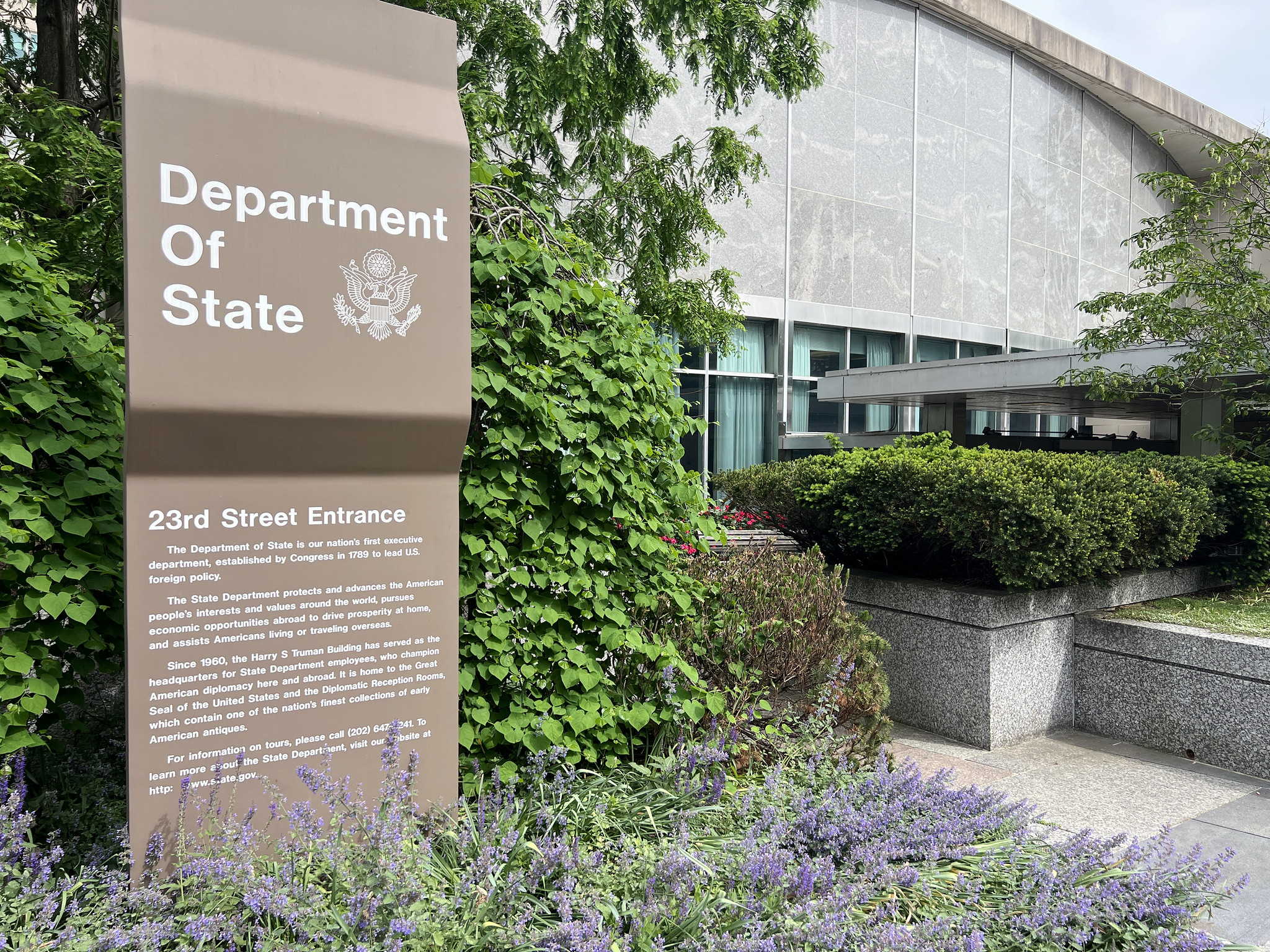
Exterior of the U.S. Department of State Harry S. Truman Building, Washington, D.C. (Official State Department photo by Linda D. Epstein)
NEW YORK — The State Department is continuing to review Nepal’s participation in the U.S. visitor visa bond program after Nepal requested to be removed from the policy, but the department has not provided a timeline for a decision.
A senior State Department official, speaking on the condition of anonymity to NepYork during a briefing, said the department A senior State Department official, speaking on the condition of anonymity to NepYork during a briefing, said the department continues to assess the visa bond program and other immigration-related measures on a country-by-country basis.
“So we are always assessing these — the visa bond program and our other immigration-related — these that were really in place to crack down on a problem that has gotten completely out of hand,” the official said. “When this administration came in, this was a serious issue that had to be addressed, and so measures had to be taken, including things like the visa bond.
“These continue to be reviewed, and we look on a country-by-country basis. We understand that Nepal has requested to be removed. We certainly do not want to hamper business-to-business ties, and so we’re constantly assessing that, so be sure to stay tuned for any changes on that,” the official said.
The official did not specify what benchmarks Nepal would need to meet to be removed from the program or whether the department had reached a preliminary decision.
Nepal has been subject to the visa bond requirement since Jan. 21, 2026. The State Department lists Nepal among 50 countries whose nationals applying for B-1 business or B-2 tourist visas may be required to post a bond.
Visitor Visa Issuances Plunge
Only 27 Nepali nationals received B-category visitor visas in February 2026, the first full month after the visa bond requirement took effect in Nepal, according to State Department visa-issuance data.
The total included one B-1 visa for business travel and 26 combined B-1/B-2 visas for business and tourism. The U.S. Embassy in Kathmandu issued 17 of the 26 B-1/B-2 visas. U.S. diplomatic posts in other countries issued the remaining nine to Nepali nationals.
The February total was substantially lower than the number of B-category visas issued in the months immediately preceding the bond policy. The State Department issued 809 B-category visas to Nepali nationals in January 2026, 765 in December 2025, 774 in November 2025 and 1,006 in October 2025.
Those four months produced an average of about 839 B-category visas per month. February’s total was therefore about 96.8 percent lower than the average for the four months preceding implementation.
The February 2026 figure was also down from 1,840 B-category visas issued to Nepali nationals in February 2025 and 2,991 in February 2024. The 27 visas issued in February represented a decline of about 98.5 percent from February 2025 and about 99.1 percent from February 2024.
Program Made Permanent
The State Department permanently established and expanded the B-1/B-2 visa bond program on Aug. 3, 2026, after operating it as a one-year pilot program beginning in August 2025.
Under the final rule, otherwise eligible B-1/B-2 applicants from designated countries must post a bond of $10,000, $15,000 or $20,000 before a visa may be issued. The new amounts are higher than the pilot program’s bond levels of $5,000, $10,000 and $15,000.
Consular officers generally are expected to set the bond at $15,000. They may require a $10,000 or $20,000 bond after considering an applicant’s purpose of travel, employment, income and other circumstances.
Applicants first schedule a consular interview and pay the standard visa application fee. If a consular officer determines that an applicant is otherwise eligible for a B-1/B-2 visa but is subject to the bond program, the officer temporarily refuses the application under Section 221(g) of the Immigration and Nationality Act.
The applicant then receives instructions to submit DHS Form I-352 and pay the bond electronically through the Treasury Department’s Pay.gov platform. The applicant or another person may make the payment.
Payment does not guarantee that a visa will be issued. The consular officer must conduct a final review of the applicant’s eligibility after the payment is processed.
A visa issued after a bond is posted may be valid for one or multiple entries and for three to 12 months, depending on visa reciprocity. Applicants generally cannot request an individual waiver. The assistant secretary of state for consular affairs may, however, grant a waiver on humanitarian or national-interest grounds.
Bond Refunds and Forfeitures
Travelers issued visas under the bond program must enter and depart the United States through a commercial airport or a Customs and Border Protection preclearance location to fulfill the bond conditions.
They must comply with all terms of their immigration status, including the prohibition on unauthorized employment. To obtain a refund, they must leave the United States before their authorized stay expires or timely submit an application for an extension of stay or a change of immigration status.
The bond generally is canceled automatically and refunded without interest if Department of Homeland Security records confirm that the visa holder did not travel, was denied admission to the United States or departed on time through a permitted airport. Travelers who timely seek an extension or change of status may remain eligible for repayment if they comply with the conditions of their new status and depart before it expires.
A bond may be forfeited if a traveler substantially violates the bond conditions. Violations include overstaying, filing an untimely extension or change-of-status request, failing to depart within 10 days after a timely request is denied, or applying for asylum or other humanitarian protection through Form I-589.
The State Department may make a preliminary finding that a traveler failed to comply with the program. The Department of Homeland Security makes the final determination on whether a bond was breached and provides notice of any forfeiture and appeal rights.
The final rule also states that U.S. Citizenship and Immigration Services may consider the existence of a visa bond as a negative discretionary factor when adjudicating applications for an extension of stay or a change of status.
Many Approved Applicants Do Not Pay
The State Department said the pilot program resulted in a substantial decline in B-visa issuance among covered countries because many applicants who were otherwise eligible chose not to post the required bond.
The department said about 20,000 visa applicants were found to require a bond during the pilot period, even though it had initially projected about 2,000 applicants. Nearly half of those required to post a bond ultimately paid it.
The State Department said B-visa issuance in pilot-program countries fell by 83 percent during the first 10 months of the program compared with the previous year. The department has described the decline as evidence that the policy deters travel by people who may not comply with visa requirements.
The final rule states that fewer than 50 bonded visa holders from more than 50 covered countries, including Nepal, overstayed during the first 10 months of the pilot program, according to federal records. The department cited the lower number of overstays as a central reason for making the program permanent and increasing the required bond amounts.
Some Nepali applicants who were approved subject to a bond have declined to pay it and therefore have not received visas. Some applicants have told consular officers during interviews that they would not proceed because of the requirement. Only a limited number of applicants have paid the required amount and received visitor visas.
Nepal Says It Has Raised the Issue
Nepali officials have said they have repeatedly urged U.S. counterparts to remove Nepal from the visa bond list.
Foreign Minister Shishir Khanal said he had raised the issue during high-level visits, in conversations with embassy representatives and in telephone discussions with U.S. officials.
“We have raised this matter clearly during every high-level visit, including in conversations with embassy representatives and in telephone discussions,” Khanal said.

Khanal said U.S. officials had explained that Nepal’s designation was connected to criteria including document fraud and visa overstays.
“They say it is based on scientific grounds,” Khanal said. “It is related to documentation fraud and overstays.”
Khanal said U.S. officials had recently praised Nepal’s efforts to discourage the use of fraudulent documents. He said Nepal hoped it would be removed from the list soon.
The State Department says visa-bond designations may take into account a country’s visitor-visa overstay rate, cooperation in accepting nationals ordered removed from the United States, information-sharing practices, identity-verification and criminal-record data, screening standards and document-security practices.
The senior State Department official did not say whether Nepal’s efforts to reduce document fraud or other immigration-related improvements would be sufficient to remove the country from the program.