





In Queens, Nepal’s Flood Disaster Becomes a Call for Climate Justice Through Mithila Art

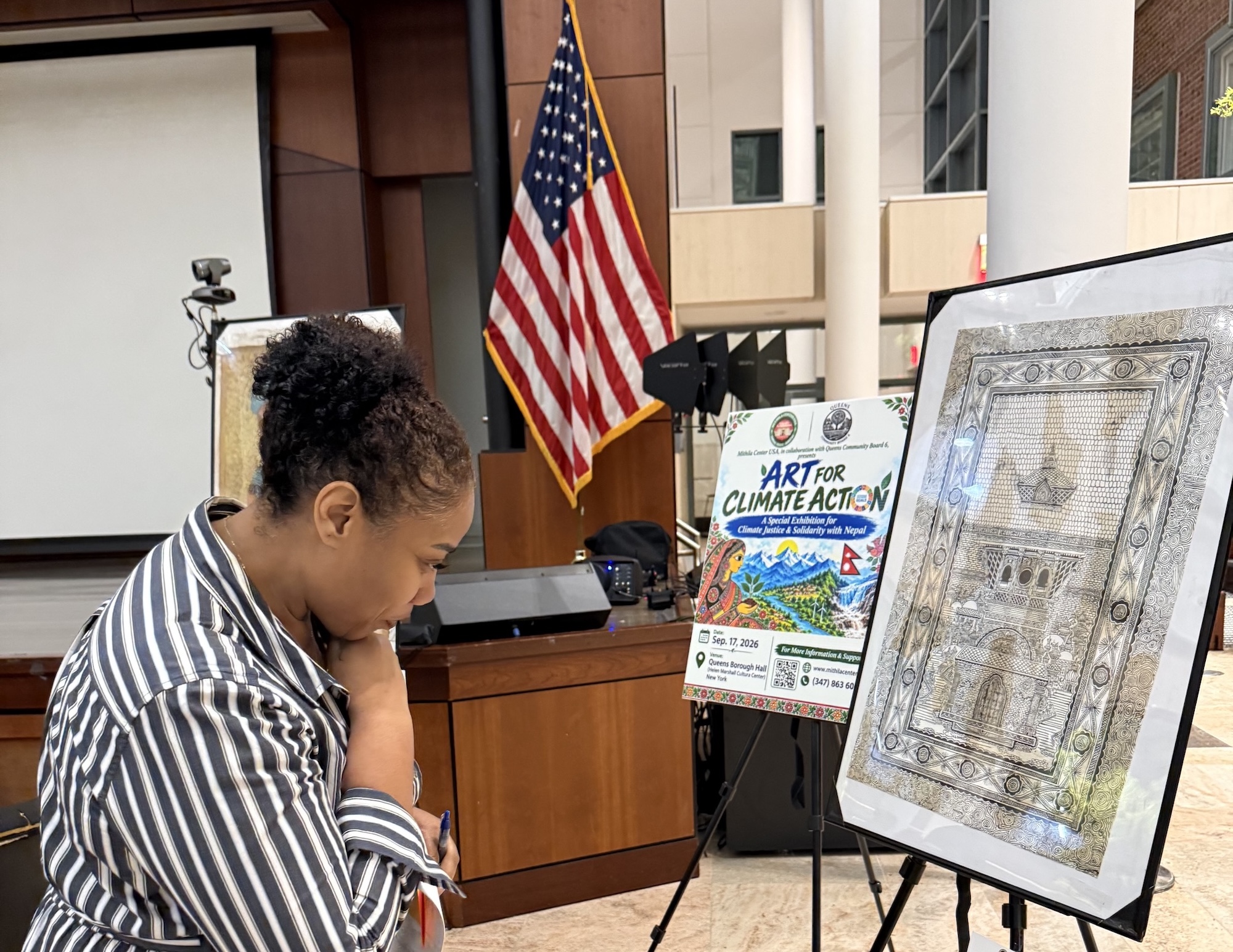
A Mithila artwork is displayed at the “Art for Climate Action” exhibition at Queens Borough Hall in New York on Sept. 17, 2026.
QUEENS, New York — As New York prepared to host Climate Week NYC and welcome global leaders for climate discussions surrounding the United Nations General Assembly, artists, community leaders and advocates gathered in Queens on Thursday to spotlight the human cost of climate change and express solidarity with communities affected by disasters in Nepal.
Mithila Center USA, in collaboration with Queens Community Board 6, presented “Art for Climate Action: A Special Exhibition for Climate Justice & Solidarity with Nepal” on Sept. 17 at the Helen Marshall Cultural Center at Queens Borough Hall.
The exhibition brought together art, cultural advocacy and community organizing around the Aug. 26 disaster in northern Nepal, which has left more than 1,400 bodies recovered and more than 6,000 people still unaccounted for, according to the latest Nepal government figures.
The scale of the disaster gave the exhibition a sharper climate justice focus. Homes, roads, bridges, schools, power systems, water infrastructure and livelihoods have been severely damaged, while search and recovery efforts continue in areas hit by the flash floods and associated landslides.
It was within this context that “Art for Climate Action” brought the Nepal disaster into a Queens community forum, using cultural expression to connect a local audience with a global climate conversation.
The evening began with a moment of silence honoring victims, first responders and families affected by the Sept. 11 attacks, as the United States marks the 25th anniversary of the attacks. Participants also remembered those affected by the disaster in Nepal, bringing the two moments of collective grief into the same community gathering.
“Art for Climate Action” builds on Mithila Center USA’s cultural advocacy work, which began with its “Art for SDGs: The Mithila Heritage” exhibition at United Nations headquarters in 2019.
The New York-based nonprofit uses art, education, cultural exchange and community engagement to promote Mithila heritage and connect cultural preservation with sustainability issues.
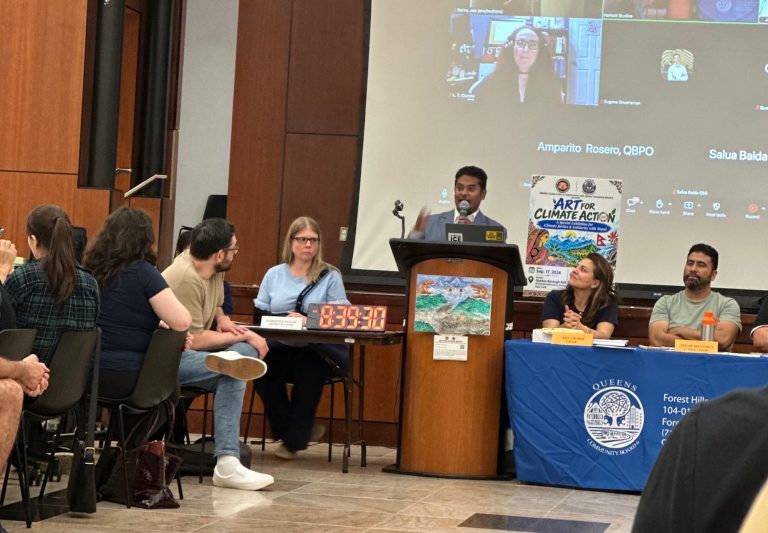
“Our work has always been about more than preserving art,” Amit P. Shah, founder and president of Mithila Center USA, said. “It is about preserving cultural memory, strengthening community connections, and recognizing the relationship between people, culture, and the natural environment.”
“With this exhibition, we are bringing that heritage into one of the most urgent conversations of our time — climate action and climate justice,” Shah said.
Shah said the timing of the exhibition was intended to give artists and community members a place in the broader climate discussions taking place in New York.
“We wanted artists and communities to have a place in the global conversation about our planet’s future,” he said. “The devastating situation in Nepal makes that conversation even more urgent.”
Queens Community Board 6 Chair Salua Baida said the exhibition reflected the borough’s diversity and its role in connecting local communities with global issues.
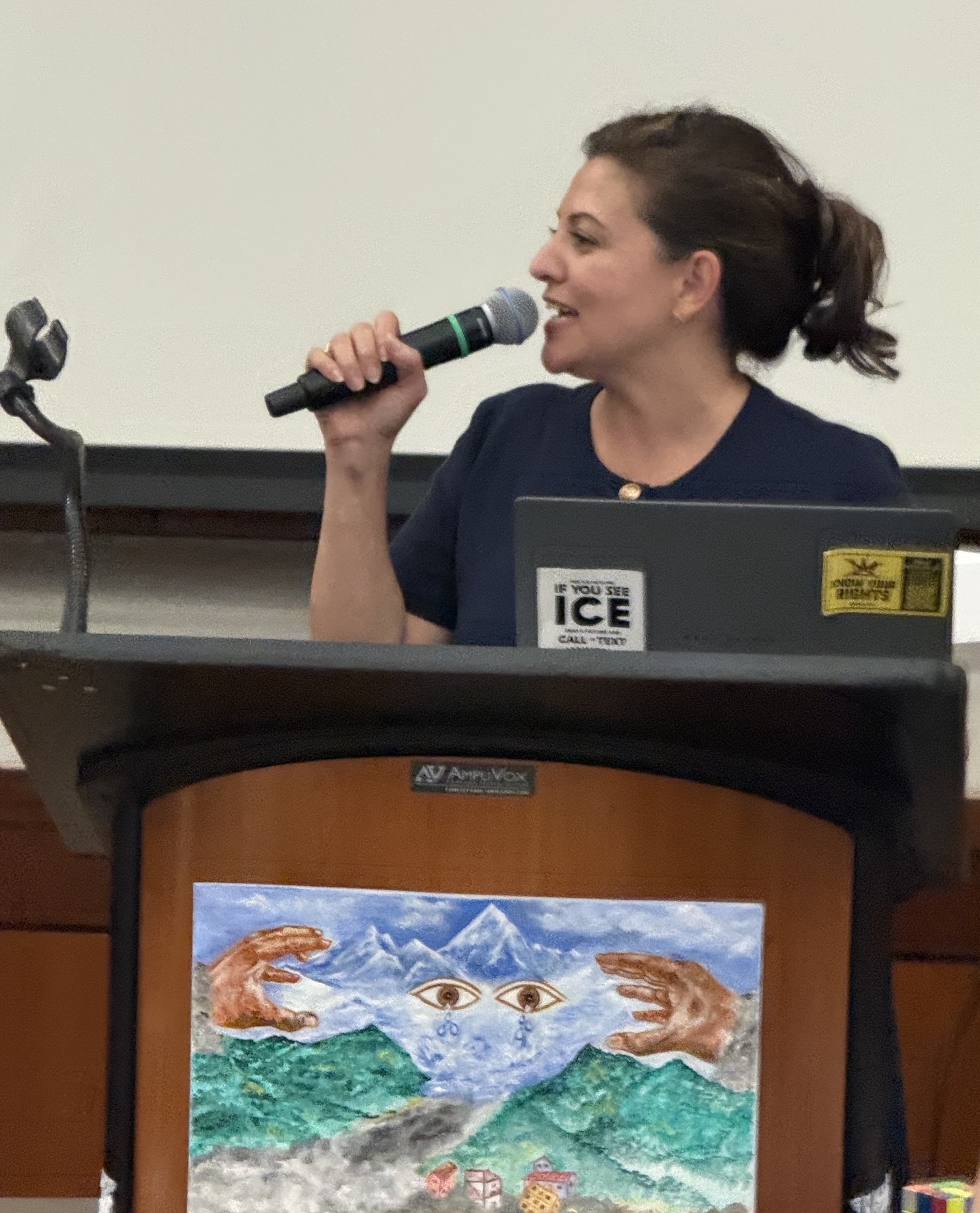
“Queens is a place where cultures, communities, and experiences come together,” Baida said. “This exhibition creates an opportunity to build understanding, strengthen community connections, and engage with an issue that affects communities both locally and globally.”
“Climate change does not stop at borders, and neither should our sense of responsibility to one another,” she said. “When artists, community organizations, civic leaders, and residents come together, we create opportunities not only to raise awareness but also to build stronger and more resilient communities.”
The exhibition featured works by S.C. Suman, Gobinda Sah “Azad,” Rajesh Sah, Pratik Rayamajhi, Namrata Singh, Komal Purbe and Manisha Shah.
The artists explored nature, cultural identity, environmental change, resilience and solidarity, organizers said. Their work was presented as a way to make the human dimensions of climate change more accessible beyond scientific data and policy discussions.
The event also emphasized the connection between cultural and natural heritage. Mithila Center USA said cultural traditions carry knowledge, identity and collective memory, as well as relationships with the natural environment, and that preserving those traditions can contribute to resilient communities.
The organization said it is working with New York City and New York state officials toward establishing a Mithila Heritage Museum in New York City. Mithila Center USA is also a recipient of support through the New York State Council on the Arts Community Grant program, according to the organization.
The event was attended by representatives from federal, state and Queens government offices, including New York State Assemblymember Sam Berger, the office of U.S. Rep. Grace Meng, the office of Queens District Attorney Melinda Katz, the office of state Sen. Joseph P. Addabbo Jr. and the office of Queens Borough President Donovan Richards, organizers said.
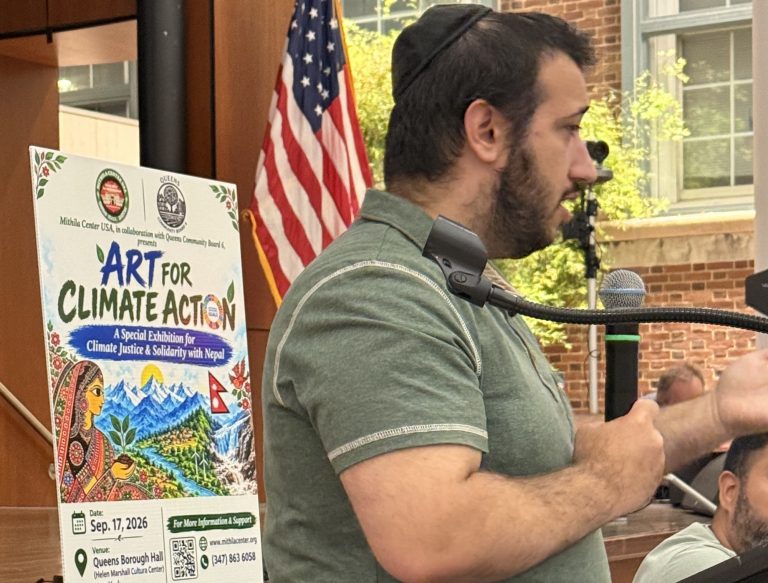
For Mithila Center USA, the event was intended to connect the experience of a disaster in the Himalaya with the wider climate conversation unfolding in New York.
The World Weather Attribution assessment said the disaster demonstrated the limits of existing adaptation measures. Researchers noted that Nepal has early-warning systems that have helped reduce deaths from more conventional and forecastable river floods, but said the speed and complexity of the 2026 event exceeded the design and predictive limits of existing risk-reduction systems.
The assessment called for stronger adaptation, hazard monitoring, early-warning systems, transboundary data sharing, recovery support and greater climate finance for vulnerable communities.
The exhibition framed the Nepal disaster not only as a humanitarian emergency but also as a reminder of the growing need for climate adaptation, resilience, loss-and-damage support and international cooperation as communities confront increasingly complex environmental risks.
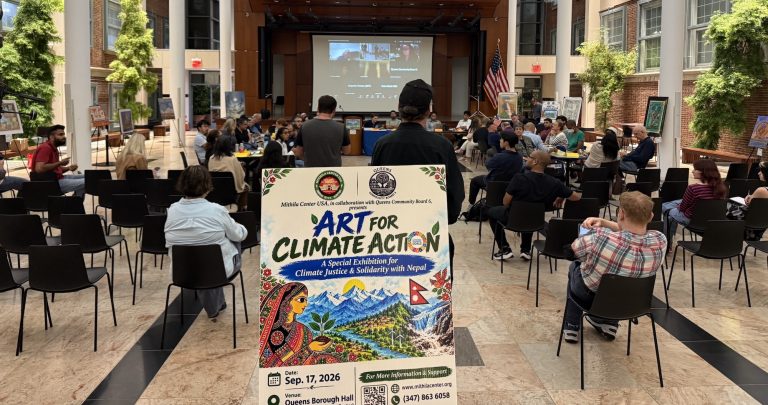
“We want our cultural heritage to be part of the solution and part of the conversation about the future,” Shah said. “Our goal is to continue building bridges between culture and climate action from Queens to Nepal and from local communities to the global stage.”
The exhibition represents another step in Mithila Center USA’s continuing work on cultural preservation, climate advocacy, climate justice, global solidarity and sustainability.